This was a week of dramatic Middle East headlines.
First, the UN Security Council approved on Monday what was billed as a transformative Gaza resolution – UNSC 2803 – laying out a new international architecture for Gaza’s future.
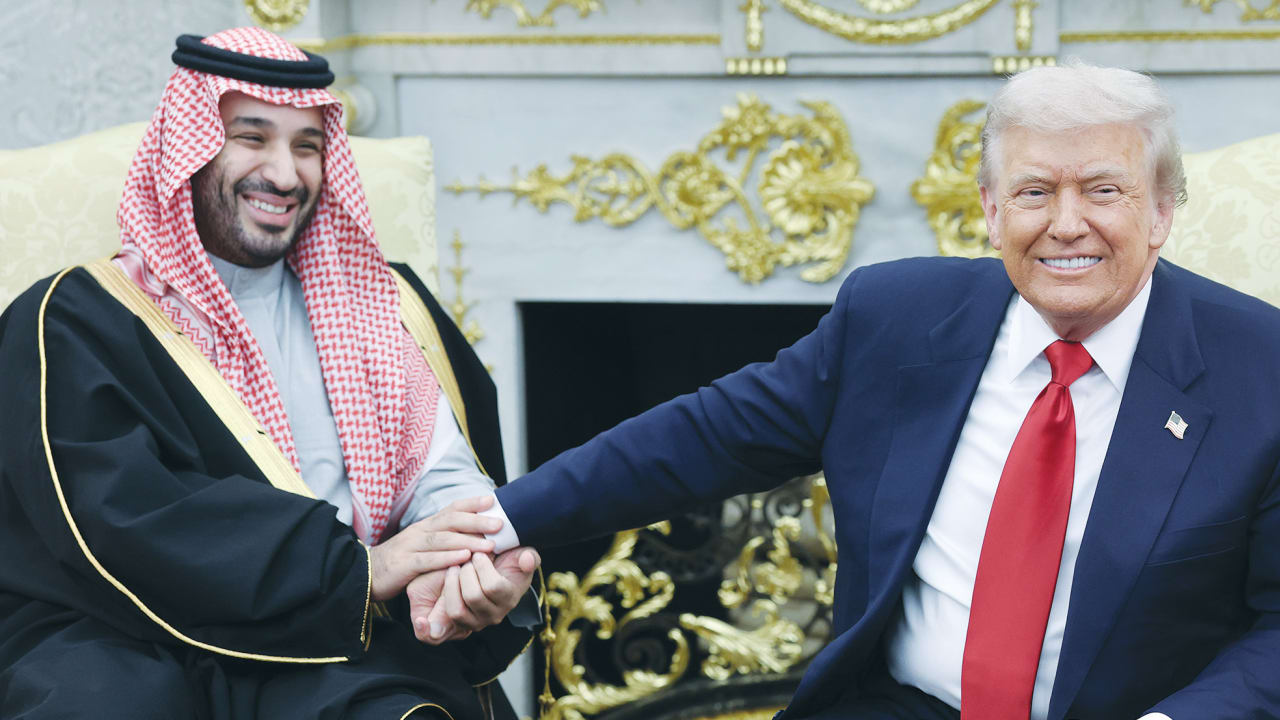
Then, on Tuesday, US President Donald Trump rolled out a royal-red-carpet reception in Washington for Saudi Crown Prince Mohammed bin Salman, complete with promises of F-35s, nuclear cooperation, and an unmistakable message that Riyadh is once again central to Washington’s regional strategy.
MBS, for his part, expressed interest in joining the Abraham Accords if – and this is a humongous if – Israel shows a clear path to a Palestinian state.
All of these were significant announcements, but in this part of the world, big announcements are the easy part. Implementation is where grand visions usually go to die. The headlines shouted a Middle East being remade; the fine print whispered something far more familiar: proceed with caution.

Gaza's International Stabilization Force: Rich in aspiration, thin on detail
Which brings us first to New York, where the Security Council voted overwhelmingly to authorize an International Stabilization Force for Gaza and endorse Trump’s 20-point Gaza ceasefire plan. For the first time since October 7, the major powers agreed not just on a Gaza ceasefire but on a framework for what comes next.
On paper, the plan promises border security, civilian protection, organized humanitarian aid delivery, training of Palestinian police, and – essential for Israel – the dismantling of Hamas’s military capabilities under international oversight.
Prime Minister Benjamin Netanyahu welcomed the resolution, though notably only in English, a choice that speaks to the fault lines inside his coalition. Netanyahu’s emphasis remained conveniently on “demilitarization, disarmament, and the de-radicalization of Gaza,” and on the close partnership with Washington.
A statement in Hebrew would have ignited fierce internal pushback, particularly over this line in the resolution: “After the PA [Palestinian Authority] reform program is faithfully carried out and Gaza redevelopment has advanced, the conditions may finally be in place for a credible pathway to Palestinian self-determination and statehood.”
Like so many ambitious UN documents before it, this one is rich in aspiration but thin on detail. Its transitional authorities run for years, but the sequencing is vague. It imagines a Palestinian Authority suddenly transparent, efficient, and capable of governing – a scenario that today exists only in the realm of fantasy. And crucially, it offers no clear mechanism to compel Hamas’s disarmament, even as Hamas loudly rejects the entire framework.
This vagueness is not new. Resolution 2803 belongs to a long line of Middle East resolutions constructed around ambiguity – deliberately so, in many cases – to win broad assent from parties who fundamentally disagree.
That was the case with Resolution 242, whose famously ambiguous phrasing on “territories” versus “the territories” enabled everyone to sign on to it in 1967 while meaning very different things.
It was true of 1973’s Resolution 338, which called for a ceasefire and for implementing 242 “in all its parts,” while never clarifying what that actually required. The ambiguity was a feature, not a bug – enough precision to pass, enough vagueness to avoid confrontation.
Resolution 2803 follows that tradition faithfully. It leaves critical terms undefined: what “demilitarization” means, who certifies it, how the PA meets its reform conditions, and when Israel’s “security perimeter” will no longer be necessary. Because of the ambiguity, everyone can see in it what they want. But it is exactly that type of ambiguity that has doomed earlier resolutions to decades of dispute, reinterpretation, and eventual irrelevance.
Trump reorders Middle East's strategic balance with MBS
Even as there were attempts at the UN in New York to sketch Gaza’s future, in Washington, Trump was busy reordering the region’s strategic balance.
MBS’s reception at the White House – fighter-jet flyovers, bands, horses, a ceremonial welcome fit for a king – signaled that his long diplomatic quarantine after the 2018 murder of Washington Post journalist Jamal Khashoggi murder is over.
It also signaled something deeper: the White House now sees Saudi Arabia as an indispensable partner for reshaping the Middle East. These optics matter. For years, the crown prince’s presence in Washington was viewed as politically toxic. This week, his arrival was not merely tolerated; it was celebrated.
The substantive announcements during his visit were equally striking. Riyadh appeared to secure movement toward a formal US security guarantee, major civil-nuclear cooperation, and, most consequentially, the chance to acquire fifth-generation American stealth fighters, the same F-35s that today only Israel operates in the region – all without agreeing to normalize ties with Israel.
“We want to be part of the Abraham Accords, but we want also to be sure that we secure a clear path to a two-state solution,” MBS said in the Oval Office.
“We want to be part of the Abraham Accords” is a far cry from “we are joining the Abraham Accords.” Before the meeting, some thought Israel would be placed on the horns of a huge dilemma: agree to the sale of the planes to the Saudis in return for normalization – peace for planes – or oppose the planes and lose the normalization. But that dilemma did not materialize. Why not? Because the Saudis were offered the aircraft even without any promise of normalization.
MBS did not reject normalization; he simply reaffirmed that it will only happen if there is a clear, credible path to Palestinian statehood. Not hopeful language, not diplomatic atmospherics – a path.
For Israelis traumatized by previous stabs at a Palestinian state, that demand feels disconnected from reality. But Riyadh, buoyed by Trump’s embrace, is negotiating from a position of strength. MBS, waving a pledge of a trillion-dollar investment in the US economy, does not need normalization to secure what he wants from Washington.
And one of the things he wants most from the US is the F-35.
For Israel’s defense establishment, the prospect of another state flying that aircraft is worrying, to say the least. Israel’s qualitative military edge has never been symbolic; it underpins the IDF’s ability to operate far from home and is a key ingredient to its unsurpassed military superiority in the region. That is the reason the sale of this plane to the Saudis is so concerning.
But here, too, there is a gap between announcement and delivery.
Even as Trump made clear he intends to sell the plane to the Saudis, Israel knows from experience that approving a sale is not the same as delivering the jet fighters.
The UAE learned this after the Abraham Accords: Washington initially green-lit its F-35 purchase, only to suspend it over concerns about Chinese technology embedded in Emirati infrastructure. Abu Dhabi refused to unwind its ties to China, and the deal evaporated.
The cloud of that episode hangs over the Saudi announcement as well, since the Saudis are even more dependent on – and invested in – Chinese technology than the UAE ever was. Based on recent precedent, therefore, a presidential handshake – as important as it is – does not guarantee that the coveted jets will one day touch down on Saudi airbases.
Still, there is power in symbols. The red-carpet treatment given to MBS was more than choreography; it was a public declaration that Saudi Arabia is firmly back at the center of America’s regional architecture.
Taken together, the lofty vision in New York and the strategic choreography in Washington paint a complicated picture for Jerusalem. On the surface, Israel is seeing elements fall into place that it has long sought: a global mandate to prevent Hamas’s return, Arab willingness to contribute to Gaza’s stabilization, and a Washington eager to be the anchor of a new regional order.
But beneath that surface lie uncomfortable truths: Palestinian statehood is once again becoming the entry fee for broader regional progress; Saudi Arabia is getting much without giving anything tangible to Israel; and Israel’s once-untouchable qualitative military edge is no longer treated as sacrosanct.
Possibility hangs in the air, but so does uncertainty. The UN plan may collapse under the weight of its own ambiguity. The International Stabilization Force may struggle to operate where Hamas rejects its legitimacy. The PA may never meet the amorphous reform requirements envisioned. The Saudi F-35 deal may unravel over China – or it may advance, opening uncomfortable new questions about Israel’s military dominance.
Still, it would be wrong to dismiss the week as much ado about nothing. For the first time in months, there is motion, where previously there was paralysis – Washington and Riyadh coordinating closely, the international community sketching a horizon beyond mere ceasefires, diplomatic energy returning to a region just recently consumed by war. And yet, motion is not movement, and real movement in the Middle East is hard to come by.
Yes, this was a week of bold headlines: a decisive UN vote, a dramatic White House reception, talk of trillion-dollar deals, and Gaza’s future under an international umbrella. But the Middle East is not shaped by headlines. It is shaped by what follows – by all the caveats, qualifiers, ambiguities, and unresolved details that ultimately decide everything.
Israel’s task now is to navigate this moment with clear eyes: embracing what is possible, without being seduced by what is not; seizing diplomatic possibilities, without sacrificing national security.
Change may indeed be afoot. But in this region, positive change is always conditional. And reality – messy, stubborn, unyielding, and usually violent – always seems to intervene and knock even the best-laid plans awry.