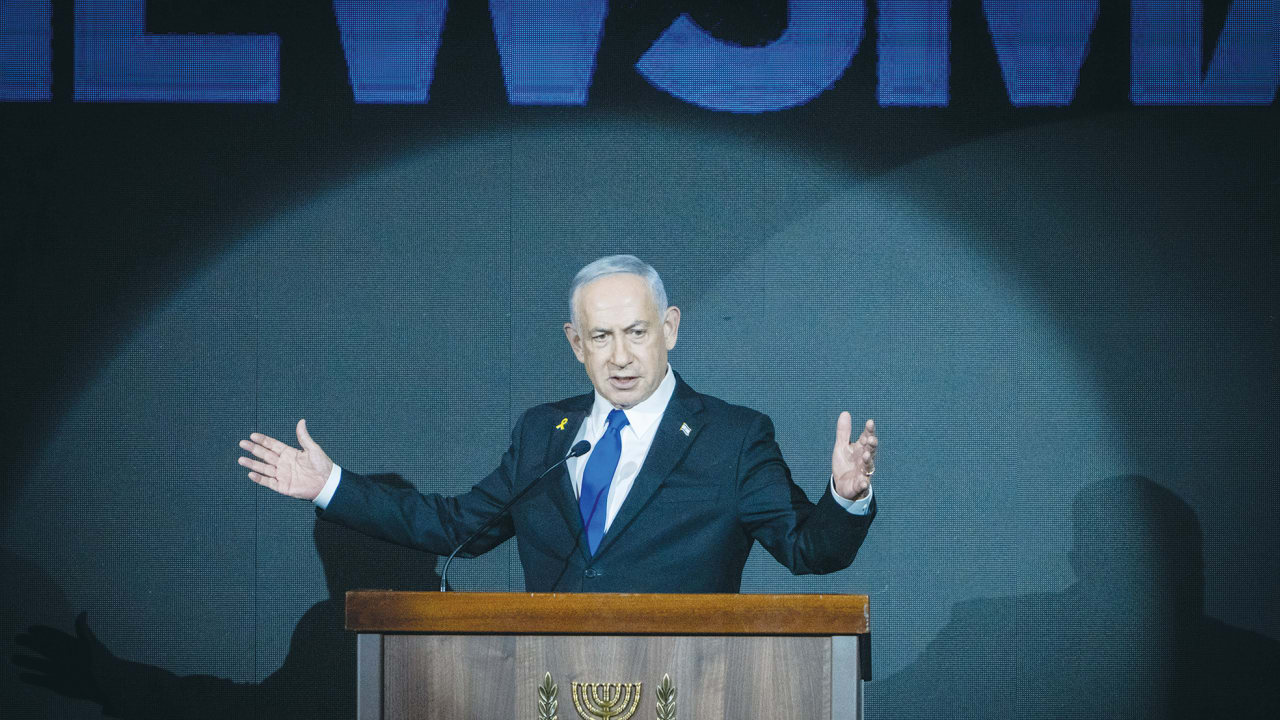
For Israel, September has always been a fraught month.
The world gathers in New York for the United Nations General Assembly, the Palestinians use the stage to slam Israel and advance their cause, and Jerusalem braces for diplomatic turbulence.
But this September is shaping up to be more consequential – and more tumultuous – than most.
Significant Western capitals – Paris, London, Brussels, Ottawa, Canberra – are preparing to recognize a Palestinian state. Jerusalem, in response, is again seriously debating extending sovereignty to parts of Judea and Samaria, while the United Arab Emirates is warning that the Abraham Accords could unravel if annexation is approved. And Washington’s position on annexation? Well, that remains a bit of an unknown.
Above all that hovers the specter of a major military push to take over Gaza City and deliver Hamas a final, decisive blow.

In other words, Israel is heading into a month where decisions at home and moves abroad could collide, shaping not only its borders but the future of its alliances.
Smotrich unveils plan to annex West Bank
Perhaps the week’s most significant diplomatic development came when Finance Minister Bezalel Smotrich unveiled a plan to annex more than 80% of Judea and Samaria.
The prospect of Israel annexing parts of Judea and Samaria has been discussed for weeks as international recognition of a Palestinian state gained momentum, but here – at long last – was an actual plan. And it was sweeping: absorbing most of the territories into Israel while leaving the main Palestinian population centers – Ramallah, Nablus, Hebron, Jericho, Jenin, and Tulkarm – as Palestinian Authority-governed enclaves.
If, until now, diplomats stationed in Israel were told largely that talk of annexation was declaratory for political purposes, Smotrich’s plan – also obviously intended for his own political purposes – put concrete substance behind the idea. This was no longer just a declaration, but something people were thinking about seriously – and planning for.
Smotrich argued that now is the moment to act. Preventing a Palestinian state, he said, reflects a broad national consensus, and sovereignty would remove the idea of partition from the international agenda. Indeed, by a 71-13 margin, the Knesset voted at the end of July for a nonbinding motion in favor of applying Israeli sovereignty to all settlements beyond the Green Line.
France’s campaign to rally for recognition of a Palestinian state, Smotrich maintained, only reinforces the need to move now: if Europe acts unilaterally, so should Israel.
The plan has wide-ranging ramifications. For instance, the UAE – five years into its normalization with Israel – warned that annexation would cross a redline. Emirati officials said plainly: Israel can choose annexation, or it can choose regional cooperation. It cannot have both.
In 2020, the Abraham Accords were made possible only because annexation was shelved. For Abu Dhabi, shelving sovereignty was the price of normalization. Reviving it now risks undoing one of Israel’s most important diplomatic breakthroughs in recent memory.
In Jerusalem, annexation is being debated on several levels. Smotrich’s maximalist map is one option, but others are also being discussed: annexing all the settlements and their roads, annexing only the larger settlement blocs, or focusing on the Jordan Valley alone.
Prime Minister Benjamin Netanyahu has reportedly instructed his ministers to avoid public discussion. His concern is well placed: talking about it prematurely could box Israel in before it knows where Washington stands. Jerusalem prefers to keep its cards close to its chest until the Trump administration signals its view.
Why? Because in the end, the decisive factor is not Europe or even the Arab world. It is Washington.
Trump blocked annexation twice in his first term: once immediately after unveiling his “Deal of the Century” in January 2020, and again that summer when Netanyahu pressed for partial sovereignty. In both cases, Israel stepped back and received the Abraham Accords instead.
Rubio slated to visit later this month
Now, half a year into Trump’s second term, the signals are mixed. Secretary of State Marco Rubio is scheduled to arrive in Israel the week of September 14, during which he is expected to participate in a dedication ceremony at the Pilgrims’ Road in the City of David – an event not without symbolism, given its location in east Jerusalem. During his visit here, annexation will certainly be a central topic of discussion.
Some Israeli officials believe the administration will not block annexation this time, particularly given its frustration with Europe’s Palestinian state recognition drive – frustration that came out in the US refusal to issue visas for PA officials seeking to attend the UN General Assembly meeting.
Others note dissent inside Washington, with some advisers warning that annexation would complicate efforts to work with Arab states on Gaza’s future or to keep alive even the faint possibility of Saudi normalization.
Netanyahu’s instinct – as usual – is to wait. Reports suggest he has clamped down on leaks – ambiguity on this matter preserves flexibility.
If Washington’s position will be decisive regarding annexation – whether it takes place and how deep – Europe is not sitting quietly on the sidelines. France is at the forefront, promising to recognize a Palestinian state and pressing others to follow suit.
French President Emmanuel Macron has cast his initiative as a breakthrough, saying it secured commitments from the PA to end payments to terrorists and their families, undertake internal and textbook reforms, and won Arab backing for a broader framework that includes disarming Hamas and stabilizing Gaza.
Jerusalem, and this is an understatement, is deeply skeptical. Foreign Minister Gideon Sa’ar accused Macron of meddling in a conflict “he is not a party to” and of ignoring the reality that PA incitement and payments to terrorists continue unabated. The exchange spilled onto social media, with Paris insisting its plan is credible and Jerusalem dismissing it as recycled illusions.
The French, along with other Europeans, point to a June letter from PA President Mahmoud Abbas pledging peace and widespread reform as an almost new foundational document.
Macron gushed at its contents, writing on X that it charts a course toward a horizon of peace: “A condemnation of terrorism, the release of hostages, the demilitarization of Hamas, an end to the war in Gaza, reforms, elections – a just and lasting peace for all in the region.”
Israelis, with three decades of Oslo experience and trauma, view it differently: another piece of paper full of noble phrases but divorced from reality. Notably, the five-page letter, whose broad aspects were reported on in the Arabic press, does not appear to have been translated or widely distributed in major Arabic media outlets or on official PA channels.
For Israel, the dilemma is real. If it does not respond to France for its unilateral push, it sets a precedent that European countries can dictate to Jerusalem on existential issues. But retaliate too strongly – say, by closing the French Consulate in Jerusalem, as has been discussed – and Europe will likely rally around Paris.
For instance, Germany, which has until now resisted recognition and blocked sanctions against Israel inside the EU, could feel compelled to side with its close ally France, further isolating Israel.
And this is where timing matters. Annexation and the military campaign in Gaza City, considered together, could magnify each other.
If Israel pushes ahead with sovereignty just as it launches its major military campaign, everything could merge, giving Europe and the Arab world more justification to harden their positions against Israel simultaneously.
That risk explains why Netanyahu is calibrating not only what steps Israel might take, but when to take them. Timing is critical, something rarely lost on the prime minister. In Netanyahu’s choreography, diplomacy and military action have long gone hand in hand, with speeches abroad often dovetailing with moves on the battlefield.
The best example came just last September, when the killing of Hezbollah head Hassan Nasrallah took place just after Netanyahu finished addressing the UN’s 2024 General Assembly. Few believe the timing was accidental; some even suggest it was designed as a diversion to cover the strike itself.
It is not far-fetched to imagine, therefore, that a Gaza operation could coincide with the General Assembly later this month, ensuring that while world leaders debate a Palestinian state in New York, Israel creates facts on the ground – militarily, with an operation in Gaza, and diplomatically, if it decides to move ahead with annexation.
This convergence would project a simple message: Israel’s future will be shaped by its own actions, not by resolutions or European initiatives.
This month, therefore, is not just another month on Israel’s diplomatic calendar. It is the month when annexation maps are debated behind closed doors, when Rubio lands in Jerusalem, when the UAE draws redlines, when France presses ahead at the UN, when the PA seeks to leverage sympathy, and when the IDF readies for its next campaign.
These are not isolated developments. They are converging streams, rushing toward a single confluence at the General Assembly later this month. What unfolds there will not only mark another UNGA season of speeches and resolutions; it will frame the choices Israel faces about its borders, its alliances, and the direction it takes from here.
Future historians may look back on this month as a pivotal one when Israel chose which path to take: toward unilateral sovereignty, greater regional integration, or a yet-imagined third way.