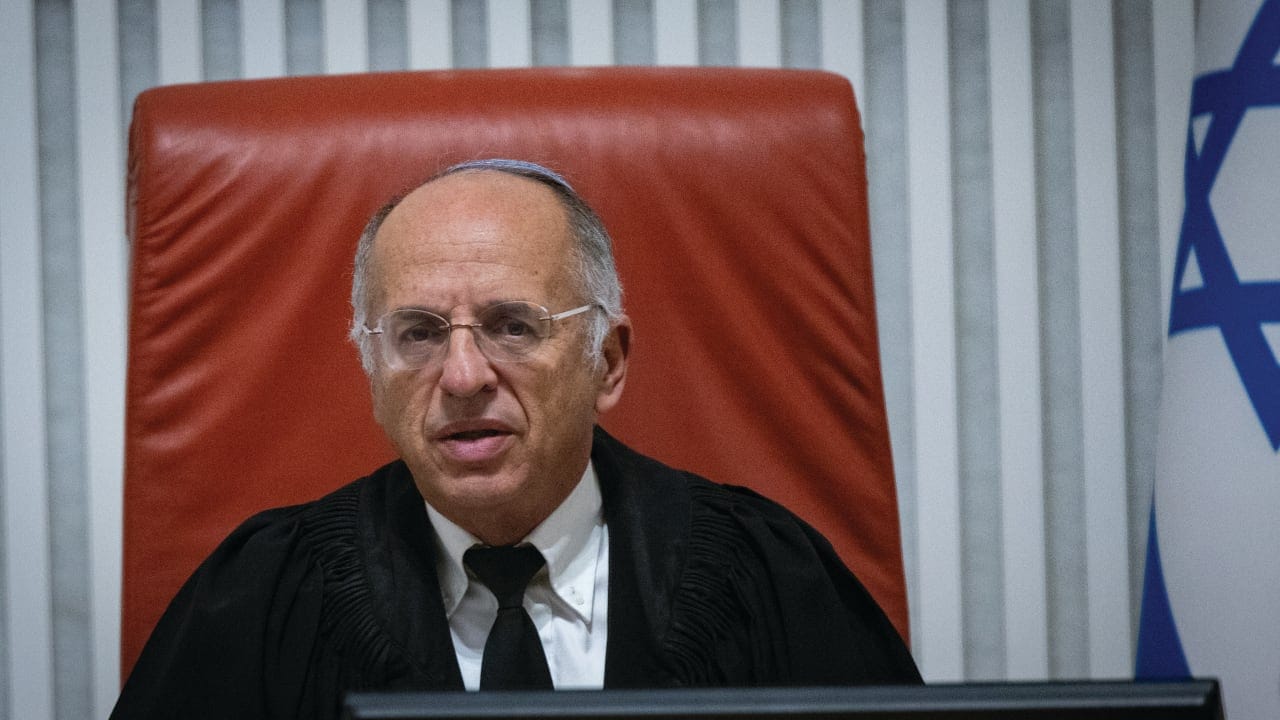
Supreme Court Deputy Chief Justice Noam Sohlberg issued a temporary order against the firing of Attorney-General Gali Baharav-Miara, blocking it from advancing until the court can review the legalities of the government's decision.
A temporary order is issued while a case is still being heard and is meant to keep the status quo until the judge reaches a final decision. Effectively, it is a legal pause to make sure nothing happens in the meantime that would render the court’s final ruling pointless.
In the fiercest iteration yet of the intense schism between the government and the Attorney-General’s Office (and with the judiciary in general), a court hearing was set last week on the case for September 3.
Gov't decision to dismiss Baharav-Miara passed last week
The government decision to dismiss Baharav-Miara passed unanimously early last week. The High Court of Justice immediately issued an injunction, which turned into a temporary order on Sunday.
Proponents of the move cite an inability to conduct a proper working relationship with the Attorney-General’s Office and the legal advisory under it due to a lack of trust and goodwill. Opponents view the move as aggressive and assert that it acts to remove one of the last checks on the government.

Sohlberg ruled already in July that the decision would not come into effect until it underwent a comprehensive judicial review.
Following the temporary order, Communications Minister Shlomo Karhi instructed his team to ignore the legal advisers assigned to his ministry. Other ministers made similar announcements.
Sohlberg noted in his Sunday decision what he already outlined in the previous one: There is to be no change to the A-G’s authority or the weight given to her advisory opinions, and the government should not announce her replacement.
He also lamented Karhi’s letter to his staff: “As it is known, the obligation to adhere to court rulings applies equally to all.” In sharp criticism, he noted that the obligation to adhere to court rulings rests even more heavily on public offices.
The government, led in these efforts by Justice Minister Yariv Levin, moved to fire Baharav-Miara via a ministerial committee, but this is not the legal framework through which the attorney-general can be fired.
The legal protocol for hiring or dismissing an attorney-general was codified in 2000, following the Shamgar Commission and the Bar-On–Hebron Affair. A public-professional committee must convene to weigh in and provide recommendations before a hiring or firing decision is made.
That committee is meant to be made up of a retired Supreme Court justice as chairperson, appointed by the current Supreme Court president and with the approval of the justice minister; a former justice minister or attorney-general, chosen by the government; an MK, chosen by the Knesset Constitution, Law, and Justice Committee; a lawyer, chosen by the Israel Bar Association; and a legal academic, selected by the deans of the law faculties.
Levin failed to find former attorneys-general or justice ministers to sit on the committee. All eligible candidates opposed his efforts.