
Regardless of where one stands on Israel’s political map – Right, Left, or Center – recent polling gives little room for optimism that a clear mandate to govern will emerge from the next elections, which will be held somewhere between late January and late October 2026.
The reason for this pessimism is that the polling numbers indicate that the parties currently comprising the coalition are projected to win between 49 and 53 seats, while the Jewish opposition parties are polling between 57 and 61 seats. In other words, both sides are expected to struggle to form a stable coalition.
While in 2022, Naftali Bennett and Yair Lapid were willing to form a government with an Arab party, Mansour Abbas’s Ra’am, the likelihood of that dynamic repeating itself with the country on a war footing, or just beyond it, which may be the case when the elections are held, is slim.
This means that the country is staring down the barrel of the same kind of political stalemate and gridlock that plagued it between 2019 and 2022, when it underwent five elections in just three and a half years.
That picture does not fundamentally change even when factoring in the possible emergence of a new party led by Gadi Eisenkot, or even if he joins Yesh Atid as its head or merges with Bennett’s new party.

The Eisenkot effect, for the most part, has been to rearrange the furniture within the opposition bloc. It has not shifted votes from the coalition bloc to the opposition. He is not moving a table and chair from one room to another; he is simply moving them around in the same room.
The key to breaking this stalemate is moving votes across the blocs, for example, persuading moderate right-wing voters currently voting for the Likud to cast their ballots for Benny Gantz’s, Lapid’s, or Bennett’s parties.
The polls, however, are not showing this dynamic taking hold.
The option to form a new government may lie with a new party
And that means the vehicle to move votes from one bloc to the other might be a new party with a different message. If the Likud goes ahead on Wednesday and ousts Yuli Edelstein from his position as head of the Knesset Foreign Affairs and Defense Committee, punishing him for refusing to back a law that fails to mandate meaningful haredi (ultra-Orthodox) conscription within a reasonable time frame, then it might – with its own hands – be creating that very vehicle.
Edelstein has issued no threats to leave the Likud for another party or to start a new one. Still, that possibility cannot be dismissed, especially if he is ousted from his post and performs poorly in the Likud primaries to be held before the next elections. And a poor showing in the next Likud primaries is not far-fetched, given that some within his party are accusing him of trying to bring down the right-wing government over the haredi draft issue.
Edelstein joined the Likud in 2003 after the party he founded with Natan Sharansky – Yisrael B’Aliyah – merged with the Likud. He vied for a position on the Likud’s list in 2006 and won the 14th slot. As the party only won 12 seats, he first entered the Knesset as a Likud MK replacement in 2007.
His standing in the party grew steadily. In the 2009 primaries, he placed 12th, dropped to 18th in 2013 when the Likud ran together with Yisrael Beytenu, and then rose to third place in 2015. His peak came in the April 2019 primaries, when he captured the second slot on the party list, just behind Prime Minister Benjamin Netanyahu.
That represented the height of his influence and reflected his popularity within the party. At the time, he was serving as Knesset speaker.
His fortunes began to decline, however, when – amid Netanyahu’s repeated failures to form a coalition after successive elections – he flirted with the idea of challenging him for the party leadership, an idea he eventually abandoned.
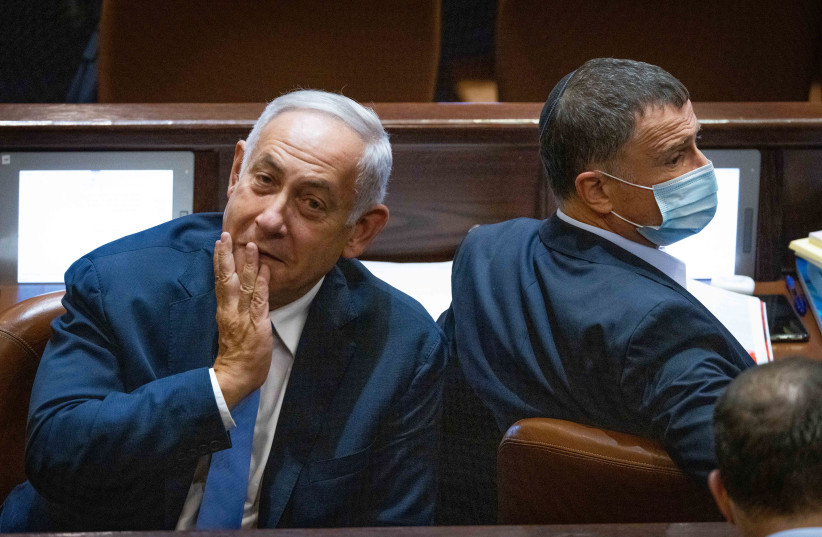
But the damage was done, and in the 2022 primaries, he dropped to 18th place. When Netanyahu selected his cabinet after winning the Knesset elections that year, Edelstein was conspicuously left out, only to be appointed chairman of the Foreign Affairs and Defense Committee as almost a consolation prize.
While Edelstein has given no indication of his next political move and has remained loyal to the Likud, it is not inconceivable that, if he is ousted, he could seek a new political home or build a new one. Doing so on the back of the haredi conscription issue may prove to be a winning strategy.
Caving to haredi demands on conscription is not only unpopular among the general Jewish public but also among Likud voters. It is a hot-button issue, one that could drive a segment of Likud voters to follow Edelstein to a party that reflects their positions and values, first and foremost, support for mandatory military service for haredim.
Polls suggest that the Likud has a solid base of about 18 seats that will remain loyal to Netanyahu no matter what. That figure is drawn from post-October 7 massacre polling.
On October 6, 2023, a Maariv poll projected 28 seats for the Likud, reflective of what most of the polls were giving the party at the time as the judicial reform debate raged. The Likud won 32 seats in the 2022 election.
In 10 polls conducted over the next two months immediately following October 7 – as the country seethed with fury at how such a catastrophe could have happened – the party averaged 18 seats, which can be considered its bedrock support.
Currently, the Likud is polling around 27 seats, meaning that nine of those mandates are floating, i.e., voters currently within the Likud camp could jump ship over one issue or another. Considering the passion that the haredi conscription issue is triggering, this could be one of those issues.
Edelstein, if he chose to form a party or join another, could offer those voters a new political home. In doing so, he could become that elusive vehicle that moves voters from one bloc to the other.
Speculative as it may be, this scenario raises questions that the Likud might want to consider before removing Edelstein from his position, particularly the political ripple effects of sidelining someone over an issue that resonates deeply with much of the country, including a significant segment of its own voters.