
It’s only mid-July, Rosh Hashanah is more than two months ahead, yet that ubiquitous phrase around the holiday season “aharei hahagim” (after the holidays) is already on many people’s lips, at least of those carefully watching or involved in this country’s politics.
In the general context, “aharei hahagim” means “we’ll get to it after the holidays,” meaning that doctor’s appointments, serious home repairs, even trips abroad will be put off until after Rosh Hashanah, Yom Kippur, and Sukkot. This year, that means October 15 – the day after Simchat Torah.
However, in the current political context, “aharei hahagim” refers to the date when the Knesset will reconvene for its winter session (October 19), following a long hiatus that will begin a week from Sunday.
It is in the interim, from now until aharei hahagim, that the country will have to wait before finding out whether this government – a government leading it in war and hostage negotiations, in striking Iran and bombing in Syria – will stand or fall.
As haredi factions leave government, coalition holds on
Why? Because although the two haredi parties, United Torah Judaism and Shas, announced this week they were leaving the government – on paper leaving it without a Knesset majority – it doesn’t have that much practical effect, because the Knesset is going on an extended summer break during which it will not be passing any laws needing a Knesset majority. And one such law that it will be unable to pass during these three months is a law to dissolve itself.

Not that such a vote would succeed right now anyway. Because even as Shas followed United Torah Judaism’s lead and declared on Wednesday it was leaving the government, it did so with a major caveat: “We are leaving the government,” meaning relinquishing ministerial and deputy ministerial positions, “but we are not quitting the coalition,” meaning they won’t vote with the opposition to bring the government down.
This also ensures that Shas leader Arye Deri will continue to participate in the security cabinet deliberations, where the country’s life-and-death decisions are made.
As religious Services Minister Michael Malkieli explained, Shas’s move stems from the haredi conscription issue – or, rather, the failure to pass legislation exempting haredi yeshiva students from military service. The government, he said, is “persecuting Torah scholars.” At the same time, he insisted the party would not “cooperate with the Left” to bring it down.
Explaining Shas's decision to exit government, but not bring it down
To some, this maneuver looks inherently contradictory. If you leave the government, aren’t you, by definition, part of the opposition?
But to those familiar with Shas’s voter base – and the Council of Torah Sages that sets its direction – the logic is politically sound.
Many of Shas’s voters are indeed haredim, but many are also ardently politically right-wing. As such, they don’t want to see this right-wing government and Netanyahu replaced by Yesh Atid’s Yair Lapid, with Yair Golan’s Democrats Party a senior coalition partner holding key ministerial posts.
So they’ve constructed the ultimate mechanism enabling the party to have its cake and eat it, too.
What this means is that Shas is making an ideological statement of opposition to the conscription of yeshiva students – in this way remaining true to the hardline stance on the matter taken by the leading Ashkenazi rabbis and seconded by its own Torah authorities – while not alienating its right-wing voter base, which does serve in the army and is deeply committed to national security.
Shas is trying to dance at two weddings – staying in the haredi camp by pledging allegiance to army exemptions for haredim, but dodging the political fallout. What is not clear, however, is whether this balancing act is sustainable over time.
Shas is trying to avoid a big political price for its decisions
The first signs are not encouraging for the party, which currently has 11 Knesset seats. According to a Channel 12 poll on Wednesday evening, before Shas formally quit the government but after it became clear where things were heading, its support dropped to eight seats. That’s a 20% slide in less than two months, compared to a similar poll conducted by the same pollster, Manu Geva, in late May.
So if Shas is trying to have it both ways, it is far from certain that it will succeed. And, of course, there are those working hard to ensure that it doesn’t.
Enter Likud MK Tally Gotliv, one of the most outspoken and combative voices in the party. Sensing a golden opportunity to peel off disillusioned Shas voters – particularly the non-haredi ones – Gotliv went on the attack.
Writing on X, she accused Deri of “spitting in the face of Shas voters” by leaving the government without bringing it down. “Shas voters are right-wingers,” she wrote, “connected to the heritage of Israel in the Land of Israel, the inheritance of our forefathers.” She accused Deri of blindly obeying the rabbis of the Gur Hassidic sect, who were the first to instruct their political representatives in UTJ to exit the government over the draft issue.
“Supporters of Shas – right-wingers, many of whom serve in the army – are horrified by this weakening of the government’s resilience in wartime,” she continued. “Do not vote for Shas! Do not believe Arye Deri.”
If Gotliv’s post sounds like a salvo in an election campaign, that’s because, well, it is.
While everyone is focusing on whether the haredi draft issue will bring down the government and lead to new elections, consider the following: new elections must be held by October 27, 2026.
If everything aligns perfectly for the opposition – and it manages to pass a bill to dissolve the Knesset during its first week back after the holidays, starting October 19 – then the earliest possible election date would be in late January 2026. Under the law, elections must be held three to five months after the Knesset is dissolved. That’s just 10 months earlier than the deadline for holding elections anyway.
Which raises a strategic question: With the clock running out on the government in any case, when exactly does it make the most political sense to pull the plug?
Looking at past precedent, it’s likely that one of the coalition parties will eventually vote to dissolve the government over a matter of ideology. Shas might ultimately leave the coalition – and not only the government – over the haredi draft. The Religious Zionist Party, or Otzma Yehudit, might walk over Gaza. That way, they can tell voters they went to the election and brought down the government over a matter of principle, not politics.
In the grand scheme of things, it doesn’t make that much difference now whether the elections are held at the end of January, March, or October 2026. The elections are already in the air, the campaigning has begun, and the country’s politicians are all jostling for position and making their decisions knowing that the next elections are not that far off.
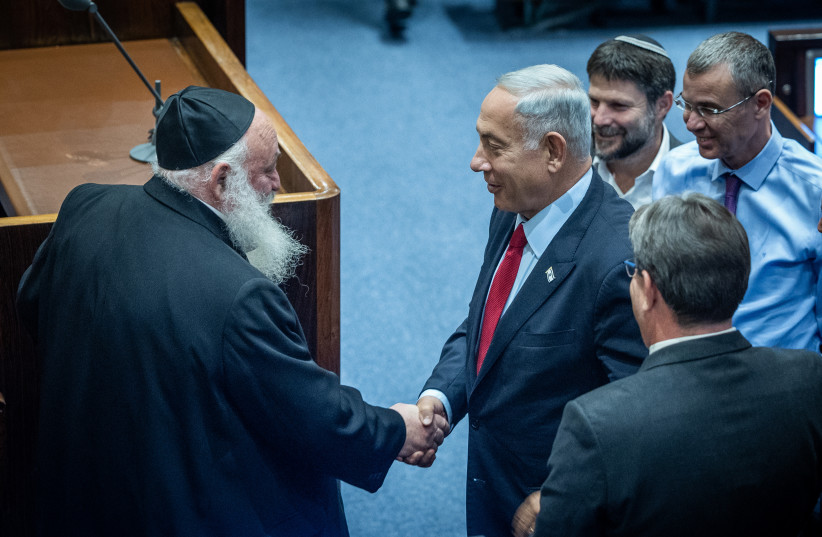
Israel's sharpest political operator is posturing for the next elections
And among those posturing is the sharpest political operator in the land: Netanyahu.
Much of what Netanyahu does now must be viewed through the lens of posturing for the next elections. This is particularly true regarding his approach to the entire haredi draft issue.
Promoting legislation to enshrine draft exemptions for haredim has been essential to keeping his coalition intact. Indeed, one of the most remarkable aspects of recent Israeli history is how Netanyahu managed to remain in power after the catastrophic events of October 7, and despite the widespread public fury and outrage that followed.
The way he was able to do so was to keep his coalition intact, and one of the key tools he used to do that was the promise of a draft exemption law for the haredi parties.
But as his government enters what could be its final stretch, Netanyahu must decide whether he wants to face voters having just passed a highly controversial conscription bill – one that pleases Shas and United Torah Judaism, but runs counter to the views of a majority of Likud voters, who polls show oppose blanket exemptions for haredim and support universal Jewish military service.
And the answer to that question will, unlike so much else, not have to wait until after the holidays. Rather, this will be decided even during the Knesset’s summer vacation.
The unusual arrangement Shas has crafted – outside the government but still part of the coalition – gives the party time to see what Netanyahu does next. Will he come up with a compromise on the draft issue that satisfies Shas and UTJ by the time the Knesset returns on October 19?
If he does, it will suggest Netanyahu is still trying to squeeze a few more months out of this coalition. But if he doesn’t – if he doesn’t work his political magic to hammer out some kind of deal that satisfies the haredi parties – then it’s a sure sign that he realizes it will be a severe liability to go to the electorate with this type of legislation registered under his name.