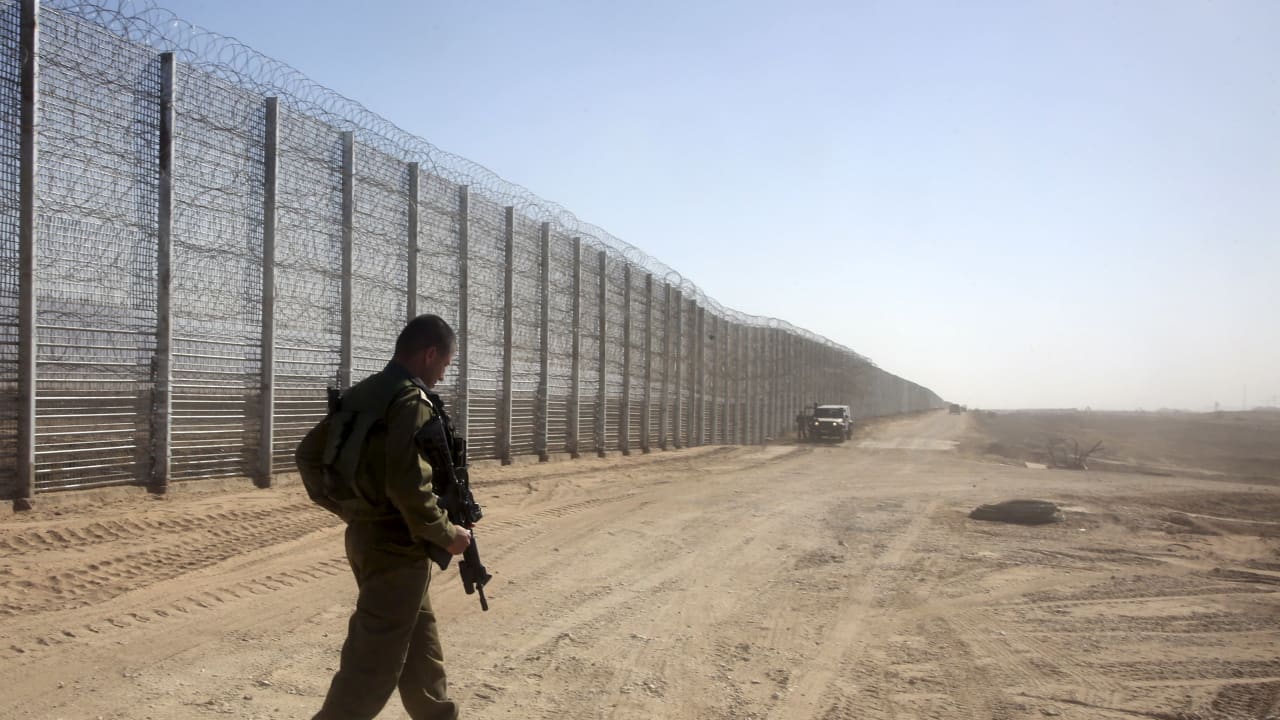
The IDF’s new security fence with Jordan could be completed as early as the start of 2028, The Jerusalem Post has learned.
In November 2024, Defense Minister Israel Katz announced that he had won a years-long battle to get authority to build a hi-tech border fence with Jordan to block smuggling, especially from Iran.
An announcement said that the fence, which will include a variety of cutting-edge sensors and cost tens of millions of shekels, would start being constructed in “a number of months,” but did not set a formal end date.
As of early 2026, the Post can confirm that the building process has long kicked into full gear.
However, there were extended delays, and construction did not start in earnest until late 2025 despite initial optimism of a quicker start.

In late 2025, the Defense Ministry updated that the initial work would cover roughly 40 km., stretching from Hamat Gader near the southern Golan Heights to Yardena, and from the Jordan Valley checkpoint to Yafit.
Israel planning NIS 5.5 billion fortification on Jordan border
That project is just one part of a larger plan to fortify Israel’s 425-km. border with Jordan, from the Samar Sands north of Eilat through the West Bank to the southern Golan Heights. The estimated cost of the project is around NIS 5.5 billion, more than the NIS 3.5b. cost of the Gaza border fence, which was finished in 2021.
The ministry announcement did not give much of a concrete timeline for finishing the project, such that the Post’s reporting on that issue is a significant revelation.
Defense sources have also made clear that Israel has escalated proactive intelligence collection missions on the border and will not rely solely on the fence, though the fence is expected to be a major boon for securing the border.
It was unclear in late 2024 how Katz had overcome the alleged opposition of Finance Minister Bezalel Smotrich, and possibly also from Prime Minister Benjamin Netanyahu, who various defense officials had accused of preventing the idea from going forward in recent years.
The defense establishment had asked for a budget to build the wall in previous requests leading into 2024 and again leading into 2025 – but until late 2024, the Finance Ministry and the government never approved the budget.
Former IDF commander Maj.-Gen. (ret.) Yehuda Fuchs had pushed for the fence for a long time, even sending a formal letter of warning to then-chief of staff Lt.-Gen. Herzi Halevi about the dangers of failing to build a fence, before retiring in summer 2024. Fuchs had pointed the finger at the Finance Ministry.
However, simply the fact that Katz entered into office and Netanyahu may have wanted him to get a quick win to move the narrative on from Katz’s fired and highly respected predecessor, Yoav Gallant, could have been a factor.
Gallant had publicly pushed for the fence multiple times and had cited that years before, the government had already approved such a fence, only to be ignored, allegedly by Smotrich and Netanyahu. This was even after the public became much more sensitive about border security after Hamas’s 2023 invasion.
In addition, whereas Gallant had significant political pull with security-minded Israelis, he had little to hold over Smotrich politically. Katz, who is more of a long-time political maneuverer, may have had more to negotiate with regarding Smotrich.
Smotrich was also one of the few officials who publicly praised Katz in late 2024 when the defense minister rescinded any new administrative detention orders against violent Jewish activists. That was despite the fact that this move was mostly criticized by current and former security chiefs as potentially empowering such extremists regarding their attacks on Palestinians.
Katz has also given Smotrich a much freer hand regarding building outposts in the West Bank despite opposition within the IDF and from Israeli allies in the EU and the US.
A spokesman for Smotrich in fall 2024 rejected this narrative, saying he has always supported a new fence on the Jordan border.
Pressed for previous statements Smotrich made in favor of the fence or regarding why such a fence was not built until now, he pointed the finger back at the IDF, saying that if it had really wanted to build the fence, no one could have resisted.
Rather, the spokesman said the IDF itself likely did not prioritize the issue given the intense wars in the North and the South.
Further, the spokesman noted a tour of the Jordan border that Smotrich took in mid-September 2024 with Netanyahu, in which he discussed the importance of reducing smuggling and penetrations of the border. Smotrich does not specifically mention a new fence in his public statement, but he does discuss budgeting new items to protect Israel positively.
It was also unclear what changes would be made to the budget to account for the new spending of tens of millions of shekels.
A spokesman for Smotrich said that this sum of money was tiny for the IDF and that it could easily shift funds from one project or another to cover it.
At the time, Katz said Israel saw a relentless and institutionalized Iranian effort to establish an eastern front in its fight against Israel.
“I have decided to intensively promote the construction of the fence on the eastern border between Israel and Jordan,” he said, “We are going to do it very quickly.”
“We cannot lose in this campaign against the establishment of the eastern front, and we will have to do root cause treatment in some places to prevent Judea and Samaria and the refugee camps from becoming a model for Gaza.”
The Defense Ministry said that it was starting to work on producing the new barrier material, as well as the intelligence collection and communication sensors and network that would be integrated into the new fence, as well as mapping out the actual topography.
The engineering and building department of the Defense Ministry and Maj.-Gen. Eran Ofir, who also led the construction of the Gaza fence, is coordinating the project.
Despite criticism of the IDF’s defense of the Gaza border and over-reliance on the Gaza fence, from a technical and technological perspective, apparently, the defense establishment still believed that Ofir did a solid job constructing what he had been tasked with doing.
It was unclear if the IDF would also increase its border troop presence with Jordan or would rely more on technology as it did with Gaza, leading up to the 2023 Hamas invasion.
Jordan has been traditionally viewed as a quiet and safe border since a peace deal between the countries in 1995, and the nations even share high-level intelligence to fight terror.
But Israel believes that Iran is outplaying the Jordanians and sometimes succeeding at smuggling high-level weapons into the West Bank for terror purposes, a phenomenon that even started earlier in 2023 and has only gotten worse.