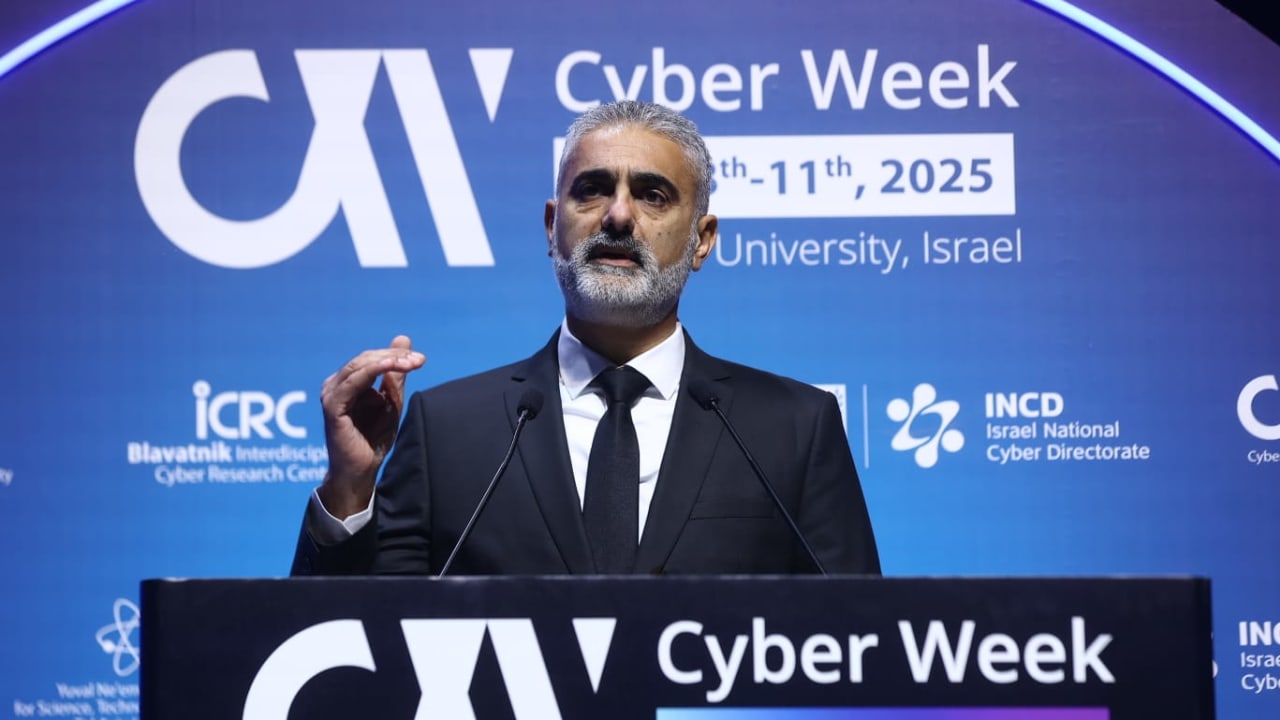
Iran used cyber weapons to try to target every citizen in Israel multiple times during the 12-day June war, the director-general of the Israel National Cyber Directorate (INCD), Yossi Karadi, said in his first public speech since taking office in March.
Speaking at the Cyber Week 2025 conference at Tel Aviv University, Karadi said that 1,200 social engineering hacking operations, each targeting thousands of Israelis, occurred during the war with the Islamic Republic in June.
Karadi replaced former INCD chief Gaby Portnoy, who had served since February 2022.
The INCD chief revealed that during this time frame, Tehran had hacked into parking and other road cameras to “track the movements of Israeli VIPs, with the aim of building operations to target and harm them.”
Further, Karadi said that when the Islamic Republic struck the Weizmann Institute of Science in Rehovot with a ballistic missile, it had taken control of a street camera facing the building first, just prior to the missile hit.

In addition, to augment the psychological impact of the missile attack, Iran sent threatening emails to workers at the targeted university departments prior to the attack.
Iran hacked camera before missile hit Israeli university
Moreover, Tehran “published leaked data to deepen fear.”
Karadi announced that Israel is about to sign a new strategic agreement with Germany to “develop the next generation of national cyber defense.”
Friederike Dahns, the national director for cyber and information security at the German Federal Interior Ministry, said that there will soon be a special Israeli attaché for cyber issues based in Germany to increase dialogue between the countries.
The Jerusalem Post has learned that the individual who will fill the role has not yet been selected.
Also speaking at the conference, Nick Andersen, the executive assistant director for the Cybersecurity Division of the US Cybersecurity and Infrastructure Security Agency (CISA), said on Tuesday that China is trying to use cyber weapons to preposition the US and the West for “societal havoc and chaos in civilian infrastructure” in the event of a conflict.
Andersen stated that in terms of hacking threats, “The most significant and comprehensive threat in the long term is absolutely from the People’s Republic of China.”
They have a “long-term cyber campaign, not just to gather intelligence, but to shape the battle space... infrastructure... using persistent reconnaissance and low-key intrusions,” the CISA cyber official said.
He accused China of “embedding in water, the energy grid, the cloud, telecommunications, and identity systems” in order to “weaken national resolve during a time of crisis.”
Andersen suggested that “US and Israeli efforts align in this regard” to block Beijing from putting civilian infrastructure at risk while masking its actions as routine network activity.
According to the CISA official, the US and its allies must “continue to shift to disrupt the Chinese prepositioning” ambushes within their civilian infrastructure.
“Operational cooperation with Israel is essential not just to our success, but as part of global cyber defense efforts."
He advocated for “higher identity protocols and improved login [defenses, as well as] improved telemetry atthe time of conflict.”
Andersen acknowledged that Russia, Iran, and North Korea are also major cyber threats, but said China is the greatest.
His words mark a shift over the last decade or so, given that Moscow was once considered the number one cybersecurity threat.
Although it wants to support the US, the issue is sensitive for Israel, which, while suspicious of the Chinese in certain areas, including their support of Iran, has tried to maintain positive relations with Beijing wherever possible.