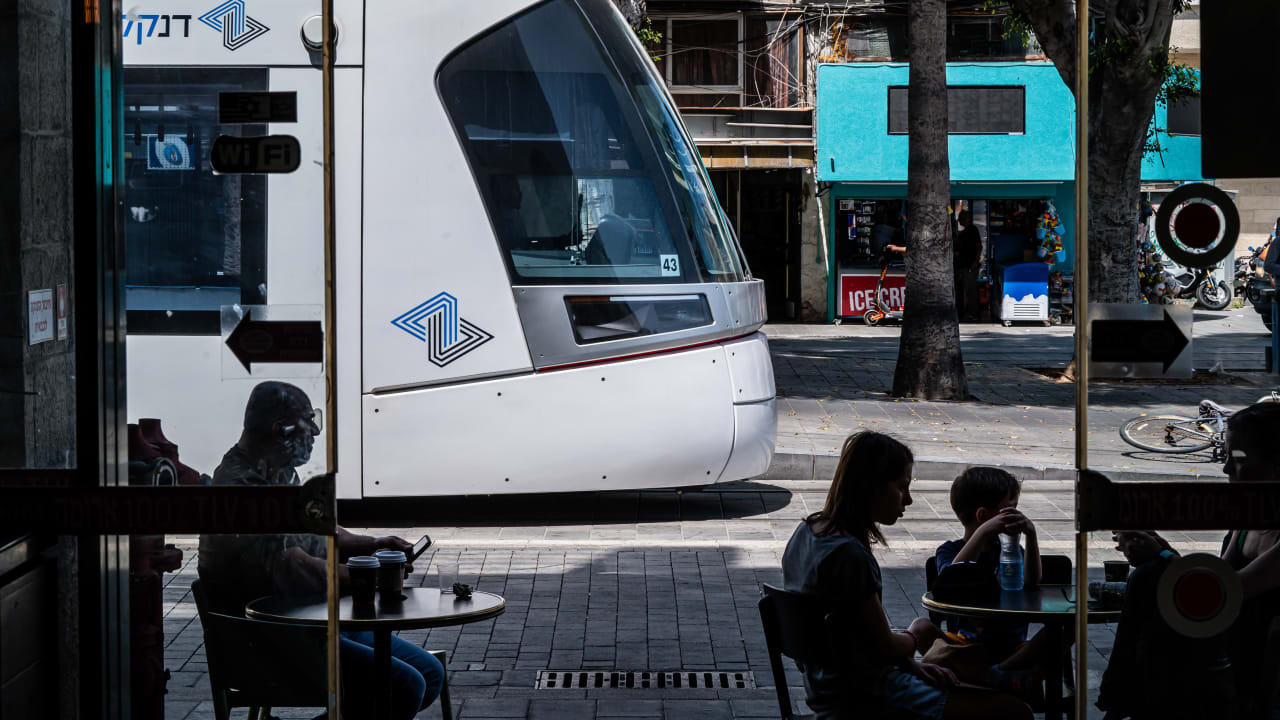
There are significant gaps in preparedness against terrorist attacks on the Dan region’s light rail, State Comptroller Matanyahu Englman said on Tuesday in a report on the country’s state of security.
Englman framed the findings starkly, saying the “security reports should keep government ministers up at night,” noting that they also touch directly on “the safety of Israel’s citizens.”
Since October 7, he stressed, the obligation to fix the deficiencies identified by his office “has only grown,” with “severe shortcomings... across a wide range of issues.”
Between August 2024 and January 2025, the State Comptroller’s Office conducted a sweeping review of the country’s preparedness for a terror attack on the Tel Aviv area’s light rail, examining the systems and institutions responsible for protecting the Red Line – the most densely used transit corridor in the country.
The audit included the Israel Police, NTA Metropolitan Mass Transit, the Defense Ministry, the National Emergency Management Authority (NEMA), the National Security Council (NSC), the Transportation Ministry, Fire and Rescue Authority, Magen David Adom (MDA), the Privacy Protection Authority, and the National Security Ministry.

Investigators also conducted field inspections along the line and carried out supplementary checks with the Shin Bet (Israel Security Agency). Cyberterror scenarios, however, were excluded.
Light rail security audit finds major gaps and staff shortages
A central finding in the audit was the absence of a legally defined authority empowered to determine or approve the casualty scenario for a terrorist attack on the light rail. Under the existing “extreme scenario,” such an attack would produce mass casualties. Yet despite the severity of the threat, there is no normative designation of responsibility.
In practice, NEMA created the scenario based on operational research by the police and NTA, and believes the Transportation Ministry must approve it – while the NSC maintains the ministry should lead all security planning for national transportation infrastructure.
The Transportation Ministry rejected NEMA’s September 2019 scenario as overly high in projected casualties, but by the close of the audit – January 2025, five years later – it had produced no expert alternative of its own.
This, the State Comptroller’s Office noted, persists even though the ministry is responsible for Israel’s transportation infrastructure and funds its force-building. The police told Englman that after October 7, it re-evaluated the national terrorist reference scenarios but determined that no changes were necessary.
The audit also found that no statutory requirement obligates major transportation projects to meet the police’s technical and operational security standards during planning, initiation, or tender stages - even though the police are the legally designated security authority and must approve certain licensed public facilities. Meanwhile, the police still have not completed the process of anchoring their underground-rail security standards as a binding national norm, despite beginning the effort in early 2023.
Another gap concerns preparedness for a chemical terror attack. Although a designated security unit holds national responsibility for responding to chemical incidents – attacks that have occurred internationally – there is no regulated consultation process with this unit during the planning or tender stages of major public infrastructure projects involving enclosed underground spaces such as train stations. Nor is there any binding requirement to implement the unit’s recommendations.
Staffing shortages within NTA’s security guard corps emerged as a critical weakness in the report’s findings. Even before the outbreak of the Israel-Hamas War in 2023 – and more sharply afterward – the number of security guards fell steadily.
Several shifts operated below standard staffing requirements, and in two cases, they fell below the minimum threshold, the report found. Guard refresher training also decreased, including hand-to-hand combat refreshers not covered in reserve duty.
With two additional light rail lines and a future metro system on the horizon, the report warns that the shortfall is projected to deepen as demand for trained guards grows.
Because mass-transit systems move extremely high passenger volumes, both the police and NTA told the State Comptroller’s Office that further use of advanced security technologies must be explored. The report also identified gaps in casualty-evacuation procedures.
One of the most persistent failures the comptroller found involves communication systems underground. Despite appearing in several earlier audits – including some published nearly a decade ago – the report found that MDA’s radio network still cannot interface with police or fire and rescue systems in subterranean environments.
This leaves MDA teams unable to coordinate with other responders during an incident, while underground units also lack handheld radios; portable devices exist only in ambulances. This means that if cellular networks collapse, responders would be unable to communicate except physically or through a third body.
The comptroller reiterated long-standing calls – dating back to 2016 – for a national underground training facility that could simulate the full range of subterranean infrastructure and train all emergency agencies – police, MDA, Fire and Rescue, Home Front Command, counterterrorism units, and light rail employees. Although officials from the Transportation, National Security, and Finance ministries, police, and Fire and Rescue Authority collectively recognized these needs already in 2016, no such facility has been built, and construction has not even begun nine years later, as of January 2025.
The comptroller did report some positive findings: The audit found strong cooperation between the police and NTA, particularly in joint trainings and routine security operations – cooperation that became especially critical after the Red Line’s opening and even more so after October 7.
Officials from the State Comptroller’s Office also visited NTA’s training facility in Moshav Tal Shahar, where Red Line guards undergo initial instruction and periodic readiness drills. They praised the modern infrastructure, which includes a dedicated train car for scenario-based exercises. However, the site is not an underground facility nor a national training center; it serves NTA guards alone, whose role is to provide the immediate frontline response in a terror incident.
Englman concluded that the Transportation Ministry must convene all bodies involved in formulating the current casualty scenario, study the research underlying it, and seek clarifications as needed. He further instructed the police and the National Security, Transportation, and Finance ministries to undertake full staff work on the national guard shortage – calling it “a national challenge requiring urgent action” – and to close the staffing gap once that analysis is completed.