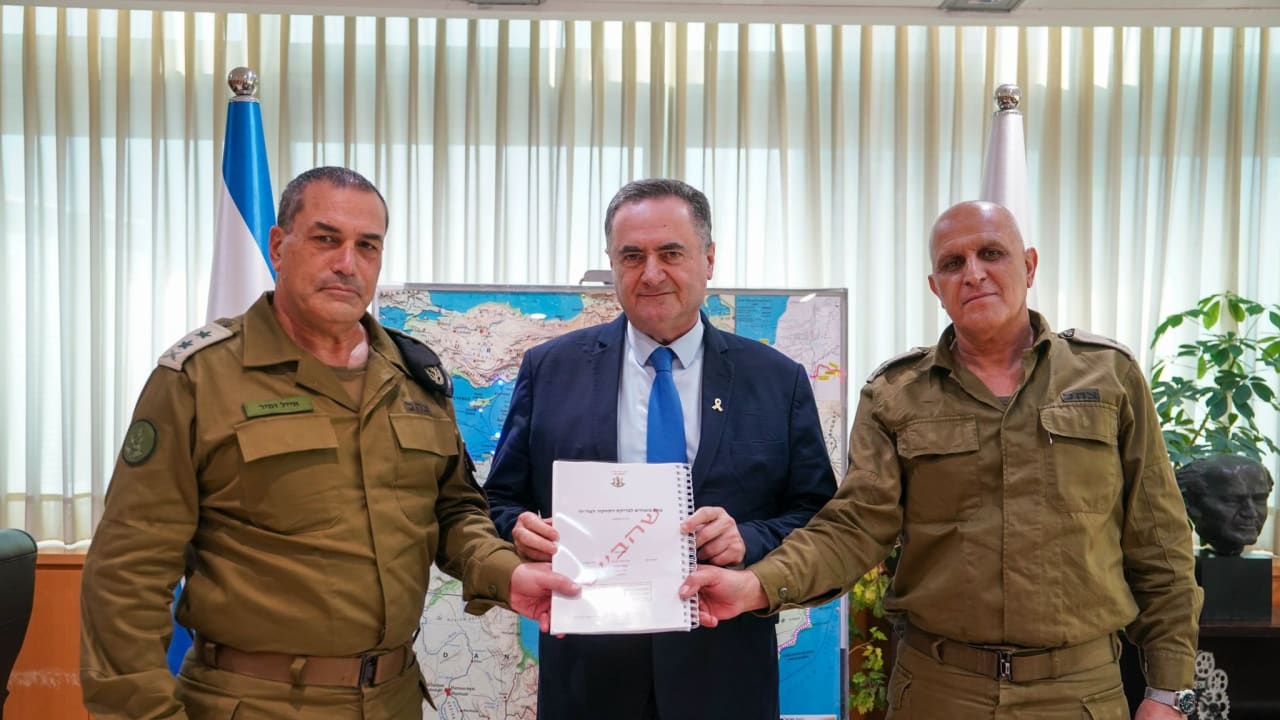
IDF Chief of Staff Lt.-Gen. Eyal Zamir went head-to-head with Defense Minister Israel Katz on Monday night in a battle royale over the October 7 probes and their consequences for IDF commanders.
Zamir called Katz out for interjecting politics into the process and trying to substitute a single lower-ranked official's judgment for the judgment of 12 higher-ranked IDF ones.
The blow-up was so large that Prime Minister Benjamin Netanyahu said he would call both of them in for a consultation on Tuesday.
The latest war between the two titans is several months in the making, since Katz has interfered in IDF promotions in an almost unprecedented fashion, leading to a freeze that is causing many top officers to retire, rather than wait to see how the dust settles.
Until now, Zamir has mostly avoided a public breach with Katz in order to defer to him as his civilian superior and not to run afoul of Netanyahu, his sponsor.

One of the points that Zamir may seek to win or clarify on Tuesday is whether he can dislodge Netanyahu from lockstep support of Katz's efforts to undermine Zamir, though initially all signs are that the prime minister had encouraged those efforts.
The IDF chief and the prime minister were close for many years, dating back to when Zamir worked as his military secretary, but had a major public break over Netanyahu's desire to continue the Gaza invasion after July, the point at which Zamir said pressing the invasion was likely to start elevating the danger to the Israeli hostages held by Hamas.
Netanyahu could still take Katz's side, but he may not want to do so with Zamir generally very popular following his successful management of the war with Iran in June, and as the prime minister turns toward a potential new election.
However, Katz launched a surprise strike on the IDF chief on Monday morning, announcing that Defense Ministry Comptroller Brig.-Gen. (res.) Yair Volansky would second-guess a commission that Zamir had established by Maj.-Gen. (res.) Sammy Turgeman to give a final verdict on the October 7 IDF probes, including personal responsibility for top General Staff officials.
He said that Volansky’s probe of Turgeman's one would last 30 days and that he would continue a promotions freeze during that time.
Turgeman's probe itself was a second-guessing investigation of the October 7 probes managed by Zamir's predecessor, Lt.-Gen. (res.) Herzi Halevi, which were released this past February.
Katz was upset at Zamir for not vetting his decisions on each IDF General Staff official with him beforehand.
Zamir vetted Turgeman's report
In turn, Zamir responded Monday night that he had vetted the entire Turgeman report with Katz before presenting it to the public on November 10, and that the consequences for his top commanders are his decision alone, not the political echelon.
The IDF chief took particular umbrage that Katz issued his announcement while Zamir was with soldiers in the field in the North, drilling for potential combat operations with Hezbollah in Lebanon and for potential Syrian invaders.
In addition, Zamir made a not-so-veiled counterstrike at Katz, Netanyahu, and the political echelon, who have blocked any attempt to probe their responsibility for October 7, strongly implying that the defense minister is being hypocritical to continue to focus so much energy on criticizing the IDF when the political class is avoiding even one iota of personal responsibility.
More specifically, Zamir took aim at Katz for continuing a freeze on promotions.
The Jerusalem Post has learned that, following Zamir's hard decisions and the rebuking and penalizing of many of his former comrades on the IDF General Staff, he expected Katz to remove the promotions freeze.
But Katz refused to budge even after Zamir's public attack Monday night.
Less than an hour after Zamir went public, Katz sought to remove the conflict from the public sphere, but held his ground saying, "I appreciate the IDF chief, who knows well that he is subordinate to the prime minister, the defense minister, and the Government of Israel. I have no intention of winning in the media."
"The Defense Ministry Comptroller will submit his conclusions within 30 days – only after that will I formulate my decisions regarding appointments, as is required for my role and my authority," he said.
Meanwhile, the Post understands from security sources that Volansky is viewed as a serious and substantive individual, but the same sources say he could be used by Katz to try to achieve political purposes unrelated to national security considerations.
Two major open questions remain after Zamir’s announcements related to successors for Israel Air Force commander Maj.-Gen. Tomer Bar and Israel Navy chief V.-Adm. David Saar Salama.
Given that Bar refused to extend his service beyond April 2026, Zamir has, for some time, tried to get Bar’s deputy, Brig.-Gen. Omer Tischler, to succeed him, so that the two men can spend months conducting the most effective possible transition.
Katz has blocked the promotion, however, either to encourage Zamir to make decisions about the consequences of October 7 for commanders – including Tischler, who has not been fired and should now be cleared to replace Bar.
However, Katz may also have been holding up Tischler’s promotion to force Zamir into compromises on other appointments, such as replacing IDF Maj.-Gen. Hidai Zilberman, who has left his post as defense attaché in Washington.
Zilberman has already moved on to become head of the IDF Planning Directorate, starting a transition process with IDF Maj.-Gen. Eyal Harel, with Zilberman due to take sole control of the position on December 21.
According to Yediot Aharonot and as confirmed by the Post, Zamir wants R.-Adm. Tal Politis to take up the US defense attaché post. Politis has served as the deputy head of the navy and as commander of Shayetet 13, the IDF’s elite naval special operations unit.
Katz has not publicized anything specific he has against Politis, but wants his military secretary, Brig.-Gen. Guy Markizeno to take the post.
The defense minister on Monday specifically denied any connection between his October 7 freeze on promotions and the US defense attaché position, but Zamir clearly did not find this denial convincing.
Often, Netanyahu and other defense ministers like to promote their military secretaries to sensitive positions afterward, feeling a greater ability to rely on them in rough political situations.
Zamir cleared the names of Brig.-Gen. Manor Yanai, Brig.-Gen. Eliad Moati and Col. Ephraim Avni for further promotions despite their conduct on October 7, finding they had made no personal command errors.
He may also be upset at Katz for holding up their promotions.
Amichai Stein contributed to this report.