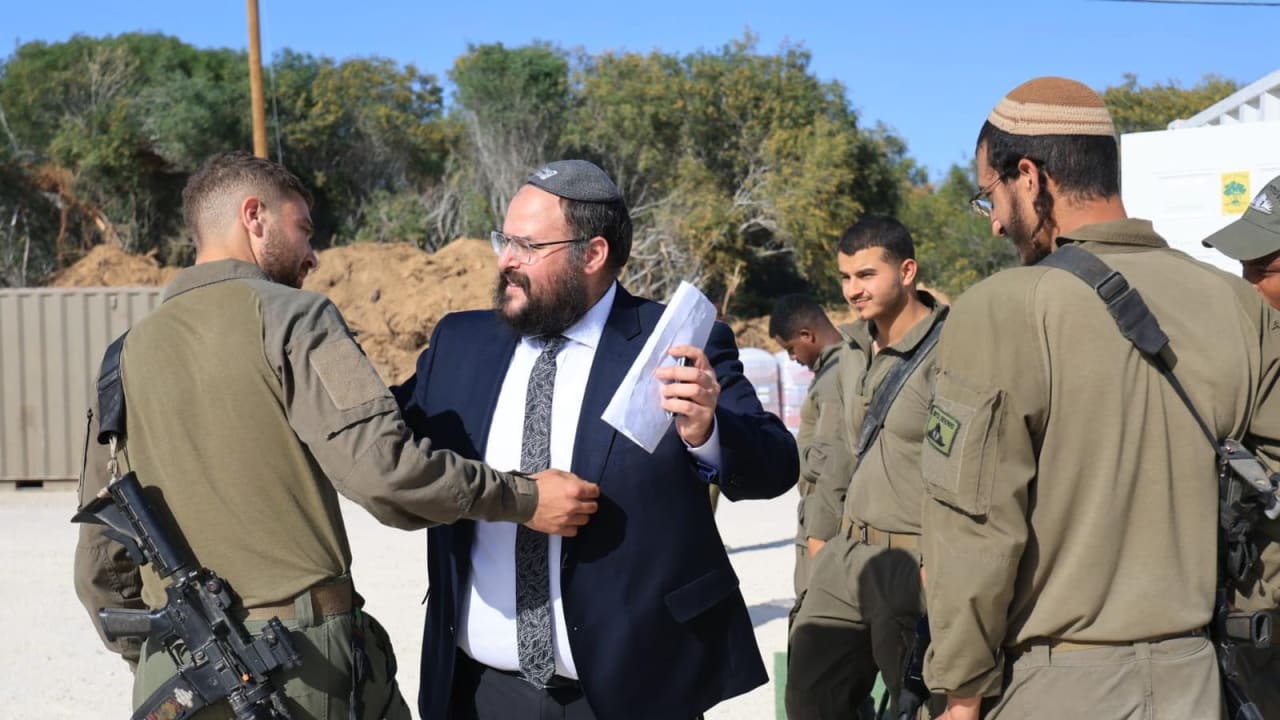
‘The only way that an old organization can survive,” says Rabbi Sholom Duchman, director of Colel Chabad, “is by constantly adapting to a new reality.” Although it was founded in 1788, Colel Chabad, the oldest continually operating charity in Israel, has remained nimble and agile, enabling it to pivot quickly and help those in need.
Colel Chabad is one of Israel’s most essential organizations, offering a broad range of programs, which include soup kitchens, daycare centers, medical rehabilitation centers, mental health clinics, and much more. Its most extensive program is its Food Security Initiative, part of the Blavatnik Food Bank of Israel. Colel Chabad has developed a partnership with the Israeli government that reaches more than 40,000 families every month, helping to ensure their food security. Participants in the program receive a special NIS 500 debit card every month, which can be used at major supermarket chains to purchase basic food items.
Designing and implementing these essential programs has required the development of a sophisticated infrastructure that can be utilized for a number of various tasks. Colel Chabad maintains an ultramodern call center in Migdal HaEmek, has a secure, sophisticated database of its beneficiaries, and can remain in constant touch with those it serves.
Because of its existing framework that it had developed to help those in need, Duchman says that after Oct. 7, Colel Chabad was able to provide debit cards to families who were saved from destruction in the Gaza envelope, enabling them to purchase food and other essentials. “We didn’t have to create new relationships with food stores,” says
Duchman, “because we had the existing infrastructure from the debit cards we give to low-income families in Israel.”
Similarly, after the 12-day Iran-Israel war, Colel Chabad distributed debit cards to enable 1,800 families whose houses had been destroyed to purchase clothing and other basic items, again utilizing the infrastructure that it had previously developed.
Now, for the coming High Holy Day season, Colel Chabad is leveraging its infrastructure to provide increased assistance to up to 3,000 families in need whose husbands have been called up for extended tours of duty in the IDF reserves.
Serving for long periods of time in the reserves is difficult for any family, regardless of its economic state. A survey conducted by Israel’s Central Bureau of Statistics (CBS) in April-May 2025 focused on spouses of reservists who served between Oct, 7, 2023, and February 1, 2025. The survey found that as a result of extended reserve duty, employment was disrupted for many families, and education suffered, as many reservists who were enrolled in undergraduate programs canceled registration. Families of soldiers serving in the ground forces also faced increased levels of financial stress. The study showed that the more days served, the greater the level of economic hardship. Approximately 130,000 reservists and five regular divisions are expected to take part in the IDF’s current operation, which will unfold in stages and extend into 2026.
“We can reach out to reservists from these families in a respectful manner,” says Duchman, “by sending them a text message from Colel Chabad, an organization that they know and trust, notifying them that we will give them an additional amount of money, up to NIS 1,200 on their supermarket debit cards, depending on how many days the family member has served in the reserves.
“We are in direct contact with the poorest of the poor in Israel,” he explains. “We have 47,000 households on our list. This year, families with men and women serving in the IDF reserves have faced extraordinary challenges. They have been taking on a huge burden for the past two years on every level, so for this High Holiday season our donors want to do something special to help reservists’ families that need the help.”
Says Fabio, a Colel Chabad supporter from Milan, Italy: “When these young men and women leave their homes to defend the Jewish people, their families are left behind to carry the burden alone. Supporting them for yom tov is the least we can do. It’s our way of saying, ‘Your sacrifice is not forgotten, and your table will be full of dignity and joy while you protect ours. We will remember and admire you and your family when we are with ours over the chagim.’”
Leaving one’s home and family to serve a stint in the IDF reserves can be difficult at any time of the year, but it is challenging during the High Holy Days, which is a time when families gather together. Families in need appreciate the additional amount of money they will receive from Colel Chabad. Says M, the wife of a reservist from Jerusalem: “My husband is now in Gaza, already for his fourth round. I work full time, and between work, the children, and the house, I do the maximum I can to hold everything together.
“In such a long war, it is truly moving and strengthening to feel that we are not forgotten, and that we are seen and supported. It gives me the strength to keep going and to be there for my family and for the people of Israel. It warms my heart to see that the people of Israel truly appreciate the sacrifice and dedication of my family and me, and that they are helping us get through this period in a much more supportive and comforting way.”
Tehila, a social worker in the Beersheba welfare department, says, “As a family social worker for many years, I have seen up close the difficulties experienced by families in which one of the parents is on reserve duty – especially when they are also facing financial hardship. The assistance of up to NIS 1,200 is not just money – it is an embrace and support that reminds these families that the community and Israeli society see them and appreciate their sacrifice. We are proud to take part in an initiative that gives them a bit of breathing space and the strength to carry on during this challenging time.”
Duchman concludes, “This program really accomplishes two goals. We are meeting the needs of IDF soldiers from needy families, and also doing something for donors who feel a sense of appreciation for the young men and women who are sacrificing their lives for the Jewish people. All of them recognize that the sacrifice that they are making is not only for the protection of the Jews living in the Land of Israel but for the Jews living in the Diaspora as well. They are not just serving in Israel’s army – they are in the army of the Jewish people.”
>> To donate to Colel Chabad’s fund for needy families of IDF soldiers, visit this link
Reservists and their families need support now more than ever.
While 130,000 reservists are serving the country, many families are struggling with severe financial hardship. Colel Chabad provides a warm and meaningful response with assistance of up to NIS 1,200 per family – not just money but a true embrace in difficult times. Discover how simple support gives families the strength to carry on. As Rabbi Shalom Duchman, director of Colel Chabad, sums it up: ‘Reservists are not only serving in the army of Israel – they are serving in the army of the entire Jewish people.’
This article was written in cooperation with Colel Chabad.