
An investigation by the Israel Air Force on Sunday found that the ballistic missile launched by the Houthis on Friday night contained cluster munitions, the first time during the war that they have used this category of weapon.
On the one hand, such a weapon tends to have a less harmful impact if it achieves direct hits as opposed to a classic ballistic missile.
On the other hand, however, this kind of missile has a higher chance of causing at least some minor harm because it splits into many parts that can have many impacts. The IDF admitted that it failed to shoot down the missile due to an unidentified human or technical failure, not because the missile contained cluster munitions.
However, it is possible that there are some instances where the IDF would need to shoot down this type of ballistic missile at an earlier point to avoid it breaking up and impacting Israel.
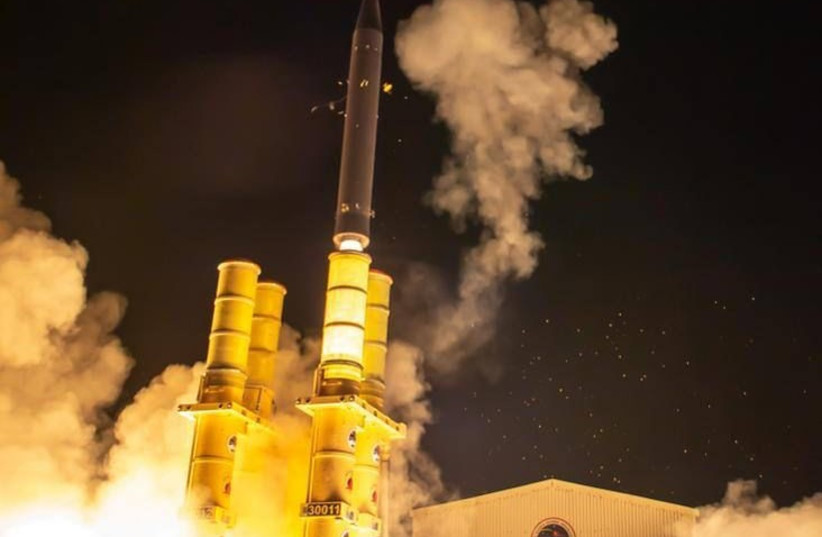
The Arrow 2 and 3 defense systems – used to shoot down such missiles – do have the capacity to strike them at different and earlier points where necessary, but sometimes a first interceptor misses. With a classic ballistic missile, shooting it down with a later second interceptor will have the same outcome, whereas with cluster munitions, it may sometimes be too late.
On Friday, the IDF said the Houthi missile that triggered sirens across central Israel likely fragmented mid-air, but it was unclear if this was planned by the terrorist group or a defect in the missile.
Magen David Adom said that there were reports of shrapnel impacting a house in the central Israeli moshav of Ginaton, landing in the house’s backyard. As a result of the missile launch, loud booms were heard around Tel Aviv and Ramat Gan. The IDF said it made several attempts to intercept the missile.
Iran's use of cluster bombs during the war with Israel
During the 12-day Israel-Iran War in June, Tehran occasionally used cluster bomb warheads with smaller explosives attached in its attacks on the Jewish state. According to an initial investigation then, when Iran used cluster munitions, the missile would split into several smaller bombs, somewhere around seven kilometers above the ground, each of which had an impact of an eight-kilometer radius.
Each one of the smaller bombs carried around two kilograms of explosives. The cluster bombs were used in an Iranian attack on Azor in Tel Aviv.
Jerusalem Post Staff contributed to this report.