
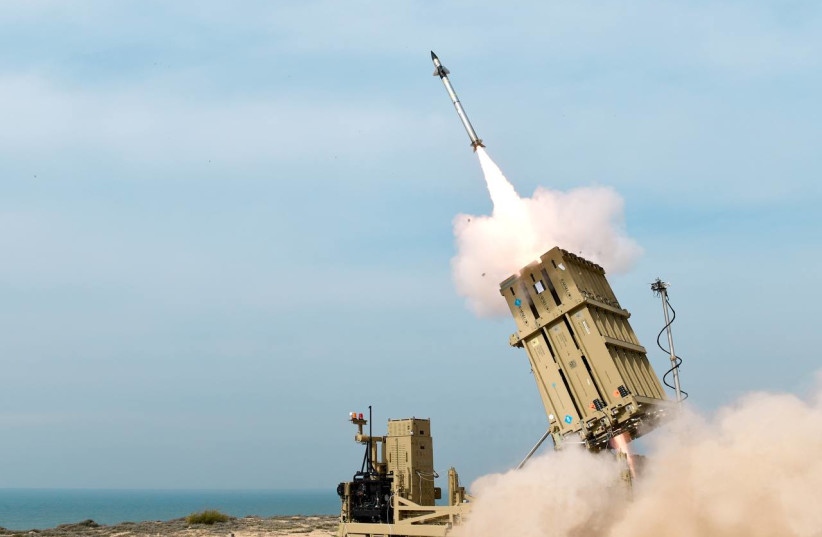
Iron Dome, Arrow and David’s Sling have become synonymous with national success. Rafael Advanced Defense Systems, Israel Aerospace Industries and Elbit Systems have won great praise, but a fundamental key to the success of Israel’s air defense lies in the multilayered defense system, which many countries are trying to copy.
The program has been led by the Defense Ministry’s Directorate of Defense Research & Development, which has been managing the development and production of Israel’s air defense since 1991.
The director of the Israel Missile Defense Organization since 2016 has been Moshe Patel, one of the veteran professionals in the field, who leads critical national missions, including planning, development, and production of air defense capabilities, and ongoing coordination with the US. About 48% of all Israeli defense exports in 2024 (totaling about $14.79 billion) were air defense systems.
“When there is war and operational events, IMDO is deployed on all fronts, in all defense industries, in the core of the air force. Every event, successful or not, we analyze in real time and learn for the future,” Patel said in a special interview. “If something is good, we will pass it on to the other systems. If there is a need to improve, we find the solutions and pass on our operational recommendation. All of our systems have experienced changes, after we sat down with the industry to examine implementation.”
The results of Israeli air defense against the Iranians as part of the Iran operation were unprecedented by any criteria. About 86% of Iranian ballistic missiles were intercepted by Israeli and US systems (THAAD and AEGIS), and about 99% of drones.
“As a matter of fact, our expectations were lower than the results,” admitted Patel. “There are achievements here that go beyond the basic demands. Regarding Arrow 3, we are implementing the lessons learned from the operational events and continuing to improve the system.”
Patel, 63, married, and father of four, is a computer engineering graduate from the Technion-Israel Institute of Technology with an MBA from Tel Aviv University. He began his defense career in the air force’s software units, working on F-16 avionics systems, later moving to command and control systems. In 1996 he first reached the defense directorate working on the Arrow system, was involved in developing the first Arrow system in 2000, and served in various ministry positions, including as a representative in Washington. After working at Elbit Systems, he became head of IMDO in 2016.
“I’ve been in the field for nearly 30 years. When we first started working on the Arrow, I said to myself, ‘We’re building an excellent system that will make it clear to the enemy that we can defend against attacks.’ I thought we were building a good deterrent capability, but I wasn’t sure we would use it,” said Patel. “To see a system that I’ve been working on for 30 years – and my predecessors for even longer – come to fruition is wonderful. The system works as smoothly as planned.”
As has been evident since the start of the war and especially in the operation against Iran, Israel came prepared for the missile and rocket threats. However, the threats that Israel faces are not the most severe today. Various countries possess intercontinental ballistic missiles that challenge defense systems due to their high speed, long flight range, and means of deception. In addition, there is the hypersonic threat, which combines capabilities between a ballistic missile and a cruise missile, flying at extremely high speeds while taking unpredictable trajectories that make interception difficult.
“We always look a few steps ahead and try to be, as before, prepared and ready for the next threats,” said Patel regarding these threats. “Upgrades and improvements have already been made to the software and hardware in each of our systems. We have far-reaching plans that existed regardless of the war, and we continue to accelerate them.”
A company that has dedicated years to intercepting hypersonic missiles
The company that has been developing a dedicated interceptor for the hypersonic threat for several years is Rafael, with a single-shot system. However, it is at an early stage compared with other air defense systems being promoted by Israeli defense industries.
Among the future developments, the Arrow 4 and Arrow 5 systems stand out.
“Arrow 4 is a system that will replace Arrow 2,” Patel noted. “We are going to bring a modern, innovative interceptor missile, with lessons learned from Arrow 3 and Arrow 2. It will be much more robust, while paying great attention to mass-producing the missile effectively.”
Arrow 5 is not a replacement for Arrow 3, but complementary. “At this stage, the industry is offering ideas, and we are accompanying the process. It will definitely be a significant leap forward. Arrow 3 has a big future with its phenomenal success; there is no precedent for its success rate.”
Israel has achieved significant international sales success, including the Arrow 3 system sold to Germany for $3.5b. and David’s Sling to Finland for about $390 million. “The very fact that the industries are simultaneously managing not to neglect Israeli needs despite foreign needs is a badge of honor for each of the industries,” Patel said.
The scale of these projects required IMDO to increase manpower by 20%. The work requires close contact with industries for executing contracts, monitoring and guidance, coordinating with the IDF, the ministry, the National Security Council, the government, and the US.
The fruitful cooperation between Israel and the US also entails a notable challenge. It is prohibited to sell a jointly produced system – for example, Arrow 3 and David’s Sling – without US approval. In contrast, US approval was not required for the sale of Rafael’s Spyder system to Romania last week (for about €2.2b.), as it is completely made in Israel.
“Our air defense systems are particularly critical for the State of Israel. First of all, there is the Israeli process that includes the Defense Export Control Division, the ministry’s security officials, and the IDF. Only then comes the US part,” Patel explained.
To what extent is the US integrated into Arrow 3? “It works hand in hand with us in Arrow 3. They receive a detailed overview of what happened in each operational event, and they also share with us about the functioning of their systems. We deal with questions such as what happened, and how to improve coordination between the systems. We built an incredible infrastructure that began as a crazy US demand for connectivity capabilities with our systems. From the first day of Arrow, we created this, and the orchestra played well in previous events but especially during the Iran operation. They are very involved, producing 50% of the components.”
Patel defined the close cooperation with the US as a “long-term marriage.” “Right now we are continuing to investigate what happened with the Houthis, what they saw, what can be done next, what they need to learn and what they need to improve. It has become more than just a professional friendship. It is mutual care, influence, amazing relationships where not only do we benefit from the generous money but also from joint management, joint deliberations.
“The competition is great, but not many countries have the ‘Combat Proven’ stamp. Only a few do, and when you consider the number of our interceptions, it is significant. With Iron Dome and Arrow, it is crazy, and with David’s Sling, too. It is a quality that not many have. We have undergone many trials, simulations, but the operational baptism of fire – bringing a system that has been tested in battle and proven itself – is a completely different world.”
Under the current memorandum of understanding (MoU) with the US, $500m. a year are allocated for joint air defense projects, but this is only until 2028. The future of the next MoU and its content are still shrouded in mystery, all the more so in the wake of US President Donald Trump’s ambition to increase US independence and his grandiose “Golden Dome” air defense program.
Patel explained that in addition to the $5b. granted Israel over a decade, there were years during which the US additionally funded other projects. In 2019, for example, an Arrow 3 trial was conducted in Alaska, for which US funding reached $700m. In 2021 during Operation Guardians of the Wall, a grant of $1b. was received, and during the current war, $5.2b. has been received for interceptor missiles and promoting the Iron Beam laser air defense system.
“Five hundred million dollars a year is significant. When I was first at IMDO and in my position in Washington, when we would receive a certain budget from the US administration, we would ask for additions. It’s a problematic situation because you present the needs, and then Congress says to move from point A to point B. In such a situation, MDA [the US Missile Defense Agency] had to cut other programs. In a situation with $500m. a year for a decade, you can plan long-term, and that is important.
“As for 2029, it is left to the dialogue between the countries. We will have to talk about it, at the decision-making level. First of all, the government and the National Security Council need to make a decision on what and how, and start processes with the administration and Congress.”