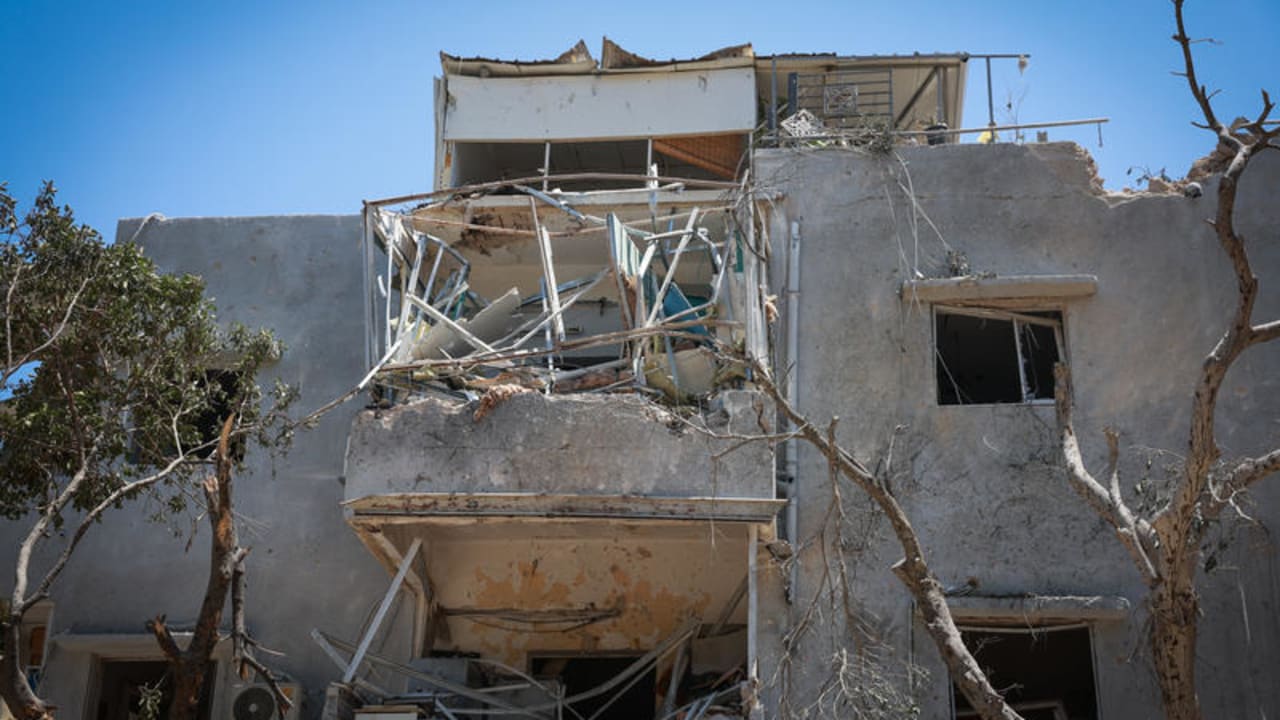
The IDF Home Front Command on Monday completely reversed its story and admitted that a ballistic missile struck Haifa on Sunday without any sirens because the military’s radar failed to identify the rocket.
On Sunday, the same IDF Home Front senior officials had said that there was an error with sirens in the Haifa area, not that the air defense systems had missed identifying the missile completely and had not even bothered to fire an interceptor to shoot it down.
Rather, the military had said that the Haifa hit was likely related to the IDF interceptor, not an Iranian ballistic missile.
In addition, the IDF had – it turns out – wrongly explained that there was no ballistic missile danger and that the sires failed to sound because they are programmed not to be set off by interceptors (otherwise, the IDF says there would be far too many overreactions regarding sirens) but rather only by missiles or fragments of missiles.
Following a deeper review of the incident, senior IDF Home Front officials acknowledged that a technological error in the radar, not a human error, had led to the missile not being noticed at all.

More specifically, the IDF said that the missile’s main body and explosive warhead had separated at some point, with the sensors continuing to track the main missile body but not the explosive warhead, which fell and hit Haifa. The military did not explain this as an Iranian tactic but as an accident, which contributed to the IDF error.
Lucky that there were not more casualties
In fact, the military said that the fact that no sirens went off – because the home front did not know that a missile was coming near Haifa specifically – meant that it was somewhat lucky that far more civilians were not killed or wounded, with only one being wounded.
A senior official added that it seemed that the Haifa residents in question had already gone to safe areas when they received the earlier nationwide warning that Iran had fired ballistic missiles toward Israeli territory.
This warning goes off simply from seeing that missiles have been fired from Iran, several minutes before Israeli radars start identifying where the missiles are most likely to actually land, which then is supposed to set off specific sirens in those specific areas.
The IDF did not explain why its original analysis of the failure presented a smaller failure – a mix-up with an interceptor – as the explanation instead of recognizing the much larger failure: An Iranian ballistic missile hit Haifa without the air defense even picking it up, let alone trying to fire on it.
Frequently, during this war, when the IDF made such errors in initial explanations, they were based on the incorrect assumption that the basic systems functioned normally and that a simple and less problematic explanation would need to suffice.
It appears that only after the IDF sized up the explosive elements in Haifa and realized that it was a ballistic missile and not an IDF interceptor did they check more deeply whether there had been a larger and more embarrassing error with the radar.
To date, Israel has shot down between 80-95% of Iranian ballistic missiles on different days since the conflict started on June 13, but almost every day, some missiles have gotten through, with over 50 hits out of nearly 500 missiles, 24 Israeli deaths, and around 1,250 wounded.