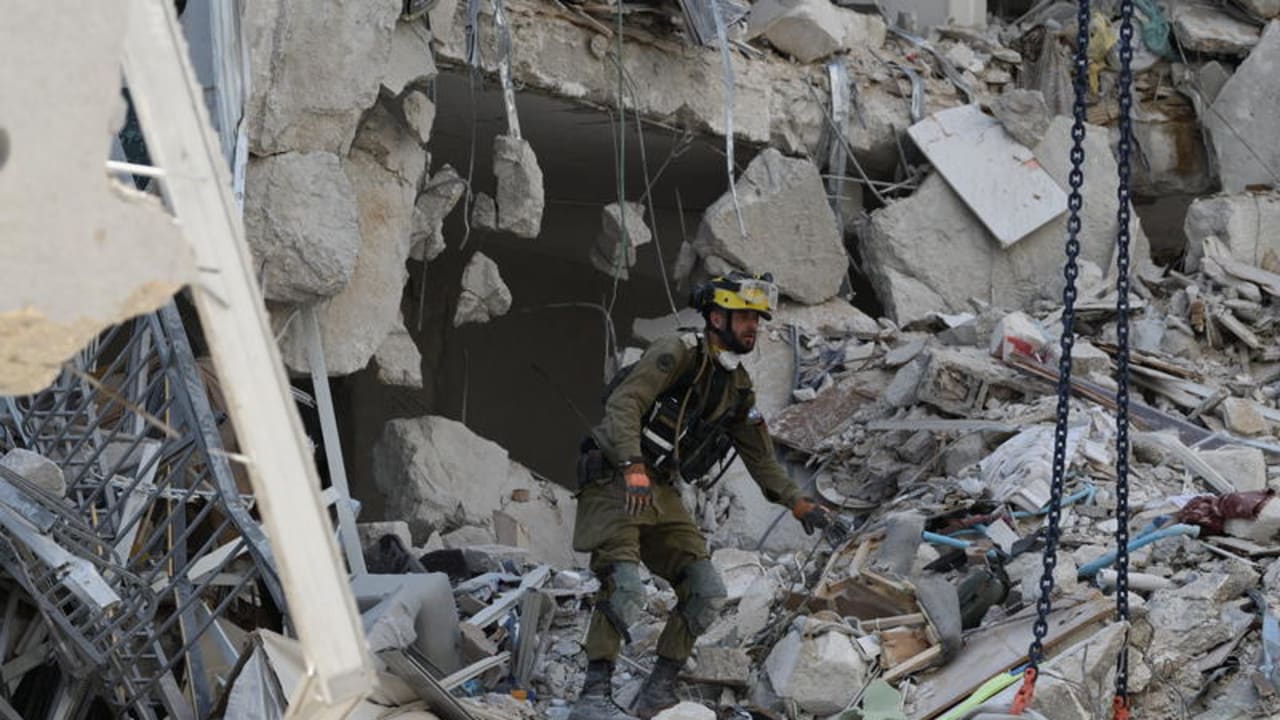
The recent Iranian missile salvo that struck Bat Yam employed largely familiar ballistic systems, yet residents and officials have wondered whether a new, more advanced Iranian weapon breached Israel’s air defenses. Tal Inbar, senior research fellow at the Missile Defence Advocacy Alliance and an expert on Iran’s missile program, says that although Iran has launched the same missiles seen in April and October 2024, one of three known variants is most likely responsible—and it is not an unknown system.
“In the current escalation, the Iranians once again fired ballistic missiles toward Israel, as they did in April and October 2024,” Inbar explained. “They’re using missiles developed and produced by the Revolutionary Guards’ factories, based on North Korean designs. The defense establishment has not yet identified which missile hit Bat Yam, but there’s a high probability it was one of three: the Emad, the Kheibar Shekan, or the Haj Qasem.”

Known missile variants
Emad: Displayed only last year, this missile’s main innovation is its maneuverable warhead. Rather than following a fixed ballistic trajectory, Emad can adjust course upon reentry to evade radar and interception missiles. It has a range of about 1,700 km and uses liquid fuel. Although liquid propellant requires lengthy, corrosion-sensitive fueling on the launch pad, it also delivers high energy efficiency, allowing a relatively heavy 750 kg warhead.
Kheibar Shekan: Revealed in 2022 and named after the Battle of Khaybar in 629 CE, this missile has a 1,500 km range and was Iran’s first to employ solid fuel—eliminating complex prelaunch fueling. Its roughly 500 kg warhead is large for its class, and it too features independent maneuvering capabilities. Upon atmospheric reentry it decelerates and employs its fins to dodge interceptors, complicating defences like Israel’s David’s Sling and the US Patriot system.
Haj Qasem: Unveiled in 2020 and named for the late Quds Force commander Qasem Soleimani, this fast missile can reach speeds up to Mach 12. It carries a 500 kg warhead with a range of approximately 1,400 km.

Can Israel’s air defences cope?
“In practice, Arrow and THAAD—the US-supplied systems deployed in Israel—still don’t provide airtight protection against ballistic salvos, however advanced they are,” Inbar noted. “They intercept most incoming threats, but you cannot achieve a 100 percent success rate.”
<br>Is there a secret Iranian trump card?
“There is one missile Iran has not yet used against Israel: the Khorramshahr,” he revealed. Based on North Korea’s Hwasong-10, Khorramshahr is Iran’s heaviest and fastest missile, boasting a range close to 2,000 km, a 1,500 kg warhead, and a top speed around Mach 14. Although currently within the interception envelope of Israel’s enhanced air defence network, a single successful penetration could inflict catastrophic damage.
The Khorramshahr also features a navigation system that corrects its course outside the atmosphere, making it resistant to jamming from electronic warfare. It is considered highly accurate—capable of precision strikes—and has exceptional manoeuvrability compared to its peers, with a warhead built to withstand extreme heat.