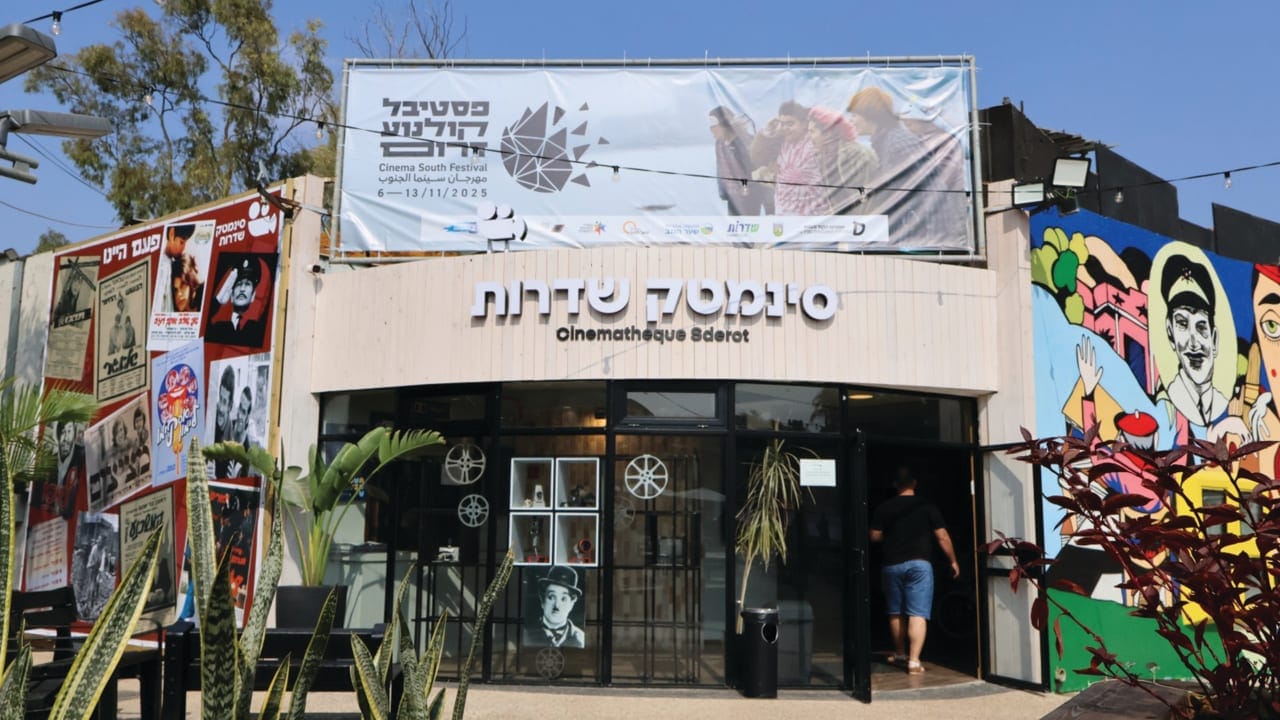
“First of all, let’s say that everything happening here is already a miracle,” said Reuma Mantzur, director of the Cinema South Festival, which celebrates its 25th edition at the Sderot Cinematheque from November 1-5.
Festival directors tend to speak in superlatives about the events they run, but in the case of the Cinema South Festival, Mantzur’s words make perfect sense. The festival has had to cope with more than two decades of frequent, unexpected bombings by Hamas from the Gaza Strip, as well as the tragedy of the October 7 attack in 2023, which took the lives of more than 50 residents, mostly civilians.
For Mantzur, the festival’s identity is inseparable from the community surrounding Sapir Academic College’s School of Audio and Visual Arts, where it began and which still sponsors and runs it. The festival’s screenings are one expression of a broader commitment to helping filmmakers develop their work and giving them reasons to remain in the South.
Mantzur arrived at Sapir as a student in 2006, when both the festival and the region’s filmmaking community were smaller.
“The festival gradually developed in response to the atmosphere and the reality of our lives,” she said. Collaborations expanded, and the connection with the school became increasingly important.
For students completing their graduation films, the festival’s pitching events and development incubators offer a possible answer to an intimidating question: What comes next?

Desire to create more is growing, Mantzur says
“In recent years, somewhat paradoxically, precisely as life here has become more difficult – perhaps it isn’t paradoxical – there has been a growing desire to create more and more work,” Mantzur said.
Among the initiatives reflecting that commitment is Through a Woman’s Eyes, a development incubator for Bedouin women filmmakers. The program, guided by filmmaker Sigalit Banai, works with partners including the Negev Film Fund. Mantzur also emphasized the involvement of the Rahat community center and the local professionals supporting the directors.
“The directors are Bedouin women, and everyone working around them is local,” she said.
The initiative is continuing, with the next group of films already shot for screening next year. For audiences, these works offer an opportunity to encounter life in the South through the perspectives of people who live there.
That relationship between filmmaking and place also shapes the festival’s ties with Sapir graduates and lecturers. Alongside its graduation film competition, it screens work by alumni who have established careers and teachers who continue creating while training another generation.
“We always look first for the local connection,” Mantzur said.
THE FESTIVAL’S regional emphasis does not mean its program excludes entertainment with a national audience. This year’s opening features the first two episodes of the second season of Bros, the series by Guy Amir and Hanan Savyon, which is broadcast worldwide on Netflix.
Watching television at a movie theater, Mantzur noted, gives viewers a shared experience that differs from watching at home. As smartphones, streaming, and changing habits reshape viewing, festivals must also respond.
But the festival is keeping its focus on its community, and the closing ceremony will launch Negba, a new incubator for young southern filmmakers.
Prior to October 7, the festival managed, against all odds, to attract many high-profile guests. I remember attending it in June 2004 to see its guest of honor, Richard Gere, give a master class. The atmosphere was festive, bordering on frenzy, with a huge crowd outside the cinematheque, mostly women but also men and children, there to greet him. Gere posed for photos and signed autographs graciously.
In those pre-Iron Dome days, Hamas was not yet officially in control of Gaza, but it still often fired missiles on Sderot and the surrounding area. A visit to the city took real courage, because all the bodyguards in the world could not help even the biggest stars if they were at the wrong place at the wrong time.
A missile had hit not all that far from the cinematheque just a few hours before the festival began, and Gere was presented with a piece of the shrapnel by then-mayor Eli Moyal. Gere accepted it and joked about how he would fit it into his luggage.
In subsequent years, the festival’s international guests included master documentary director Albert Maysles and acclaimed director Sergei Loznitsa. This year, Swiss director Thomas Imbach will present two films, Nemesis and The Exposure, and give a master class, in cooperation with the Swiss Embassy.
Bringing overseas guests and building collaborations has become much more difficult, Mantzur said, emphasizing that the obstacles have reinforced the importance of supporting the local creative community. Visitors from elsewhere are very welcome, she stressed. Their presence broadens the celebration and brings new audiences to these stories. But its distinctive quality remains rooted in the people making them.
“Let’s invest in ourselves,” she said.
Asked what distinguishes Cinema South Festival from other Israeli festivals, Mantzur described an institution still examining that question after years when survival itself took precedence. Between the pandemic and the upheaval experienced by the region, there was little room for long-term reflection.
“The focus in recent years has been on simply continuing to exist,” she admitted.
The next stage, she said, will grow from the work itself: how it brings people together and lets them examine their own experiences and put their stories on screen.
“We want to see what is developing in the South during these years, emerging from the South,” she said.
The bond between local filmmakers involves more than geography. It rests on experiences and feelings that people who have lived there recognize in one another.
“It’s a festival that belongs to us and is for us… That is what makes us distinctive – that southern perspective,” she said.
For more information and to see the full program, go to the festival website at www.sapir.ac.il/cinema/csf