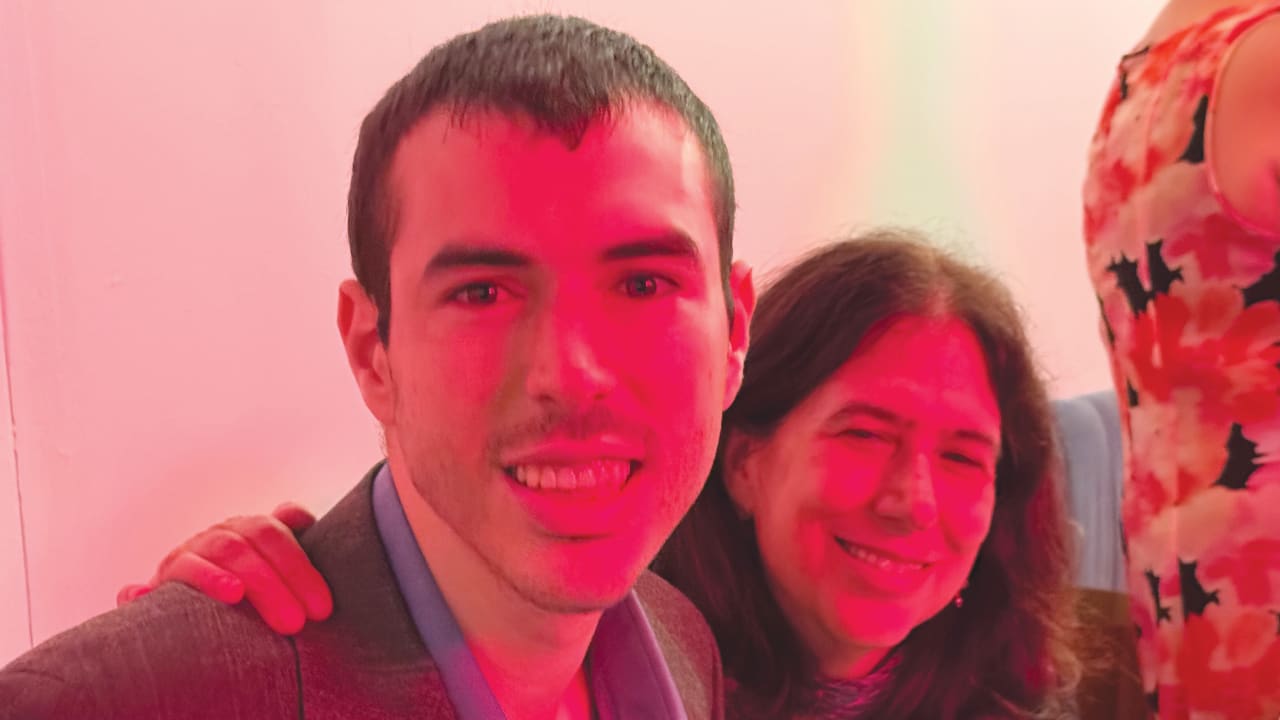
My son, Danny, and I left Israel and traveled to New York and Washington in September for a family wedding, and he had a great time – except when he heard a truck backfire, or the siren of an ambulance or fire engine. His body would tense, and he would get ready to run to a bomb shelter.
Danny, 29, is on the autism spectrum, and when I told him, “There are no missile alerts in America, no missiles,” my words seemed to comfort him. But just for a moment. Soon, he would slip back into a topic that makes up about 20% of his conversation since the war broke out two years ago: “The noise can’t hurt me. It just makes noise. It can’t hurt me.”
This ongoing need for reassurance and the flashes of fear over certain noises were the only signs of lingering tension on an otherwise wonderful trip to America, the first time that he has been stable and healthy enough to travel outside of Israel in 15 years.
The wedding of one of his cousins was the perfect excuse to give him the vacation he has long deserved, in a place that isn’t at war.
He lived in New York until he was four and still loves the city. He knows the subway backward and forward and would be happy to ride it all day, every day; and although it is noisy, he enjoys this kind of noise. He is dazzled by the bridges and the busy streets. He went to the American Museum of Natural History again, and he spent time with family he hasn’t seen for many years.

We traveled by train from New York to Washington, and of course he got to fly to the US and back. He danced at his cousin’s wedding – and miraculously, the bride and groom chose his favorite song, Randy Newman’s “You’ve Got a Friend in Me,” from Toy Story, for their first dance. But even at the wedding, he still asked whether the noise could hurt him – he couldn’t shake the feeling that a missile was about to fall.
Difficulties in understanding the war
DANNY DOESN’T know about any of the issues involved in the war, and he doesn’t ask about them. Abstract concepts are difficult for him; he knows what he can see and hear. He enjoys going to synagogue, for example, because he likes the people and the prayers, but he doesn’t really know what religion is, or that there are different religions.
I don’t think he knows that Jews and Arabs are separate groups, but he does understand – very well – that different people speak different languages, because he can hear them. He knows that English, Hebrew, Russian, and Arabic all have different alphabets, because he can see that in the credits for Toy Story 2, which has credits in all four languages.
And he knows what sirens are, and what to do when they sound. He knows that they mean that something bad is happening or is about to happen. He learned that over a decade ago, during the 2014 war with Hamas. The high school he attended created a presentation that made it clear enough why they needed to run to the shelter, and he became frightened by the sound of sirens.
For a long time, fortunately, there were no sirens. But during the past two years, he has had to run to the shelter more times than I can count. During the week, he lives in a therapeutic village in the center of Israel, and the area was bombed frequently by Hamas in the beginning of the war, by the Houthis about twice a week for months, and by Iran hundreds of times during their two 2024 attacks and the 12-day war in June.
Danny and many (if not most) people on the spectrum thrive on routine, and what could be the enemy of routine more than sirens that sound with no warning at any time of day or night? How many times since 2023 has he had to be hurried to put on his shoes, to stop eating or drawing, to get out of the shower or the pool, and run because of these noises that are part of a conflict he doesn’t understand?
During the particularly difficult time of the Iranian attacks, his anxiety was compounded by the fact that I had taken an ill-timed trip to the US to visit a relative who was sick. Although he doesn’t normally see me during the week, he knew I was away, and my absence upset him.
When we were able to see each other again, about 10 days after the conflict with Iran, he was his old self, with a few small differences. He had trouble falling asleep at home after almost two weeks of sleeping on a mattress in a bomb shelter. And for the first time in years, he wanted me to read him a dozen books at bedtime. When he finally fell asleep, he awakened often with nightmares he couldn’t talk about.
It’s a testament to the devotion and skill of the staff who work with him that he got through that experience and the whole last two years so relatively unscathed. It’s no easy matter to move more than a dozen young people on the autism spectrum to sleep in a communal space amid loud sirens and deafening booms. A few of the residents simply couldn’t make the transition to sleeping in the basement, and staff members were assigned to help them downstairs when the alarms sounded.
As experts remind us often on the news, almost all problems anyone could possibly have can intensify during wartime, such as sleeping-pill dependency and alcoholism, so it’s hard to imagine how destabilizing the events of the war could be on people with autism. Virtually all of Danny’s fellow residents in the village regressed or struggled in certain ways. And the staff, who often had to leave their own families for days on end to help care for Danny and his friends, made this impossible situation as painless as they could.
I’ve heard of other people on the spectrum having far more serious problems during this war, becoming afraid to go anywhere and screaming for hours on end.
One family I know with dual citizenship moved to the US. On our trip to the US, many asked me why I didn’t do the same.
My answer was that although it hasn’t always been easy over the past two years, if we lived in the US, I could never afford anything close to the level of care Danny receives in Israel. A place like the village where he lives, where he works in a carpentry workshop, has art lessons, and creates all kinds of crafts with the support of an extremely caring staff, would cost in the neighborhood of $200,000 per year in America – if I could even get him in; the good places all have long waiting lists. Before the war started, I was approached online several times a year by American-Jewish families of people on the spectrum, asking for advice about moving to Israel, hoping to find better and more affordable living situations for their children.
I certainly don’t regret moving back here when he was in preschool, and he has adapted to the wartime reality, as we all have. He always leaves his shoes in the same place. No matter how tired he is, he gets out of bed when prodded, if a siren sounds when he is fast asleep. At home, we have 90 seconds to get to the bomb shelter, whereas at his village, it’s one minute. But he makes it with time to spare.
Incredibly, he has actually thrived in many ways during this period, despite his increased anxiety level.
He has found balance within himself and has discovered a way to express himself more clearly, both in speech and writing. In an inexplicable turn of events, following the war with Iran, his typing speed and ability to spell words correctly improved by leaps and bounds. He can type 100 words, completely unaided, more quickly than he used to type 50.
He’s become more focused on drawing, and several of his drawings were included in two exhibits of artists from his village at art galleries in Tel Aviv since the war started. He takes pride in talking about these exhibitions, especially because so many friends and relatives came to them.
Even more important, since part of the definition of autism is that those who are on the spectrum supposedly cannot understand and do not care about what others are feeling, he has been helpful in pointing out when his fellow residents start getting stressed out to staff members, especially during the war with Iran. Go figure.
Perhaps most Israelis won’t be surprised by his progress in the face of challenges, because we’ve seen even young children learn to cope. In our building, the children drew a huge picture, with the words “Welcome to our bomb shelter” painstakingly written on it.
At the wedding, though, most Americans wondered why Danny kept talking about loud noises. I found out that all but the most committed Zionists among our friends and family were shocked to hear that missiles were still being fired on Israel. I could see different emotions pass across their faces as I told them. For a second, they wanted to think that I was making it up, exaggerating somehow. Because if this were an ongoing war, if missiles were being fired on Israel a few times a week and nothing they read or listened to reported on it, they might have to rethink their news sources and, perhaps, a good chunk of their worldviews.
And speaking of worldviews, I’m mindful of how lucky my family has been during this war. We haven’t had to endure the loss that so many have. On October 7 two years ago, the Hamas terrorists were finally stopped about 40 minutes away from where Danny lives. While a 40-minute drive is quite far in the context of Israel, in the bigger picture it’s chillingly close.
I think every day of Noya Dan, a 12-year-old girl with autism who was murdered along with her 80-year-old grandmother, Carmela Dan, from Kibbutz Nir Oz. Their bodies were found near the border, and apparently they were abducted and then killed.
I also think of all the people with special needs in Gaza, who understand as little about the war as Danny, but who haven’t had the opportunity to take refuge in a bomb shelter or in the hundreds of miles of tunnels Hamas built only for its own use.
THE NIGHT we returned home to Jerusalem from America, the Houthis were at it as usual. The warning sounded, and then the siren, and there we were in the bomb shelter again.
After a moment of pulling himself together quietly in the corner, Danny got up and chatted with our neighbors, asking people how their pets were.
As the 10 minutes wore on, he also amused himself by looking at pictures of our trip on my phone.
“We took the subway,” he said. “We took the 1 Train. We took the Q. I saw the Brooklyn Bridge. I saw the whale at the museum.”
He had been happy to be there, and he was happy to be back. Except for the noises that I always promise can’t hurt him.