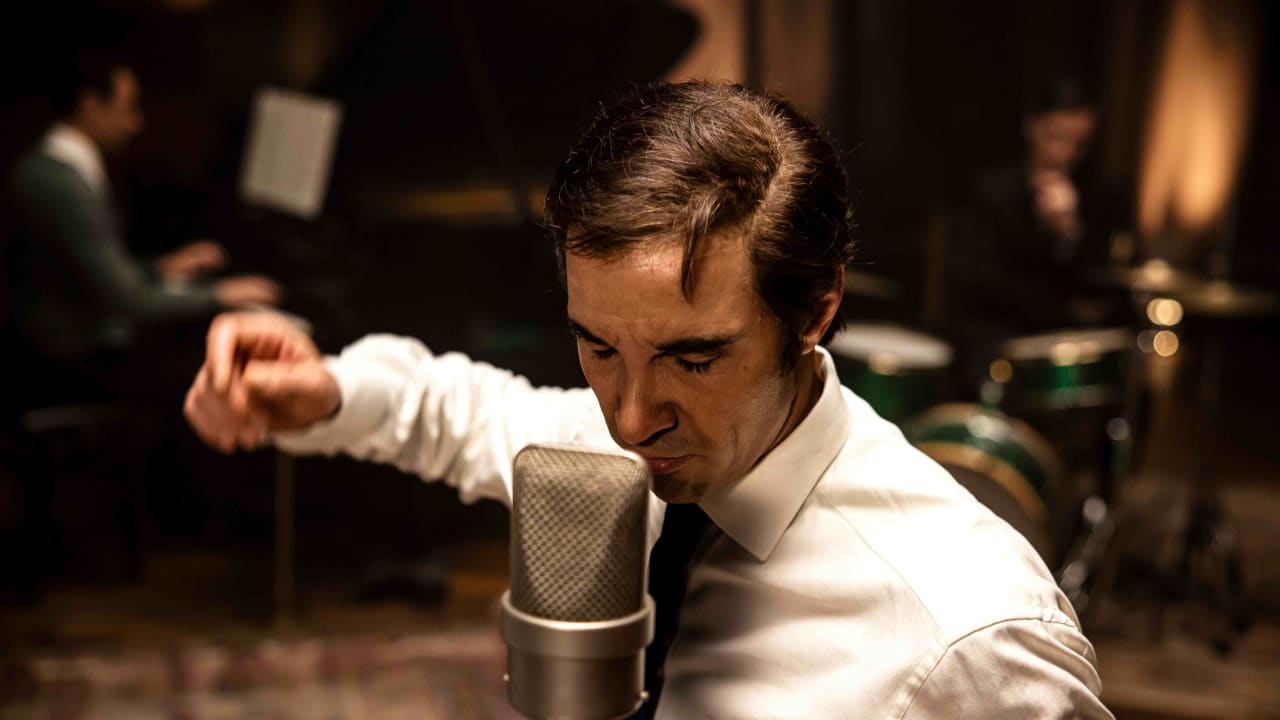
Charles Aznavour was a quintessentially French singer, sometimes called “France’s Frank Sinatra,” whose songs became classics and who sold over 200 million albums. His life story is told in the biopic, Monsieur Aznavour, directed by Mehdi Idir and Grand Corps Malade, which opens throughout Israel on Thursday.
Although he became a French icon, he was born Shahnur Vaghinak Aznavourian to a family of Armenian immigrants and had to fight for every moment of success he achieved, aided by a monumental talent for singing and songwriting, a distinctive stage persona, and a phenomenal drive.
The more you love French music of his peak era – the ‘50s, ‘60s, and early ‘70s – the more you’ll enjoy this movie. But his early life was unusual enough that the movie will be fun for those who don’t know his work.
As is so often the case in biopics, the first half, which details the crooner’s childhood and his struggle to break into the music business, is more fun than the second half, which focuses on how he wants even more fame and shows how he neglected many of the women and children in his life in his single-minded climb to the top.
Tahar Rahim, a French actor from an Algerian family known for A Prophet and The Mauritanian, gives a credible and appealing performance in the lead role, emphasizing the singer’s quirky stage persona without imitating him too closely. He also does a fine job singing the Aznavour tunes, and he reportedly rehearsed for a year to bring Aznavour’s voice and mannerisms to life. The film features full performances of many of his classic tunes, including “La Bohème” and “Emmenez-moi.”
In the early part of the movie, Aznavour is played by child actor Norvan Avedissian, and we see how Aznavour grew up in a poor but joyful family of Armenian immigrants to France, in a home where they took pride in their traditions, especially music and cooking.
He quickly found his way to performing in children’s theater, reveling in the money he could bring home but also simply enjoying the experience of captivating an audience. His sister, Aida (Camille Moutawakil), was also a performer, and she became his lifelong best friend.
During the dark days of the Nazi occupation, when Aznavour was a fledgling cabaret performer, he was sometimes mistaken for a Jew, and he and his family risked their lives to hide Jews in their home. Although the film does not detail this fact, he and his sister received the Raoul Wallenberg Award for their wartime activities and received a commendation from former president Reuven Rivlin in 2017.
Aznavour was very popular in Israel, and his songs were often played on the radio – and still are on oldies shows. He performed in Israel several times, including in a peace concert in 2013 with Achinoam Nini, at an event attended by president Shimon Peres. He took stands on political causes, opposing far-right political parties, and was proud of his Armenian heritage, raising money for Armenia after an earthquake.
Criticized early on for being short, not conventionally handsome, and for having a husky voice, Aznavour proved to be a versatile performer and composer, teaming up with the less driven, fun-loving Pierre Roche (Bastien Bouillon).
The two caught the eye of diva Édith Piaf (Marie-Julie Baup), who instantly singled Aznavour out for having come up from poverty, as she did. She alternately supported, promoted, and tormented Aznavour, who eventually went on to a solo career. Along the way, with her encouragement, he left his first wife and ignored his daughter with her, only to connect later in life with a son he had out of wedlock.
Once he makes it to the big time, it’s not that fascinating to see him scheme to make it even bigger. Eventually, he falls for a Swedish model and achieves as much domestic bliss as anyone so concerned with success can. No matter what happened in his personal life, he continued recording and performing.
Aznavour's acting career
The film’s key omission, and it’s a big one, is his acting career. For about 30 seconds, we see how he starred in Francois Truffaut’s second movie, Shoot the Piano Player, in 1960, but that’s it. You would never know from this movie that he appeared in more than 80 films or that his performance in Shoot the Piano Player won raves.
Although he portrayed an Armenian pianist, he did not sing in the movie and relied on acting talent alone, and the movie helped establish Truffaut as a talent to be reckoned with and not just a one-hit director.
Aznavour played the same character years later in Atom Egoyan’s Ararat, a movie that dealt with the Armenian genocide. He appeared in many other high-profile films, including The Tin Drum, Ten Little Indians, Candy, and The Adventurers, not all of which were hits. While Aznavour clearly saw himself as a singer first and foremost, he spent quite a chunk of his life on movie sets.