
Which item is among the most commonly shoplifted objects in Israeli supermarkets? Expensive wines from the store’s liquor section? Perhaps shoppers are trying to sneak out choice cuts of meat under their coats? Or maybe it’s a box of fine Swiss chocolates that customers are trying to spirit out of the store?
The answer may surprise you.
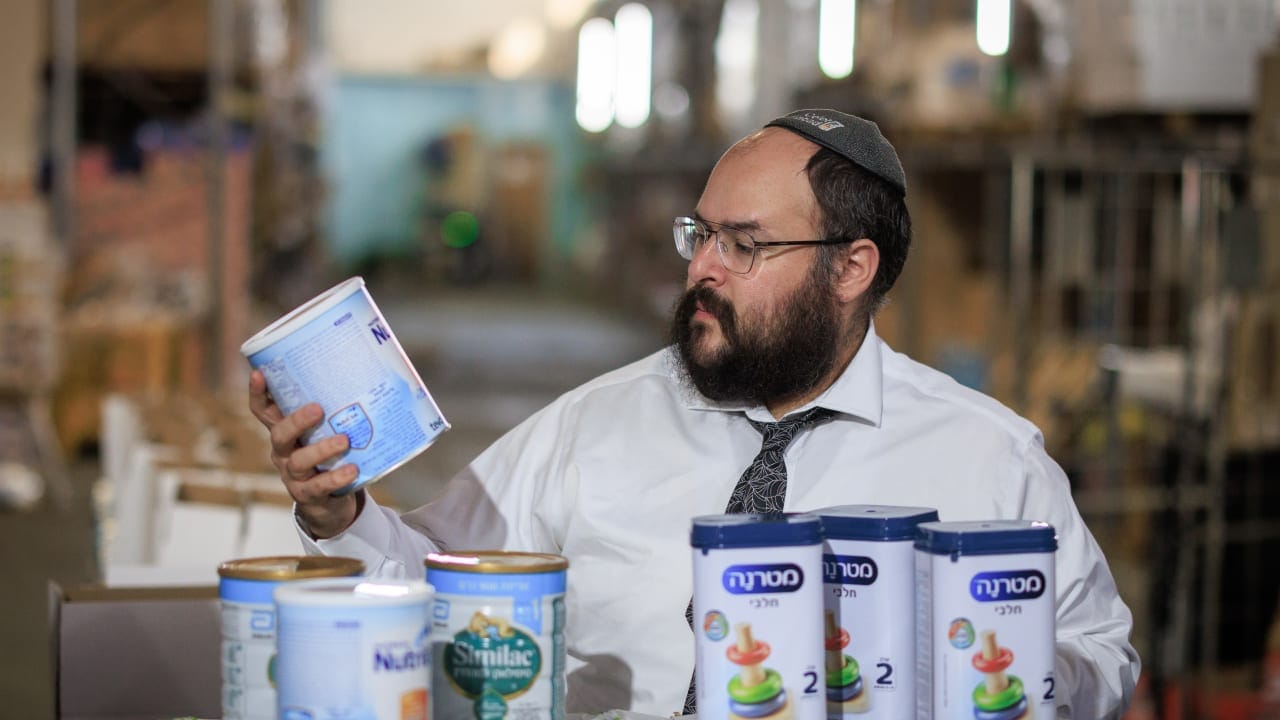
The item that is most frequently targeted for theft from Israeli stores is infant formula. That’s right, those ubiquitous multicolored tins that contain powder made from cow’s milk, whey, or soy protein, blended with carbohydrates, vitamins, and other ingredients, that are designed as a substitute for breast milk for infants and babies. Many supermarkets and drugstores in Israel now store infant formula behind locked cases near the cash registers.
Infant formula is not inexpensive. In May, Osem-Nestlé announced a 7% price increase for infant formula, attributed to rising costs of raw ingredients and packaging. Individual 700-gram containers of infant formula, such as Materna Gold or Similac Gold, are priced at NIS 79.90 in Israeli supermarkets and have become a significant expense for families struggling to make ends meet. While newborns require less formula, a six-month-old infant will consume between 600 and 800 grams of formula per week.

“Baby formula is something that affects working mothers most,” says Zalman Duchman, managing director of Colel Chabad. “Economically, they have no choice; they must return to work,” he explains. “Baby formula is a recurring expense.”
While poverty and food insecurity are frequently considered in terms of their effect on adults, the impact is equally significant for children. According to the 2023 poverty and inequality report from Israel’s National Insurance Institute (Bituah Leumi), 872,400 children lived below the poverty line.
Children account for 32.5% of the Israeii population, yet they represent 44% of all individuals living in poverty in the country. The report notes that internationally, Israel ranks second-highest among developed nations in child poverty, just after Costa Rica, and far above the OECD average.

Duchman notes that the high cost of baby formula in Israel does not mean that mothers in economically challenged households are starving their children. Many times, he explains, they provide smaller amounts of formula in each bottle that they prepare for their child as a tactic to extend the use of the formula.
“If the formula recommends mixing the water with three scoops, they may put in two and a half scoops of formula, which will gradually have a negative effect on the child. The cutback is gradual and has a cumulative effect.” Mothers may not notice an immediate effect from providing a reduced amount of formula to their children, but ultimately it will have an impact on them.
According to the World Health Organization (WHO), under-nutrition is estimated to be associated with 2.7 million child deaths annually, or 45% of all child deaths. The WHO states that infant and young child feeding is a crucial area for improving child survival and promoting healthy growth and development.
The first two years of a child’s life are particularly crucial, as optimal nutrition during this period can lower morbidity and mortality, reduce the risk of chronic disease, and promote overall better development.
Duchman adds that the effect of under-nourishing a child by 15% to 20% can have a major impact on brain development and other developmental challenges. “For us, ensuring that parents have an adequate, consistent, and reliable source of infant formula goes far beyond the financial impact.”
ADDRESSING THE issue of the high cost of infant formula in Israel, Colel Chabad, which is the oldest continually operating charity in Israel, has partnered with the International Fellowship of Christians and Jews, the Iranian American Jewish Federation of New York, the Blavatnik Food Bank, and the Ted Arison Family Foundation to provide infant formula to working mothers in Israel.
This initiative is part of Colel Chabad’s National Food Security Initiative, which it conducts in cooperation with the Welfare and Social Affairs Ministry.
“As a mother, I can’t imagine the heartbreak of not being able to feed your baby properly,” says Lin Meir-Drori of the Iranian American Jewish Federation of New York. “Colel Chabad’s Baby Formula Project ensures that no mother in Israel ever has to face that nightmare alone. We’re honored to partner in this sacred mission.”
Every month for the past four years, eight delivery trucks from the Chabad logistics center in the southern moshav of Be’er Tuvia fan out throughout the country, delivering infant formula to 3,150 families in need, as designated by the Welfare and Social Affairs Ministry.
Tzvi Blau, logistics manager for the program, says that every family receives a carton containing five 700-gram containers of formula, one for each child. Blau estimates that 30% of the deliveries are to single-parent families. As with Chabad’s other Food Security Initiative programs, the plan is available to all Israeli citizens, Jewish and non-Jewish alike.
There are approximately 30 brands of infant formula in Israel, and recipients of infant formula from Chabad can choose the type of formula they receive, or switch to a different brand, via an app or phone call. Families are eligible to receive the infant formula for a period of 18 months.
Discussing the most important parts of the initiative, Duchman says, “The first point is that we’re talking about the poorest of the poor – the most vulnerable people in society. Many of them are working mothers, from all groups and denominations.”
He explains that the program is not a dollars-and-cents distribution of financial aid. “We are giving them infant formula to make sure that their children receive the proper nourishment they need. It will have a very strong, long-term impact on the child’s growth.”
Duchman emphasizes that the program’s goal is to provide proper nourishment as part of Colel Chabad’s Food Security Program. “Parents can supply 75% to 85% of the nutrition for their children. We need to provide them with the extra 15%. If we can do this, we will, in the long run, be saving thousands of shekels because the children will develop normally.
“The key is making sure that the child gets that extra 15% to 25% of baby formula,” says Duchman. “Think about the impact that can make 20 to 30 years from now. We believe that from a charitable perspective, this is the most effective use of our funds. Providing babies with proper nourishment helps them in their development. Better nourished babies become properly nourished toddlers. Better toddlers become better students, and better students become functioning members of society.”
The mother of a 13-month-old baby who receives formula through the Colel Chabad program wrote, “Until we received the Materna infant formula, we hadn’t been giving it to our son. Instead, we gave him milk, fruit, and other foods. However, now we give him Materna at night before bed, which he absolutely loves, and it also significantly strengthens him. We can see the improvement in practice.
“His developmental therapist also noticed the progress and attributed it to her exercises; the truth is, it’s due to both. We simply didn’t have the money to buy him Materna – there are so many monthly expenses, so we gave him everything except the formula. But there’s nothing like Materna before bedtime; he really enjoys it.
“Thank you so much; you’ve truly made us happy.”
This article was written in cooperation with Colel Chabad