
Forty-four women have been murdered in Israel since the start of the calendar year, 32 of whom were victims of femicide – the intentional killing of a woman or girl because of her gender – data from the Israeli Observatory on Femicide, published on Thursday, shows.
The tragic trend experienced a sharp rise in 2025 compared to 2024.
The IOF, based at the Hebrew University of Jerusalem and headed by Prof. Shalva Weil, explained that the 12 deaths not categorized as femicide were the result of criminal activities, and that of the 12, nine were from the Arab sector.
The report calls for modernizing Israeli law with dedicated legislation against femicide, an offense not yet recognized independently and still lacking adoption of the Istanbul Convention.
It recommends establishing a national observatory to centralize data, conduct ongoing monitoring, and coordinate policy efforts.
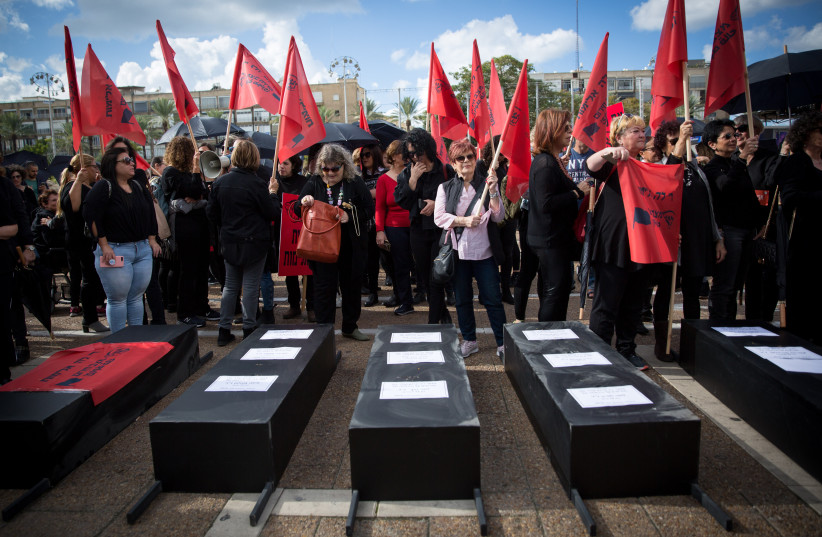
The findings also stress the need for a nuanced understanding of femicide, noting that motives in Jewish and Arab communities often differ and should not be treated as a single category.
Finally, it urges comprehensive firearms reform: while licensed weapons are not a major factor, reducing illegal firearms is expected to significantly lower femicide rates in the Arab sector, whereas the Jewish sector requires a separate, tailored assessment.
The data was collected from the beginning of the year until this past Tuesday and was released ahead of the International Day for the Elimination of Violence against Women, which is annually marked on November 25.
At this time last year, 37 women had been killed, 20 of which were characterized as femicides.
Ethnic trends in femicide in Israel
Further broken down, among Jewish women, the victim count was higher: 18 this year, compared to eight last year.
In the Arab sector, 2025 saw 13 murders, while 2024 saw 11. Matricide – the act of killing one’s own mother – accounted for six cases (20%), compared to two last year.
As well, in most cases, the assailant was found to be from the same ethnic origin, save for two murders that were carried out by foreign workers.
In terms of execution, 14 women were killed by firearm, 12 by knife, and six cases included different forms. Out of the four murders of Jewish-Israeli women, three were carried out using a registered automatic weapon.
Weil commented, “The ongoing rise in the killing of women, and especially cases of femicide, requires us to act quickly in order to fight it effectively.
“Legislative changes and signing the Istanbul Convention should be the first steps, but they are not enough. This demands a systemic response at every level in order to bring about real change.”
Jerusalem Post Staff contributed to this report.