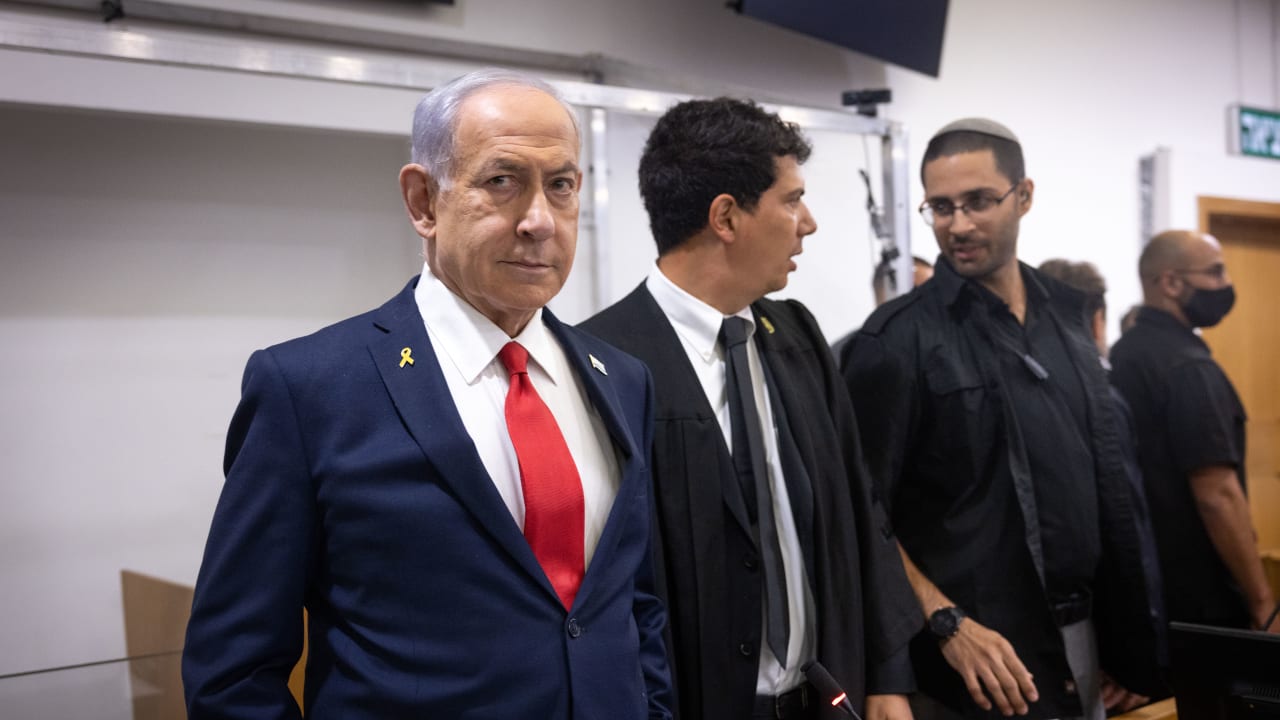
The hearing in the criminal trial of Prime Minister Benjamin Netanyahu opened at the Tel Aviv District Court on Monday, amid global tensions surrounding the crisis in US-Iran negotiations.
The hearing began with a closed-door session, moved to public testimony, and ended early at 12:45 p.m. Netanyahu was expected to convene a security meeting on Monday afternoon, as Israel continues to closely monitor developments that could carry significant implications for regional security and tensions with Tehran.
The closed-door portion of the hearing reportedly dealt with Walla publications relating to Netanyahu’s son, Yair Netanyahu.
During the public portion, prosecutor Yehudit Tirosh continued questioning Netanyahu in Case 4000 (the Bezeq-Walla affair), the central case in his criminal trial and the only one in which he is charged with bribery.
Prosecutors allege that Netanyahu, while serving as communications minister, advanced regulatory decisions beneficial to Bezeq, then controlled by businessman Shaul Elovitch, in exchange for favorable coverage on Walla, which Elovitch also owned at the time. Netanyahu denies the allegations and has repeatedly argued that the cases against him are politically motivated.

Netanyahu says the cases against him are politically motivated
Tirosh questioned Netanyahu on what he knew in late 2016, when reports first emerged that an investigation was underway regarding his ties with Elovitch.
At the time, Netanyahu and those close to him reportedly raised several possible names in connection with the probe, including Elovitch. The possibility was linked, in part, to an earlier State Comptroller’s examination under then-comptroller Yosef Shapira.
Tirosh argued that there was no reason Netanyahu should have thought the investigation involved Elovitch unless he “knew well” that he had not fully disclosed the nature of his relationship with Elovitch and the instructions he had allegedly given to then-Communications Ministry director-general Shlomo Filber regarding Bezeq.
“Both things are false,” Netanyahu responded. “I did not hide, and I did not instruct. The fact that the comptroller examined it does not mean there was any flaw in my relationship with Elovitch.”
Tirosh pointed to a gap between Netanyahu’s police interrogation and his testimony in court, noting that he did not raise Elovitch’s name during the police investigation, but did so during his direct examination seven years later.
Netanyahu said his memory had been refreshed ahead of his testimony.
“They refreshed my memory before the direct examination,” he said. “I remembered that there had been a State Comptroller investigation regarding Elovitch, and it could certainly be that, even though there was no flaw there, they could have raised it.”
Tirosh also cited the testimony of former Netanyahu aide Nir Hefetz, according to which Netanyahu sat with attorney Yossi Cohen for several hours and tried to obtain information about the list of possible names tied to the investigation. Netanyahu said he did not remember such an incident.
Tirosh accused Netanyahu of adopting a tactic in investigations in which he says he does not remember when he does not know what evidence investigators have, and then adjusts his version after stronger evidence is presented.
“That is nonsense,” Netanyahu said. “I say what I remember.”
When pressed on how seriously he had considered the possibility that the investigation involved Elovitch, Netanyahu said, “It was one of the possibilities. In my case, there is no limit to the madness.”
When Tirosh noted that Netanyahu had previously said in his direct examination that he thought the Elovitch possibility was a joke, Netanyahu said he did not remember exactly what he had said, adding, “There are a few other things occupying me.”
Tirosh also referred to Filber’s testimony, according to which Netanyahu called him and asked whether they had done anything improper regarding Elovitch. Netanyahu said he did not remember such a conversation.
When Tirosh quoted portions of Filber’s testimony suggesting that Netanyahu believed he may have been involved in something improper, Netanyahu called it “a complete lie.”
Tirosh argued that Netanyahu later used explanations Filber had allegedly given him, including that the Communications Ministry had acted according to the recommendations of the professional echelon. Netanyahu responded that all the checks reached the same conclusion, and therefore, that was the truth.
Netanyahu again denied that he had intervened in professional decisions relating to Bezeq and rejected the prosecution’s broader theory in Case 4000.
“I did not interfere whatsoever in the decisions of the professional echelon,” he said. “I did not receive favorable coverage from Walla, but terrible coverage.”
At one point, the hearing was interrupted after Otzma Yehudit MK Almog Cohen, who was present in the courtroom, shouted at Tirosh and called her “amateurish.” Judge Rivka Friedman-Feldman ordered him to be removed. As he left, Cohen also made remarks toward the bench.
The Case 4000 cross-examination is nearing its final stretch. Cross-examination in Case 2000, which concerns Netanyahu’s conversations with Yediot Aharonot publisher Arnon Mozes, is expected to follow.
Netanyahu was indicted in 2019 and began testifying in December 2024, becoming the first sitting Israeli prime minister to take the stand as a criminal defendant. Cross-examination began in June 2025, after months of direct examination by the defense.
Beyond Case 4000, Netanyahu is charged in Case 1000 with fraud and breach of trust over allegations that he received gifts from wealthy businessmen, and in Case 2000 with fraud and breach of trust over alleged discussions with Mozes concerning favorable coverage.
He denies wrongdoing in all three cases.