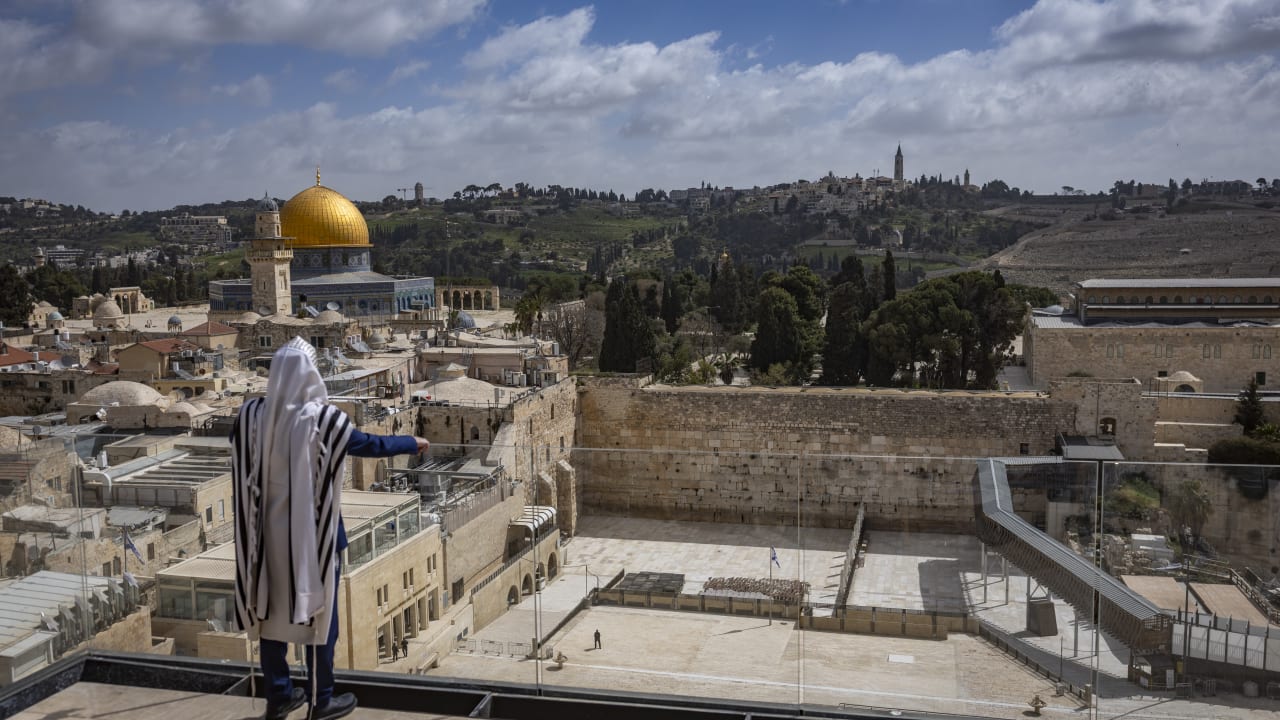
The High Court of Justice on Sunday raised the number of worshipers allowed at the Western Wall from 50 to 100, while also keeping alive a broader challenge to the state’s wartime policy for holy sites and ordering a further hearing later this week.
In a decision issued after Sunday afternoon’s hearing, the court gave binding force to the state’s updated arrangement increasing the cap to 100 worshipers, effective immediately. It added that because entry to Wilson’s Arch continues throughout the day, with one group entering as another leaves, the practical result is that hundreds of worshipers, if not more, will be able to access the site daily, subject to the instructions of the relevant authorities.
At the same time, the judges made clear that the broader issue is not over. They issued a conditional order requiring the respondents to explain why they have not set a policy for holy sites that balances security needs with freedom of religion and worship. A further hearing was set for Thursday morning, with the state’s response due by Tuesday.
The court did not fully accept the state’s threshold argument either. Although it said the petitioners appeared, on its face, not to have exhausted proceedings and had acted with delay, it declined to dismiss the petition outright because of the sensitivity of the issue.
The petition had sought much more. Filed by Emet LeYaakov, a public-benefit company associated with haredi (ultra-Orthodox) public-interest advocacy, and Jerusalem resident Israel Gafner through attorney Natan Rosenblatt, it asked the court not only to raise the number of worshipers permitted at the Western Wall plaza, but also to allow prayer in the Western Wall tunnels, open protected and covered spaces in the area for public worship, and require the authorities to apply the rules equally to prayer gatherings and other assemblies.

The case was brought a day after the High Court intervened in the dispute over Saturday night’s anti-war protests, criticizing the Home Front Command’s framework and later ordering the state to allow demonstrations at all four sites at issue in that case, with no fewer than 150 participants at each and no fewer than 600 at Habima Square. In that ruling, the justices also criticized what they described as enforcement of Home Front Command instructions against protest demonstrations, but not against other gatherings.
Western Wall plaza lacking protected spaces
In Sunday’s filings, the state said a prior Home Front Command tour of the site found only two protected spaces near the Western Wall plaza, each capable of holding only a few dozen people, and that both are located in the offices of the Western Wall Heritage Foundation rather than in the prayer plaza itself. It said the Western Wall tunnels and other underground spaces had been examined but found not to be protected, and that remaining there during a missile attack could put those inside at heightened risk.
The state also said that under the previous arrangement, 50 worshipers at a time were allowed into Wilson’s Arch, with additional worshipers entering as others left, meaning hundreds could pray there over the course of a day. After a fresh review Sunday morning, it said, Home Front Command concluded that a limited exception could be made there for up to 100 people, including both visitors and staff, in areas with access to a proper protected space.
The hearing suggested why the judges chose that narrower immediate step while keeping the broader issue open. Supreme Court President Isaac Amit said that while Home Front Command bears responsibility, administrative law still requires balancing, even in prolonged wartime.
He added that freedom of religion and worship is fundamental and that seeing the Western Wall empty during the Priestly Blessing had been “embarrassing.” Justice Yechiel Kasher pressed the state on where the balancing with fundamental rights had taken place, while Justice Ruth Ronen indicated that the more realistic immediate question was not opening the tunnels, which Home Front Command described as dangerous, but whether the number of worshipers allowed could be made more flexible.
The filing also included two letters from Western Wall Rabbi Shmuel Rabinovitch. In one, sent Saturday to Home Front Command, he argued that if large protest gatherings were being allowed, prayer at the Western Wall should be permitted on at least similar terms. In a second letter Sunday to the High Court, he appeared to back a more limited updated arrangement, saying Home Front Command had reexamined the issue and found it possible to allow entry of up to 150 people at a time at several protected points near the site, together with dozens more in additional spaces.
Sunday’s ruling therefore gave immediate effect to the 100-person framework, but also transformed the case into something broader: a live High Court challenge to how the state sets wartime policy for holy sites, and how that policy is meant to balance security with freedom of religion and worship.