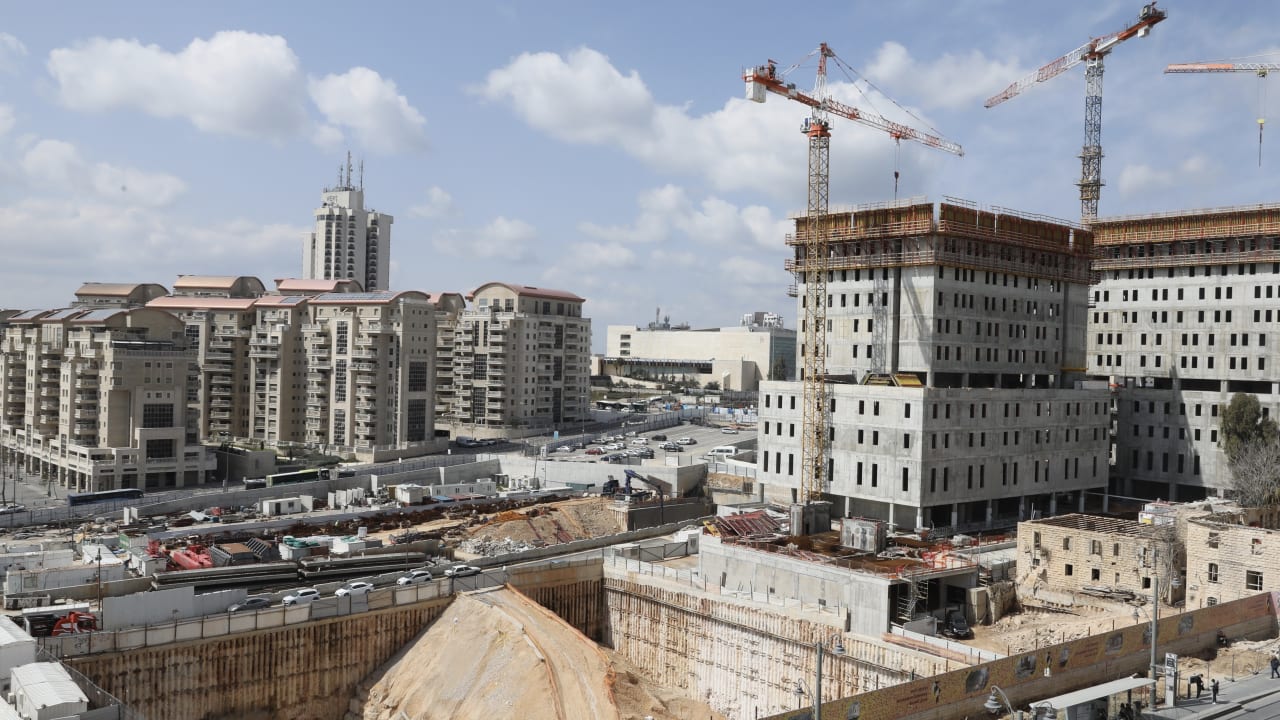

Business has been seriously affected by construction at the King George-Jaffa-Strauss intersection. On Jaffa Road, a whole row of shops was closed and emptied without warning, and another store, which for years has been crowded with customers, was in the process this week. Some merchants along King George have also vacated, as have some on Hillel Street.
Building frustration: More construction in Jerusalem
■ IN ADDITION to light rail construction, there is so much hotel, residential, and office construction, that sidewalks have become narrower as protective fencing is put up around the scaffolding.
On many streets, cars are parked on the sidewalk, and scooters and bicycles have become so common that it is simply unsafe for pedestrians. Traffic violations are rampant, with motorcycle, bicycle, and scooter riders often ignoring traffic lights, which poses yet another threat to pedestrians. Owners of these vehicles also ride along the light rail tracks, as do some cars. This is illegal, yet it goes unchecked. Where is law enforcement?
Give public officials water guns
■ ATTACKS ON public officials in Jerusalem by haredi draft dodgers do attract police attention, but there are insufficient deterrents. Every public official should be equipped with a water pistol filled with indelible liquid, so that when attacked, they can shoot, thereby staining the assailants and making it easier for police to locate individuals who are violent disturbers of the peace. It’s certainly a much less risky method of self-protection than that advocated by National Security Minister Itamar Ben-Gvir, who wants to increase the number of people licensed to carry guns with live ammunition.
An overdose of positivity
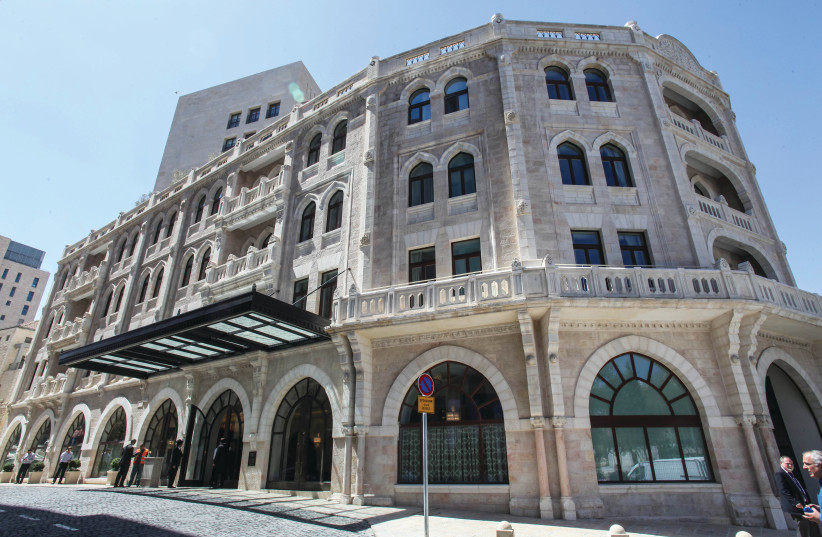
■ OPTIMISM IS a positive trait, but building luxury hotels in a city in which tourism is at a low ebb, and where war and politics have driven tourists away, indicates an overdose of positive thinking. There are at least three luxury hotels in which construction is nearing completion. The largest is the Intercontinental on the edge of Independence Park, across the road from the National Institutions complex housing the Jewish Agency, World Zionist Organization, Jewish National Fund, and Keren Hayesod. The Intercontinental is bound to take business away from some of the nearby luxury hotels, firstly because the natural inclination of many people is to try something new; and secondly, because of its proximity to major Zionist organizations and to the Yeshurun Synagogue and Jerusalem Great Synagogue, as well as the synagogues of Chabad, and the Conservative and Reform movements. The trend for hotel investors is to build a residential complex alongside, which the owners of the Intercontinental have done, as did the original owners and developers of the Waldorf, and the current owners of the Theatron hotel. The hotel services are available to the owners of units in the residential buildings. Some of the residences are permanently occupied, while others are either holiday homes for the owners and their relatives and friends, or investments that are rented out, offering more room and privacy than a hotel suite. The Intercontinental is due to open in the first quarter of 2026.
Although tourists are scarce, American and British students are not. On buses and on the light rail, one can hear a lot of English spoken, mainly by young people of student age.
Winter is here
■ YOU KNOW that winter has arrived when you travel along Agrippas Street late at night and see that, with maybe one or two exceptions, all the eateries are closed, and even those that are open have less than a handful of customers. Change can be very sudden. In the first half of November, the street was full of young people late at night. Restaurants were well patronized, and there were lines of would-be diners waiting for tables to be vacated. But this week, the street was dark and empty at 10:45 p.m., and had probably been that way for a few hours, as most of the restaurants in the area remain open until the last customer leaves.
What will happen to social spaces?
■ SOCIAL SPACE has become an important community asset. It is used for meetings, religious services, dance and yoga classes, art exhibitions, and more. Among the better-known social space facilities are the former Shaare Zedek Hospital on Jaffa Road and the former President Hotel on Ahad Ha’am Street. Both may cease to be in the social space category when their owners decide that the time is ripe to build a hotel-cum-residential complex. But for the time being, each building is serving as an important community asset.
With the increase in mental health challenges, especially those cases that are being treated on a voluntary basis, more social space facilities are needed. The most recent to be acquired is in Efrat, which this month inaugurated a new therapy yurt. A yurt is a portable circular hut traditionally used by the nomads of Central Asia, which is easily assembled and collapsed. The new wood-lined yurt that forms part of the Mondlak Center in the Rimon neighborhood is a warm and inviting space designed for group therapy activities, yoga, and martial arts sessions for individuals coping with mental health problems. The yurt was officially opened by its sponsor, Igor Tulchinsky of New York, together with Rabbi Efraim Duchman from Kollel Chabad, in the presence of Mayor Dovi Shefler; Yonatan Marcus, chairman of the Efrat Foundation; and Ryan Levin, the foundation’s CEO.
Mondlak’s chief clinician, Dr. Aliza Bir, described the work of Efrat’s Community Resilience Center and its crucial role in supporting local soldiers and their families. She noted that many individuals affected by the war are experiencing PTSD symptoms, creating a significant surge in demand for therapeutic services offered by the center.
Tulchinsky, a venture capitalist and philanthropist originally from Belarus and now based in New York, dedicated the therapy yurt to Israel’s heroes. He emphasized the importance of helping IDF soldiers and their families to heal, and described “the war after the war” that is being fought by therapists, volunteers, and by soldiers and their families who are learning to breathe again. He defined the domed yurt building as “Israel’s inner Iron Dome,” emphasizing that healing is an essential component of Israel’s national security. “Just as we train our soldiers to run toward fire,” he said, “we must train our citizens to run toward healing with the same courage. Every survivor who stands back up again declares to the world: “You can wound us, but you will never break us!”
greerfc@gmail.com