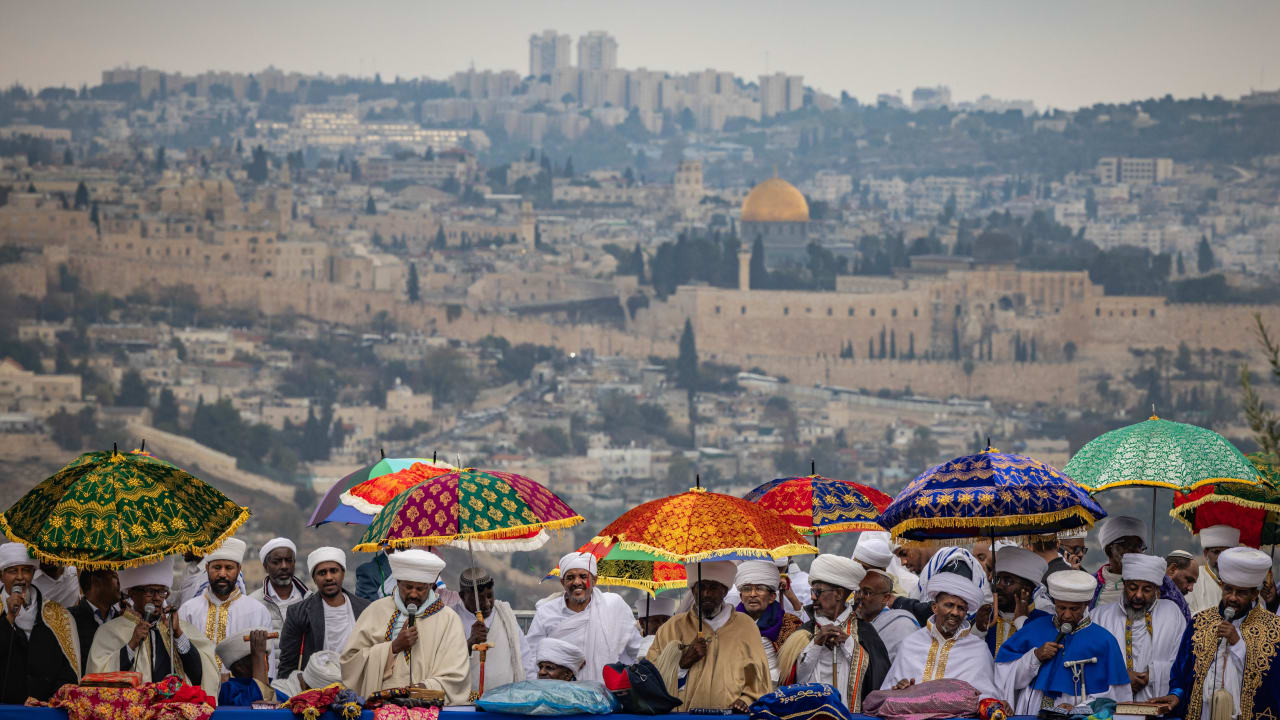
For MK Moshe Solomon (Religious Zionism), the Sigd holiday is far more than just another date on the calendar or a folkloric event. It is the living bridge between the child who immigrated to Israel through Sudan in 1983 after a grueling three-year journey, and the elected official who now sits in the Knesset in Jerusalem.
“On Sigd, there is a special dimension of dreaming, of yearning for Jerusalem,” Solomon says in a special interview with Maariv. As a child, he wondered why only the Ethiopian Jewish community observed this day. The answer, he explains, lies deep in the Bible, in the Book of Nehemiah (chapter 9), which describes the renewal of the covenant by the returnees to Zion: “On the twenty-fourth day of this month the Israelites gathered, fasting and wearing sackcloth, with earth upon them.”
“The only community that preserved this commandment for 2,500 years is the Ethiopian Jewish community,” says Solomon. “While other communities were dispersed in exile and lost the practice, we kept it meticulously.”
Solomon describes the Sigd in Ethiopia as both a spiritual and physical event. Preparations began weeks in advance, similar to the preparations for Shavuot. On the day of the holiday itself, the community would ascend a high mountain — a symbol of Mount Sinai and of longing for the highest and most distant place: Jerusalem.
“The day was divided into three parts. The first part was devoted to soul-searching, climbing the mountain, sometimes with a stone on the head as a sign of mourning and submission, and reciting prayers such as ‘We have sinned, we have transgressed.’ The second part was the renewal of the covenant — reading from the Orit (the Torah) and reinforcing Jewish identity in the face of the danger of assimilation in the remote villages. And the third part, at midday and after the fast, was the descent back to the village for a festive mitzvah meal," he said.
What is Sigd?
One of the interesting points Solomon highlights is the essential difference between Yom Kippur and the Sigd.
“Yom Kippur is a personal day — a person before his Creator and his fellow human beings," Solomon said. "Sigd, which is celebrated exactly 50 days after Yom Kippur, is a communal day. On this day we pray for the unity of the people, not just the individual. The correction is collective.”
When Ethiopian Jews immigrated to Israel in the 1980s, a dilemma arose: Should the holiday of longing for Jerusalem continue to be celebrated once the community had already arrived there? “
The kesim (spiritual leaders) and the community leaders decided to continue,” Solomon explains, “because the Temple has not yet been rebuilt, and the unity of the Jewish people is still incomplete.”
Today, the holiday is celebrated in two major locations: on the Armon HaNatziv Promenade, overlooking Jerusalem and reminiscent of the mountain in Ethiopia, and at the Western Wall Plaza.
This year, the Sigd celebrations at the Western Wall are expected to be especially emotional. Solomon reveals that the central ceremony will include the use of a rare historical artifact: a 400-year-old Torah scroll (Orit) taken out especially from the genizah of the National Library.
“We are bringing out a scroll that has been passed from father to son for hundreds of years,” Solomon says with excitement. “It carries a simple message: we are not the owners of the Torah — we are just one link in the chain of generations. We received tradition and history, and our role is to pass them on. This scroll symbolizes eternity and continuity.”
The conversation with Solomon naturally flows from ancient tradition to Israel’s burning contemporary reality. He sees in the values of the Sigd — unity and a shared covenant — a key to resolving the current crises in Israeli society.
“The more division there is, the more powerful the holiday becomes,” he argues.
“As Deputy Speaker of the Knesset, I try to work for statesmanship. Everyone must correct their ways. The difference between me and a person in the street is that I am an elected official, and so my words resonate more. Our responsibility is to speak with restraint.” Solomon emphasizes that he is willing to dialogue with any Zionist camp, right or left, and recalls his past acquaintance with Yair Golan from their military service in the Northern Command.
On the draft law and tensions with the Haredi public, Solomon presents a nuanced but firm position. “I support a draft law,” he declares. “The Haredi public cannot return to the mindset of October 6. They must take their share of partnership with both hands.” The path forward, he says, is a combination of support and sanctions: “We need to embrace, but anyone who does not comply — there will be clear consequences. In the end, I believe the law will pass because there is no other choice.”
Solomon wishes to deliver a message to all of Israeli society before the holiday, not only to Ethiopian-Israeli Jews.
“My message from the Sigd is that we must break free from the mindset of division. Each of us must relinquish a bit of ego and absolute righteousness for the sake of the collective. Without that willingness to compromise, without a broad view of the needs of the nation, we risk heading toward ruin — and our enemies, like Sinwar, are waiting for exactly that moment.”
The Sigd celebrations are an open invitation for every Israeli to come to Jerusalem, to the Western Wall or to the Armon HaNatziv Promenade, and to experience a moment of elevation above everyday disputes.
“We are the chain of generations,” Solomon concludes, “and we bear the responsibility to protect this home together.”
The main Sigd ceremonies will take place this coming Thursday, the 29th of Cheshvan, at the Western Wall Plaza and the Armon HaNatziv Promenade.