It's not unusual for a nurse who does not work in the maternity department of a hospital to help deliver a baby. After all, pregnant women cannot always plan when they will go into labor, and if a woman’s water breaks at a social event or when she’s shopping in the supermarket and a nurse happens to be on hand, she will obviously be the one to deliver the baby if the mother rapidly goes into labor. But it’s much more unusual for the nurse to be a baby’s surrogate mother.
When Pnina Cohen had her first child through natural childbirth, she could hardly wait to get pregnant again.
Pnina and her husband were eager to have a large family, but it was not to be, at least not in the way they’d dreamed. Pnina has a rare medical condition that prevents her from carrying an embryo for a sustainable period. After two stillbirths and five miscarriages, she realized that something must be wrong because all of her pregnancies were terminated before they reached full term.
She consulted many specialists and underwent numerous treatments, but nothing worked. Prof. Simcha Yagel, her physician at Hadassah-University Medical Center on Jerusalem’s Mount Scopus, suggested that she should think of having a baby via a surrogate. She was initially reluctant, but in the final analysis, Pnina reached the conclusion that this was the only way to expand her family.
She posted a message on Facebook, explaining why she was looking for a surrogate. Her story resonated with a nurse at Hadassah, who offered to be her surrogate, and the process was initiated very quickly.

There was instant chemistry between Pnina and the nurse, but based on her own previous experiences, she worried that the baby might not survive, and she occasionally had doubts about whether she had made the right decision. But everything went smoothly, and there are now two sons in the Cohen family.
Pnina is grateful that none of the people who treated her at Hadassah gave up on her but simply looked for solutions. While waiting at the hospital for the baby to be born, Pnina and her husband were supported by Hadassah social worker Tamar Attias, who was just as excited as they were when the baby, whom they named Daniel, arrived.
Pnina was in the delivery room and received as much attention from the professional staff as was given to the nurse who enabled Pnina to go home with a beautiful baby boy.
Election of the first Muslim mayor in NYC
There's a first for everything. John F. Kennedy, whose assassination will be commemorated later this month, was the first Catholic US president. Barack Obama was the first African-American US president. Henry Kissinger was the first Jewish Secretary of State of the US, though Jews have been elected and appointed as officials in state and federal bodies since as far back as 1774, when Francis Salvador of South Carolina became the first Jewish member of a colonial legislature.
Abraham Beame was the first Jewish mayor of New York, though from a halachic standpoint, it may have been Fiorello LaGuardia, whose mother was Jewish. Beame became mayor in 1974, while LaGuardia governed from 1934 to 1946. Other Jewish mayors were Ed Koch and Michael Bloomberg.
Now it’s the turn of Muslims to wield greater influence in New York. What is worrying about the election of Zohran Mamdani as the first Muslim mayor of the Big Apple is how pro-Israel organizations will be affected by a mayor who’s openly anti-Israel.
Muslim political influence across the US is relatively recent. Keith Ellison, the first Muslim in Congress, was elected less than a decade ago. Altogether, five Muslims have been elected to Congress, the most prominent being Rashida Tlaib and Ilhan Omar, but there is little doubt that the numbers will increase. Not all American Muslims are anti-Israel; there are various interfaith, business, and community organizations in which Muslims and Jews work well together. Yet for all that, America will no longer be “di goldene medina” (the golden country) for Jews.
Michael Mann to be the keynote speaker at conference on Israeli-European trade
A conference on Israeli-European trade and people-to-people relations will be held on Wednesday, November 12, at the Tel Aviv headquarters of the Federation of Israeli Chambers of Commerce. Keynote speakers will be Michael Mann, the head of the EU delegation in Israel, and FICC president Shachar Turjeman. Discussions will focus on whether reforms introduced in Europe are good for Israel.
British Commonwealth pays tribute to soldiers on Sunday morning, November 9
People of British Commonwealth backgrounds who wish to pay tribute to soldiers who fell in battle in Mandatory Palestine can do so this coming Sunday morning, November 9. Arne Rabuchin, the president of the British Olim Society, advises that there will be a service at the Commonwealth War Graves Commission Cemetery in Ramle at 11 a.m.

All leaders have their flaws
No national leader, regardless of his or her accomplishments, is without flaws. This was obvious in the four-day tribute to slain prime minister Yitzhak Rabin, respectfully and affectionately presented on KAN Reshet Bet by Yoav Krakowsky.
It also holds true of President Isaac Herzog, who is arguably the hardest-working and conscientious head of state in Israel’s history, often taking upon himself tasks that should be performed by the head of government, rather than the head of state. For instance, he attends the funerals of deceased hostages and delivers eulogies.
For the past two years, he has been meeting on an almost daily basis with family members of hostages and has also hosted special events honoring the heroism of civilians and soldiers who were involved in fighting and rescue operations on and after October 7, 2023, and who, in many cases, paid the supreme sacrifice.
He visited people in southern kibbutzim long before Prime Minister Benjamin Netanyahu set foot in a kibbutz. He also visited Druze and Bedouin towns and villages to honor members of Israel’s minority communities and has included Druze and Bedouin citizens among recipients of awards in the various presentations for valor, volunteerism, and excellence in specific fields that he makes throughout the year, indicating that he is indeed the president of all the citizens of Israel.
His working day often starts very early in the morning and ends late at night. If truth be known, he does not receive sufficient credit for what he does. But he, too, is not without flaws, some of which have been listed in Grapevine during his period in office.
One of the commendable things he did this past week was to attend the official opening of the Jusidman (pronounced Husidman) campus of the Bedouin Desert Stars youth village that was co-founded by Dr. Mohammed al-Nabari and fifth-generation Israeli Matan Yaffe, who each believe that Bedouin and Jews are destined to live together in the Negev. Both are determined to remove the stigma from Bedouin youth, which casts them as thieves, smugglers, and drug addicts.
The new campus was donated by Mexican visionary and philanthropist Daniel J. Jusidman and his family, one member of which, Igal Jusidman, sits on the Desert Stars board, which includes several Bedouin and Jewish academics and philanthropists. Igal Jusidman is president of the family’s Daniel Foundation, which is involved with a variety of NGOs and institutions in Israel.
Herzog said at the inauguration of the new Jusidman campus that he always believed and continues to believe that the Bedouin community in Israel will eventually produce a Nobel Prize laureate.
Praising the Mexican Jewish family for supporting the vision of al-Nabari and Yaffe, Herzog said that the new campus was a historic step toward fostering leadership among bright Bedouin students. The Daniel Foundation is engaged with a variety of other projects in Israel and has made a valuable contribution to the country’s development.
Jewish communities have not experienced antisemitism in India
The Indian Jewish Heritage Center, together with the Cochin Jewish Heritage Center, will host a conference on Monday, November 10, to illustrate India’s unique and long-standing role as a haven for Jews and a country in which Jewish communities did not experience antisemitism or religious persecution.
The conference, which begins at 5.30 p.m. at Moshav Nevatim in the northern Negev, will include diverse subjects relating to Jews and Hindus.
One of the most heartwarming stories will be told by Dr. Yigal Sitry, a former director of the Zionist Archives, about the extraordinary rescue of orphaned Polish Jewish children by the maharaja of Jamnagar in the context of India as a World War II haven for Jews. This will be followed by a discussion of the maharaja’s compassion, in which Indian Ambassador J.P. Singh and Polish Ambassador Maciej Hunia will discuss this event from their individual perspectives.
Natan Datner directs the Hebrew Theater production of A View from the Bridge
At the premiere last week of the new Hebrew Theater production of Arthur Miller’s A View from the Bridge, directed by Natan Datner, at the ZOA Theater in Tel Aviv, people from the entertainment industry and the business world rubbed shoulders and were present to show their support for Datner, who was not only behind the scenes but also on stage in the starring role.
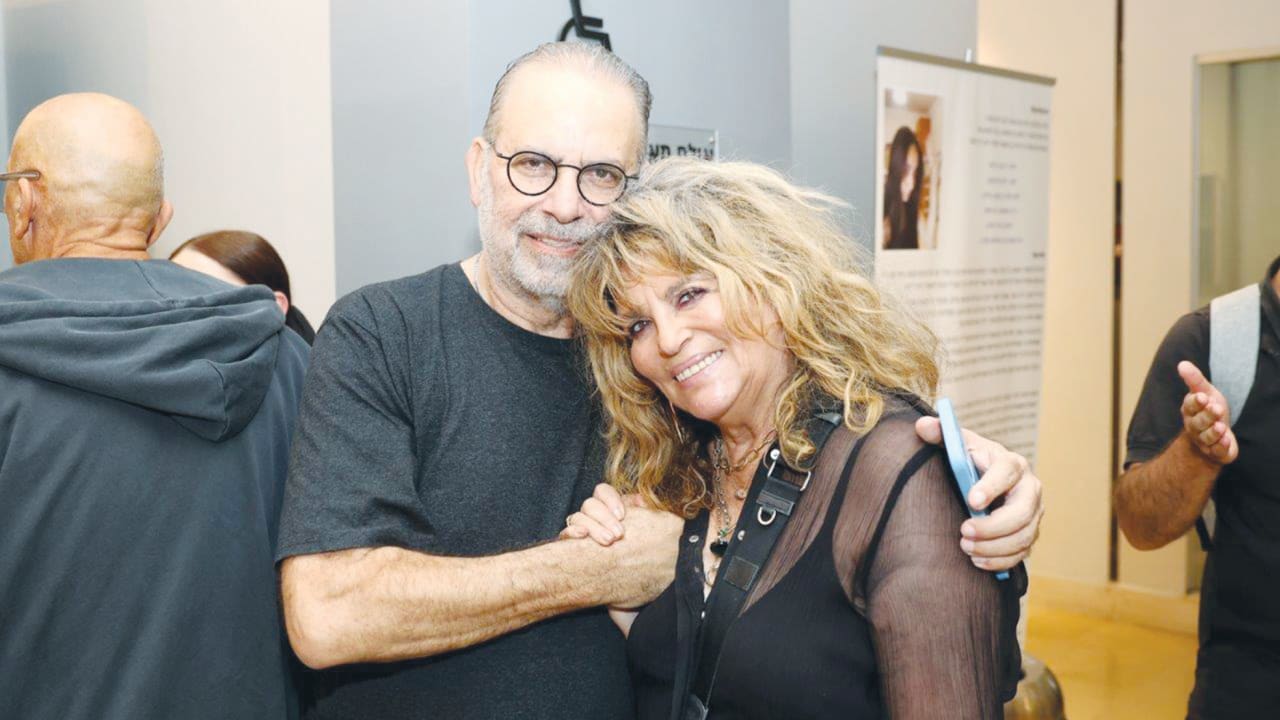
This is the 70th anniversary of the play’s first staging on Broadway. Spied in the audience were Moshe Datz, who came in a wheelchair due to the fact that he’s recuperating from a broken leg; Yona Elian and her husband, Sassi Keshet; Aki Avni; Nurit Hirsh; Shlomo Vishinsky; Shlomit Aharon; Gil Riva; Hanan Yovel; Galit Giat; Anat Atzmon; Moshe Lahav; Liora Ofer; and many other well-known figures. After the performance, Datner, who is an accomplished actor with a long list of credits, was surrounded by friends and colleagues who congratulated him and wanted to be photographed with him.