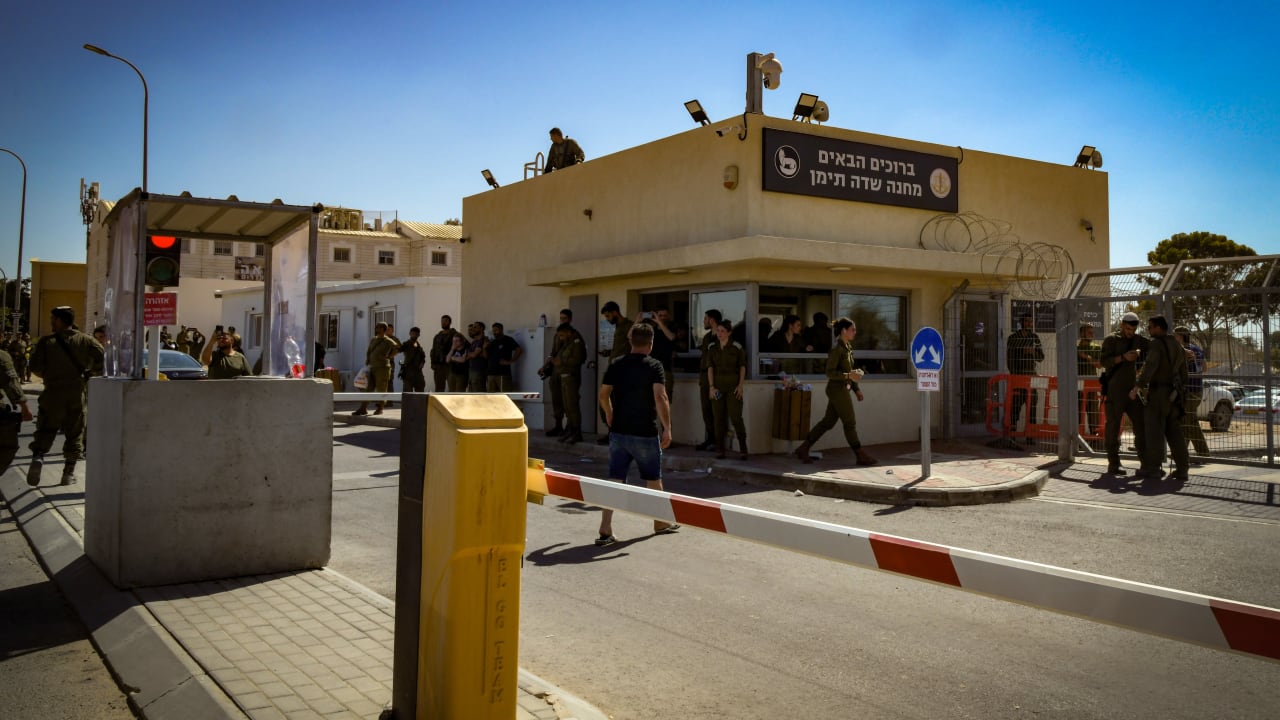
It must be stated unambiguously, according to her own admission, that outgoing Military Advocate-General Maj.-Gen. Yifat Tomer-Yerushalmi and members of her staff broke the law when they leaked a video showing alleged physical abuse of Palestinian prisoners at Sde Teiman prison.
According to her own admission, assuming she does not retract it, Tomer-Yerushalmi and her staff will face legal consequences for their actions. Them there was a twist that Tomer-Yerushalmi disappeared and left a suicide note, but thankfully, she was found safe and well after a wide search for her several hours later.
This is a dark moment for the military legal establishment and it is understandable if the public’s faith in it has been undermined.
Most of the current coverage in the case has been focused on the leaked video and may be sidetracked to include coverage of the state of Tomer-Yerushalmi’s mental health, but none of this is the main part of the issue for the country in the long-term.
What is fundamental is what the government and the general public are more afraid of: the International Criminal Court and questions whether Israel is willing and able to prosecute its own soldiers when they allegedly abuse Palestinians, arrested terrorists or otherwise; or whether they are more afraid of Israel’s extreme right-wing, some of whom broke into a secure IDF base to try to free the soldiers who were being questioned for their alleged sexual assault and beating of a Palestinian detainee.

In July 2024, five IDF soldiers allegedly inserted an object into a Palestinian detainee’s anus and damaged his ribs.
The evidence not only includes the video footage which was leaked to Channel 12, which by itself appears relatively damning, but might not be enough to convict, but also includes a medical report from the physician who examined the Palestinian detainee.
To date, in this case, the focus of the soldiers’ defense lawyers has not been that the event did not take place, but that the investigation was prejudiced by the leaked video, and an uphill narrative of self-defense. There are many ways to restrain a detainee which do not cause extensive bodily harm that this detainee suffered.
Essentially, the defense lawyers looked to be seeking a plea deal for lesser charges, but no one is saying the incident did not happen.
Likewise, nobody is denying that far right-wing activists forced their way into an IDF base to interfere with a military investigation and potentially break out soldier-suspects.
Some of those who broke into the base try to justify their manifestly illegal actions, either by saying that the way that the soldier-defendants were arrested was improper and humiliating, or by arguing that Palestinian detainees, if they are considered to be terrorists, have absolutely no rights.
It is possible that the way the soldier-suspects were arrested was improper, but that is also a separate issue that can be contested by the defendants’ lawyers without breaking into an IDF base.
Do Israelis think abusing Palestinian terrorist detainees is legal?
Really, the other point is the crux of the debate: do Israelis believe it is legal to allegedly beat and sexually assault Palestinian detainees who are terrorists?
Until now, the answer in Israel and in democratic countries worldwide, would be that such actions are unequivocally illegal, even if the detainees themselves are awaiting prosecution for their own terrorist crimes.
This comes before the question whether the soldiers are guilty or innocent.
It is a foundational question: do you arrest, interrogate, and investigate soldiers when there is an allegation with serious evidence that they beat a detainee?
The answer is a simple: yes or no.
If the answer is no, then Israel will not only have much more severe problems before the ICC, it will also likely, over time, lose support from the US, much of Europe, and other democratic allies.
While some may rush in and ask: what value is that support? The answer is that it is humongous, both on a military (France and Britain have both helped shoot down Iranian aerial threats along with the US), economic, and public diplomacy level, even if Jerusalem and many Europeans do not see eye to eye on a quite a few issues.
If the answer is yes, soldier-suspects must be investigated, then the country must prepare for the possibility that a court may find them guilty, This would have no connection to Tomer-Yerushalmi’s own alleged violations of leaking the video.
Further, the country must be ready to bring to justice those extremists who broke into the IDF base.
While this decision may be difficult emotionally in an era when 2,000 Israelis were killed by Hamas (the vast majority), Hezbollah, and Iran, it still frames the direction of the country’s democratic character and future allies.
This primary dilemma cannot be lost in the debate about the video leak.
The next real element to the story is how the broader political class had treated the whole incident from start to finish.
Prime Minister Benjamin Netanyahu and his supporters did not violate any laws. But they also did not give the IDF legal division any backing in summer 2024 when it was being attacked physically by extreme activists, and verbally by many of Netanyahu’s coalition partners.
Tomer-Yerushalmi broke the law because she leaked the video without a transparent process, something which could also have violated the soldier-suspects’ rights.
But if Israel needs to prosecute its own for allegedly violating detainee rights, then either top government officials need to back the legal system when it is under physical and verbal attack, or the legal system needs to have some authorized way to defend its own legitimacy, without having to decide whether to break the law by leaking or not.
Part of what has been seen in the public corruption trial against Netanyahu is that, whether he is innocent or guilty, the legal establishment suffered deeply from being delegitimized by the political class as the investigation and trial played out.
To try to respond, elements of law enforcement – though sometimes it was also defense lawyers – leaked anti-Netanyahu evidence from the case prior to trial numerous times.
These leakers also violated the law, though none of them were caught.
Why were none of them caught, whereas Tomer-Yerushalmi was caught?
The truth is she was not caught either in the classic sense as the latest developments come around 15 months after the leak. Whatever alleged cover up she and other officials carried out worked in real-time.
The case finally broke open when one of her aides underwent a standard polygraph test at a Shin Bet interview as part of the process to receive a promotion.
The polygraph revealed the lie which broke the case open.
If that aid had not been sent to interview for the promotion, the cover up likely would have succeeded, just as all improper anti-Netanyahu leaks succeeded without anyone being caught.
But this, too, obscures the problem that the legal establishment is prevented from defending its reputation and the political class no longer follow norms of refraining from personally attacking the legal establishment (as opposed to substantively attacking the charges which are part of any standard defense.)
The country needs to ask itself difficult questions about finding a balance between defendants being able to make their case versus prosecutors being able to make their case, either with both sides sticking to making their cases in court or some room for both sides to respond also in public.
There was probably also a stage where the prosecution’s advantage, in that it is holding jail time over accused political officials, was too large, and needed to be balanced.
But when activists break into an IDF base and any noises from coalition officials are against the IDF legal division or silent, the pendulum has likely swung too far in the other direction.
On Sunday, Netanyahu accused Tomer-Yerushalmi of terribly harming Israel’s reputation in the world by releasing the video. But the history in real-time gives a different narrative. In real time, Israel had been taking hits for months in the global media for failing to prosecute many alleged beatings of Palestinian detainees. So what was more harmful to Israel’s reputation, releasing a video and probing and prosecuting the alleged offenders, or continuing to allow Israel’s accusers to argue that Jerusalem was not willing to do anything to prevent its soldiers from beating detainees?
And there is no debate that detainees were beaten. A smaller Sdei Teiman case already led to a conviction.
Defendants should be able to plead their defense as robustly as possible on the substance. Yet, if the country wants to both salvage its legal establishment, but de-incentivize unauthorized leaks, there likely needs to be some format for the legal division to respond to attacks on its legitimacy in real-time – and without waiting months or years until it can present all the evidence at trial.
Above all, the country needs to understand what is truly at stake in this case, and it is far more than the offending leak.