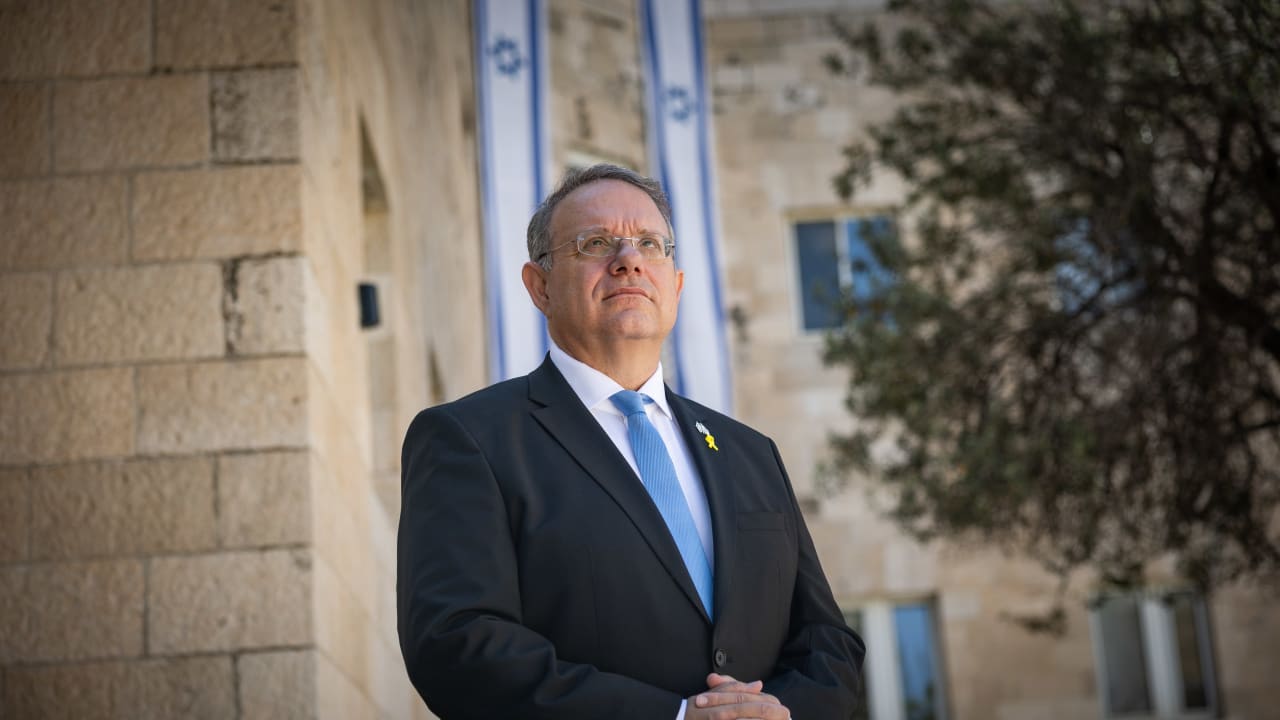
The 39th World Zionist Congress launched to the applause of hundreds of delegates from around the world on Tuesday, but the October 7 massacre and inter- and intra-party tensions cast a long shadow on the festive opening plenary.
More than 1,400 delegates and alternate delegates from 43 countries had gathered to set the agenda for the Zionist movement by deliberating on issues, voting on resolutions, and determining who would lead the National Institutions, but the Israel-Hamas War and appeals for unity were the agenda in the main plenary.
A moment of silence was held at the plenary’s outset in memory of all those who lost their lives during the October 7 massacre. American Zionist Movement President and World Mizrachi Board Member Debbie Isaac reminded the audience how there were still hostage bodies that had yet to be returned to Israel, highlighting Lt. Hadar Goldin, whose body had been held in Gaza since 2014’s Operation Protective Edge.
Ronen and Orna Neutra, the parents of Armored Corps Capt. Omer Neutra, shared with the delegates and leaders the story of the Long Island, New York, native who fell in combat during the Hamas-led attack. Neutra’s body has still not been returned to Israel despite a ceasefire deal with Hamas, and his parents reminded the audience that there were still 12 other hostage bodies that needed to be returned.
“It’s been a very long fight, and it’s not over yet,” said Netura’s parents. “This war will not truly be over until the very last hostage is home to be buried.”
Neutra’s parents led a prayer for the 920 soldiers who fell in the October 7 war, reminding participants that they were one people bound in solidarity for the safety of hostages and soldiers.

World Zionist Organization Chairman Yaakov Hagoel noted in his speech how the delegates and everyone in Israel and the Diaspora were united in agreement on embracing the bereaved families, praying for wounded soldiers, and wishing luck to those still fighting to protect the country. Hagoel said the pain of the past was framed as something that propels Zionism forward, rather than something that makes Zionism stagnate.
'we are all brothers and sisters'
The hostages and soldiers were not the only point of unity raised by speakers, with Supreme Zionist Court acting President Steve Adler dismissing cleavages of politics, denomination, and gender when “we are all brothers and sisters” and Zionists.
In a video address, Adler called for the end of quarrels between WZC political parties and urged delegates to do what was best for Israel rather than their slate. The judge said that participants should rally around shared objectives, and World Zionist Organization President Tova Dorfman suggested in her speech that the question that should guide delegates should be “What would Herzl do?”
“These past two years taught us that we are able to work so well together if we want to,” said Dorfman. “We have an opportunity here to correct, to fix things.”
Dorfman’s address focused on the challenges of 21st-century Zionism and the ways it must be reimagined, reconceptualized, and rejuvenated to fit today’s climate.
“In a world where discourse on Israel is becoming more and more extreme, we must take ownership of Zionism,” she said. “We should not allow those who speak badly about Zionism to define it for us. We have to create new alliances, new unions; it’s time to create a real, courageous, authentic Zionist movement.”
Like Herzl – whose vision led to the creation of the State of Israel – modern Zionists must think ahead, she said. “We need to rebuild Israel. We need to move the Zionist movement into a new place.”
Similar sentiments were expressed by Hagoel.
“It is worth reminding ourselves from time to time: the Zionist movement is not just a historical memory, but a living and active engine – the force that paved the way for the establishment of the state,” said Hagoel. “And from here, that mission continues: to ensure the state’s continued existence, its security, and its moral integrity.
“Faced with the flames, the Jewish people again chooses light over darkness. Faced with fear, it chooses faith, unity, and hope. And that – that is Zionism in its deepest meaning: not only to establish a state, but to ensure that at its heart beats a living Jewish soul.”
Isaac said that part of the purpose for being there was to remind themselves and Jewish youth, “that if you are a Jew, you have the right to self-determination.”
Adler urged the delegates to exercise that right by immigrating to Israel, where they would “have vast opportunities, and a Jewish life.”
World Zionist Organization Executive Member Masha Lubelsky reminded attendees that the building of Israel hadn’t ended, and that it was a great privilege not only to be at the congress, but to be in the capital of Israel, Jerusalem. She told delegates that when they returned to their countries, they should remember the congress.
The 2025 congress is the first proper convention in a decade, as the last event was disrupted by the pandemic, Hagoel reminded. The event will see delegates deliberating on draft resolutions in committees on Wednesday, but behind the scenes, the real power struggle will still be played out with negotiations for the coalition.
The result of the negotiations will determine who will control the National Institutions like the World Zionist Organization and KKL-JNF, and the purse strings they in turn pulled. Isaac reminded that leaders from all over the world needed to be well represented at the National Institutions so that they could get the funding and support that they required.
The coalition negotiations for the WZC and its institutions continued into Tuesday, without announcement of their finalization by the time President Isaac Herzog spoke at the evening ceremony.
The negotiations had been complicated by infighting in the World Likud movement, which was divided by factions led by Hagoel and Culture Minister Miki Zohar. A failure by World Likud to hold elections complicated negotiations, forcing other slates to come to separate agreements with each Likud faction.
During his address to the 39th Congress, Herzog discussed the word “Zio” used as a slur to refer to Zionists.
“Let me tell you who these so-called ‘Zios’ are. These ‘Zios’ are the finest of human beings, who returned to their ancestral homeland, their biblical, historical, promised land after millennia of persecution, after the devastation of the Holocaust, and built a Jewish, democratic, life-affirming and peace-seeking state!
'<strong>A nation of doing good, a nation of healers'</strong>
“A nation of doing good. A nation of healers of the world in almost every field.”
Herzog added that these “Zios” were brutalized, assaulted, taken hostage, and burned in their homes by their neighbors, with whom they tried to live peacefully. “Zios” in communities all over the world saw their sisters and brothers under attack in Israel, and showed up, “no questions asked.”
“These ‘Zios’ are us. The men and women in this hall, across Israel, and throughout the Jewish world,” he said. “We are proud of our Zionism and we will never forsake it. We will fight for it and defend it. We will remember and we will proudly declare: the people of Israel live.”