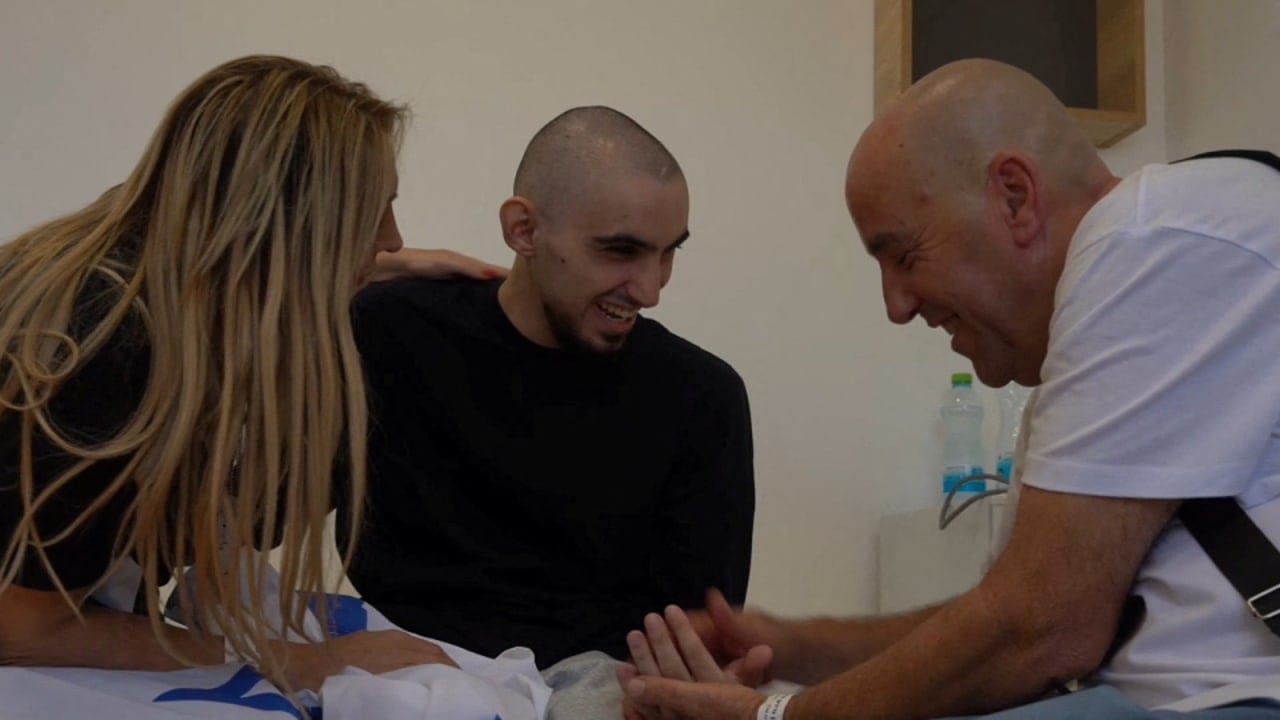
Rom Braslavski, who was released Monday after spending 738 days in Hamas captivity, is still in shock, his uncle, Ze'ev, told Walla on Tuesday, adding that if there had not been a deal, he would have died.
"He's in shock, not really understanding what's happening to him. He wasn’t in Thailand, after all. For us, it’s nothing short of a miracle that he made it out of that hell. If there hadn’t been a deal, there would have been no one to release. I understand this from seeing him and also from what he tells me."
According to Ze'ev, who shared Braslavski's testimony, they were shot at while he was in captivity, and when Gaza was bombed, both Braslavski and his captors were in the line of fire - shells and bombs fell near them.
Once the terrorists realized that there was no deal in sight, their attitude towards Braslavski became worse.
"Less food, they starved them. A piece of bread in the morning and another spoonful of rice at noon - and that was it. Punishments, including physical ones. No light, no water, no showers, constant mental stress, and fear. Every time the negotiations hit a deadlock, the attitude would change drastically. You're dealing with psychopaths," emphasized Braslavski's uncle.

Throughout his time in captivity, Braslavski held onto his faith, often praying, which, according to his uncle, gave him mental strength. "The will to live, the inner strength, seeing us, kept him going," Ze'ev said. He wrote to himself there, but at one point, the terrorists took away what he had written. He spoke Arabic with his captors, and now he speaks fluent Arabic. From time to time, he had other hostages with him, like Sasha Troufanov, but most of the time he was alone," he said.
Braslavski not held underground during much of his captivity
Braslavski, who was not underground during his captivity, was moved from place to place, with conditions that changed frequently. At times, he was held alone, though occasionally, he had other hostages with him, such as Sasha Troufanov.
Despite the hardships, Braslavski's faith and inner strength have been evident even now, as he reassures his mother: "Don’t worry, everything will be fine," Ze'ev said.
According to Ze'ev, Braslavski saw him on television twice. "It gave him strength and joy to see that they were talking about him. He saw on the news channels that they were discussing the war. But there was only television on a few occasions. Rom wasn’t underground, and the conditions changed constantly because they moved them from place to place. Rom is shocked that the entire nation is fixated on this. All of Israel and the world, even abroad. They were talking about it all day. It strengthened him to see that the whole nation was with him. He can’t believe he's so well-known that everyone knows him. He got off the helicopter, saw people greeting him and blessing him," he elaborated.
Ze'ev described to Walla what happened that morning on October 7. "He saved people at Nova and saw horrors. From 6:00 a.m., when the chaos began, there was nowhere to escape. Rom says they were constantly thinking about how to save bodies and people," he recounted.
"They were shot at all the time, he said, 'Bullets were constantly passing by us.' All the police officers in his area died. He said, 'I had no place to escape to, so we jumped from place to place for hours. Everywhere we went, there were bullets.' He said the terrorists caught them with weapons and led them. Crazy, like a horror movie," Braslavski's uncle said.
When Braslavski heard about other hostages being freed, he was happy; he never said, "Why not me?" "When Avera Mengistu was released, he was very happy, and also when Edan Alexander was released. That's the type of person he is, thinking of others first. Even now, he reassures his mother, 'Don't worry, everything will be fine,'" Ze'ev said.