Israel’s health system is buckling under the dual pressure of war and an aging workforce, with pediatrics, psychiatry, endocrinology, and other essential specialties struggling to meet demand.
For more stories from The Media Line go to themedialine.org
According to the Organization for Economic Cooperation and Development (OECD), Israel has fewer physicians per 100,000 people than most developed countries, leaving the system especially vulnerable as older doctors retire and reforms such as new medical schools and shortened internships take years to bear fruit.
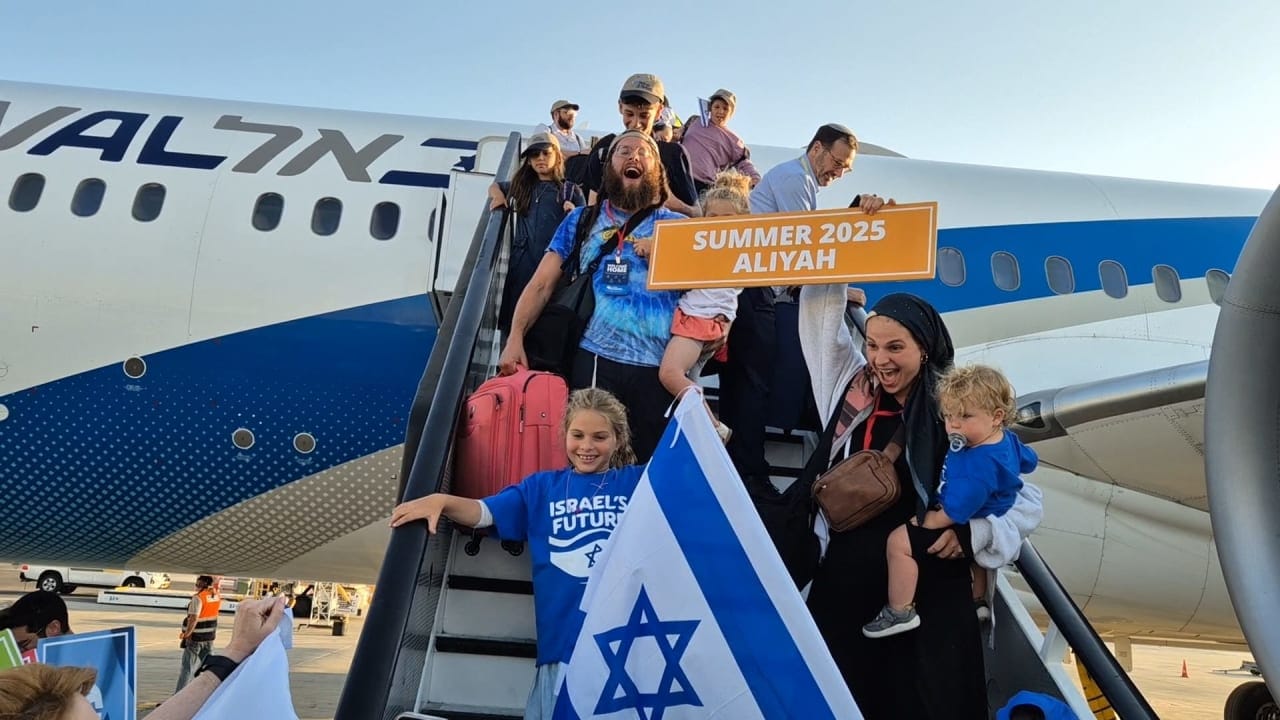
Into this strained landscape came a modest boost: on August 20, 2025, 225 new immigrants arrived at Ben-Gurion Airport on the 65th charter flight organized by Nefesh B’Nefesh in partnership with the Ministry of Aliyah and Integration and the Jewish Agency.
Among them were five physicians and nearly 20 other medical professionals. Journalists, government officials, and even a klezmer band greeted the newcomers as they waved small Israeli flags. Children in matching shirts held signs reading “Israel’s Future” and “We’re Home,” while Nefesh B’Nefesh co-founders stood alongside the minister of aliyah and other senior representatives to welcome them.
“It’s an honor and privilege to be a small part of their aliyah journey,” Rabbi Yehoshua Fass, co-founder of Nefesh B’Nefesh, told The Media Line. “It might not be just their dream; it could be a dream of generations. And to see it actualized, it’s quite profound and very emotional.”

His partner and fellow co-founder, Tony Gelbart, also spoke to The Media Line: “It feels like the first time. These people are making it. They’re fulfilling their dreams. And that’s special. They’re going all over the country. There are all kinds of professions - you know, lawyers, doctors, engineers, lone soldiers, students.”
For pediatrician David Tauber, who studied at Tel Aviv University before completing his residency in the United States, October 7 was the turning point for his family.
He told The Media Line: “It only made our desire to move here stronger. My wife and I were like, we need to go now, we need to be with our brothers and sisters in Israel, and be a part of the story.”
He acknowledged the pressures facing pediatrics in Israel. “It’s moving to be able to fill a role in serving the Jewish people in the Jewish homeland. I hope to be someone who can both be part of the system but also make changes for the better. I would love to be involved with the recruitment of doctors from outside of Israel to try to encourage them to come and move here and be a part of the health care system.”
Among the newcomers were also psychiatrist Joseph Baskin and endocrinologist Revital Gorodeski, who arrived with three of their four children, determined to bring their American medical expertise to Israel’s urgent needs.
Baskin, a specialist in forensics, told The Media Line: “I always wanted to be here, and so my profession was only secondary. But obviously, it’s very important to me to help as many as I can. I’m very comfortable doing general psychiatry and looking forward to practicing here and doing as much as I can.”
His wife described the country’s looming medical challenge. Gorodeski, who led an obesity program at a US university hospital, told The Media Line that stress-related illness is likely to surge. “When there’s a lot of stress in a country, we turn to food, and so obesity is going to explode in Israel as we respond to what’s been going on since October 7. The downstream consequences in terms of medical care are huge. I do think I’m coming here with a specialty in a field of medicine that is needed, and I am so excited to help people across the country.”
She added that their decision was personal as well as professional: “If we can help people here, our people, this is where it really, really counts.”
The couple’s commitment goes beyond professional service. “I especially really want to help soldiers who’ve been on the front line and are struggling,” Baskin said, even if it means volunteering before securing formal employment. Gorodeski added that both see the challenges of aliyah as part of their larger calling. “We’ve gone through many obstacles just to be doctors, with night shifts, being interns and residents and fellows. This is just another one of those steps. If you have the goal that you want to proceed forward, you can overcome those obstacles. We feel passionate about it, and we’re going to tackle them with smiles on our faces.”
Another newcomer, psychologist Atara Wertentheil, echoed that sense of responsibility when she spoke to The Media Line. “I feel lucky. I feel really excited and lucky to be a part of what this country needs and to help, and to be just a support. It’s a value and a priority for all of us to be together and to unite in everything that all the challenges that we’re going through as a Jewish nation.”
Medical experts warn that Israel’s difficulties go well beyond the war. Dr. Charles Weissman of Hadassah Medical Center described the shortage in stark terms in an interview with The Media Line. “If you look at the OECD numbers, Israel has relatively few physicians per 100,000 people compared to other OECD countries,” he said. “There was a big immigration from the Soviet Union around 1990. And those people slowly have or are in the process of retiring. And the number of physicians that they have trained who have come to Israel has not kept up with this retirement lag.”
Foreign training has played an outsized role. “Over 58% of Israeli physicians are foreign-trained,” Weissman explained. “Among them are a lot of Israelis who didn’t get into medical school in Israel who went abroad to do their medical studies. But some of them obviously are not coming back.”
The shortage, he emphasized, is both geographic and professional. “Physicians tend to work in the central part of the country. And the peripheral areas do not have enough physicians,” Weissman said. “Yes, psychiatry is a problem in Israel. It’s basically a problem around the world because of its nature. Neonatology has been a problem for a while. Anesthesia is problematic. Radiology, too.”
Medical students studying in Europe, not returning, exacerbates issue
Talent “leakage” abroad also threatens the system. “Ten to 30 percent do not come back” after studying in Europe, Weissman said. “The other area where you have a leakage is people who go away for fellowships. They finish their residency here, and then they go off to a fellowship in the US or Canada or Britain. And after two or three years there, they’re offered jobs there. And they stay.”
Asked about incentives for doctors abroad who may consider moving to Israel, Weissman was direct. “Israel is a good place to practice medicine. It’s advanced. There’s a big need for practitioners at almost every level and every field. The level is equal to that of the US, especially in the central areas. The big challenge is to work in a peripheral hospital and provide your expertise and try to really improve medical care there.”
Yet obstacles remain. “Obviously, the pay is not enough compared to other countries, especially in certain specialties. That’s no secret,” Weissman said. “And unfortunately, the cost of living here is rather high. Yes, they’re going to have to take a pay cut. And that is the disincentive. But on the other hand, pay has gone up slowly, there are incentives to work in the peripheral areas, and in certain areas you can add private practice to your income.”
His conclusion was blunt. “Every hospital is its own entity, and they have to work to attract. If you are in a peripheral hospital, you have to think about how you’re going to make it attractive. But the need is very real. And doctors are respected here, and most of them are very happy.”
The symbolism of the charter flight extended far beyond numbers. “October 7 was a turning point,” Gorodeski said. “It actually encouraged us to come more. Mental health is going to be the most important thing to help right now.” For Tauber, the move is not only about practicing medicine but also about training the next generation. “I really enjoy mentoring,” he said. “In five years, I hope to be involved with the recruitment of doctors from outside of Israel. … That would be amazing.”
While Israel invests in reforms that may reshape the medical profession by 2030, the doctors stepping off this flight are already here. They have unpacked their boxes, filed their licensing paperwork, and begun preparing to join wards that cannot afford to wait. Their decision to immigrate during wartime is not only a personal dream realized - it is also an act of national service.