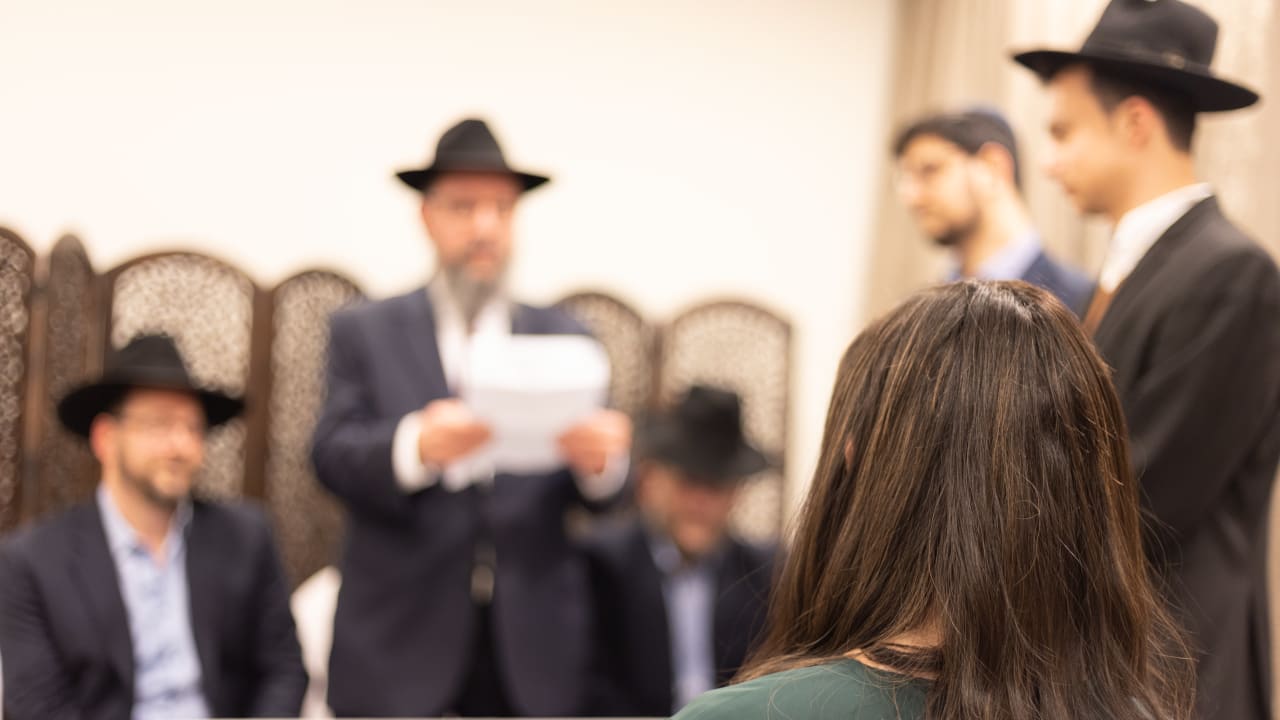
The Rabbinical Court in Safed has approved the granting of a get (Jewish divorce document) to a woman who had been an aguna (Jewish woman who is “chained” to her marriage) for more than 20 years, the Justice Ministry announced.
According to the statement, the case was resolved through a coordinated effort involving the Public Defender’s Office, the Justice Ministry’s Pardons Department, the Rabbinical Court, the justice minister, and the president of Israel.
The couple married in the United States in 1997 and had three children. In 2002, the woman filed for divorce in a US court, but her husband refused to participate in the proceedings. A refusal order was issued against him.
Refusing to grant the get
In 2011, when the man entered Israel for his son’s bar mitzvah, the woman filed for divorce in an Israeli court. A travel ban was placed on him, and the Rabbinical Court subsequently ordered him to grant the get. The man refused despite further rulings from both the Rabbinical Court and the Great Rabbinical Court.
In 2012, the man was arrested and sentenced to seven years in civil prison for get refusal. Three years into his sentence, the Rabbinical Court imposed additional sanctions, including a ban on receiving kosher food, but he continued to refuse to grant the divorce.

In 2021, a criminal indictment was filed against him for violating a court order intended to protect an individual. He was convicted by the Haifa District Court and sentenced to 18 months in prison. His appeal was denied.
Following the court’s decision, Public Defender Attorney Abraham Sofer submitted a proposal to the Rabbinical Court in which the man would grant the get in exchange for a presidential pardon and early release.
The proposal was referred to the Justice Ministry’s Pardons Department, which coordinated with a Rabbinical Court representative who had been supporting the woman throughout the process.
After reviewing the case, the Pardons Department issued a recommendation to the justice minister and the president of Israel. Both approved the conditional pardon.
Following the approval, the man signed the get during a session held at the Rabbinical Court in Safed. In return, the official document reducing his sentence was delivered to him.
A statement from the President’s Office said: “The president has done and will do everything in his power to assist women whose get is withheld in their struggles. The power of pardons is a vital social tool, allowing for solutions to complex social and human issues.”
Justice Minister Yariv Levin said, “Despite the difficulty of granting a pardon to someone unworthy of it, I saw it as my privilege to help a woman who remained an aguna for over 20 years. I hope this will allow her to start a new chapter in her life.”
Limor Goldenberg-Hadad, head of the Pardons Department at the Justice Ministry, said the woman had been waiting for the get for many years and is currently facing a serious illness.
Sofer stated, “This is Israel’s longest-serving get refuser, and we are glad we managed to help find a solution that enabled the granting of the get and led to the man’s immediate release.”