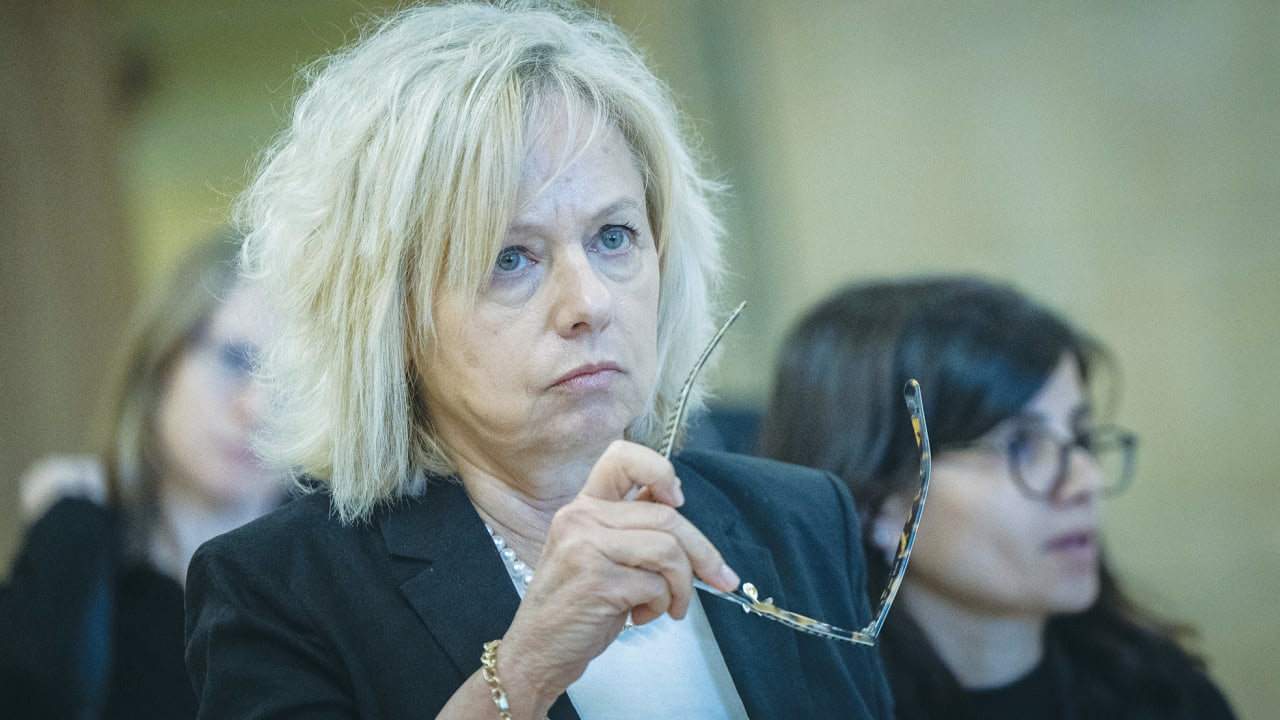
Attorney General Gali Baharav-Miara wrote a letter criticizing the government's summons for a hearing on her dismissal on Monday, calling it part of a political deal” aimed at ensuring the government's survival, and warning of the consequences of the decision: The politicization of future attorney-generals.
“The hearing scheduled for today allows the government to dismiss the attorney general and any future advisor for foreign and corrupt considerations. In response to the fact that the advisor prevented illegal actions, ordered an investigation or prosecution of a coalition member, refused to halt a criminal proceeding against a sitting government member, or as part of a 'political deal' to ensure the survival of the government,” she wrote.
“This is a hearing for appearances only, the outcome of which is already known in advance, and its significance is a severe blow to the rule of law and Israeli democracy,” she added.
The letter by Baharav-Miara comes after a government decision penned by Diaspora Affairs and Combatting Antisemitism Minister Amichai Chikli on the matter on Sunday. Later that day, Supreme Court Justice Noam Sohlberg rejected an injunction request to cancel the hearing.

She wrote that the hearing was based on an illegal government decision that is laden with foreign influences, and that she cannot, in good faith and in commitment to her role, attend.
Baharav-Miara won't attended hearing, says erases past consequences and lessons
“It erases, as though they never existed, the consequences and lessons learned from the Bar-On-Hebron Affair,” which established the public professional committee that advises the government when it elects or dismisses an attorney general, and “provides the government with complete political control over the appointment, with no external review.”
In January 1997, lawyer Roni Bar-On was appointed attorney-general. He was not qualified for the position and resigned two days later after public and political outrage.
About a week later, it was revealed that his appointment was part of a deal between Prime Minister Benjamin Netanyahu and Shas head Arye Deri, who was then interior minister, to advance a plea bargain in Deri’s corruption case. Deri pushed for the appointment in exchange for his party’s support of the controversial Hebron Agreement for the withdrawal of Israeli military forces from the southern West Bank city.
Deri was later indicted after a police investigation concluded that charges should be brought, and as a result, he was barred from politics for a decade.
The committee was created to avoid such a scenario. It is comprised of a retired Supreme Court justice as chair, appointed by the Supreme Court chief justice and by approval of the justice minister; a former justice minister or attorney-general, chosen by the government; an MK, chosen by the Knesset’s Constitution, Law and Justice Committee; a lawyer, chosen by the Israel Bar Association (IBA); and a legal academic, selected by the deans of Israel’s law faculties.
Levin failed to fill all the positions of the committee. His decision does away with it and leaves the hiring and firing decision in a ministerial committee - the one Baharav-Miara refused to come to on Monday.
This decision has faced fierce criticism for politicizing a delicate and sensitive position. Proponents argue that the situation is so dire as to make the work relationship between the government and the attorney-general obsolete, and that since the public-professional committee could not be filled, this is the next necessary step.
The Attorney-General wrote that the decision was made swiftly and without the necessary groundwork that gives it the legal basis it needs, and most importantly, does not address its own dangerous consequences.
Baharav-Miara warned in her Monday letter that the consequences of the committee are a freeing of the legal constraints around the government, giving it free rein in a way that severely harms the rule of law, equality before the law, human rights, and cripples authorities against corrupt governmental control.
“The public-professional committee is the safety net that prevents improper use of the government's authority to dismiss,” she wrote.
“Without it,” she continued, “the government will have the authority to dismiss any future attorney-general for political goals.”
According to protest organizers, fifty to sixty people gathered outside the Justice Ministry to protest the hearing. One was arrested and later released.