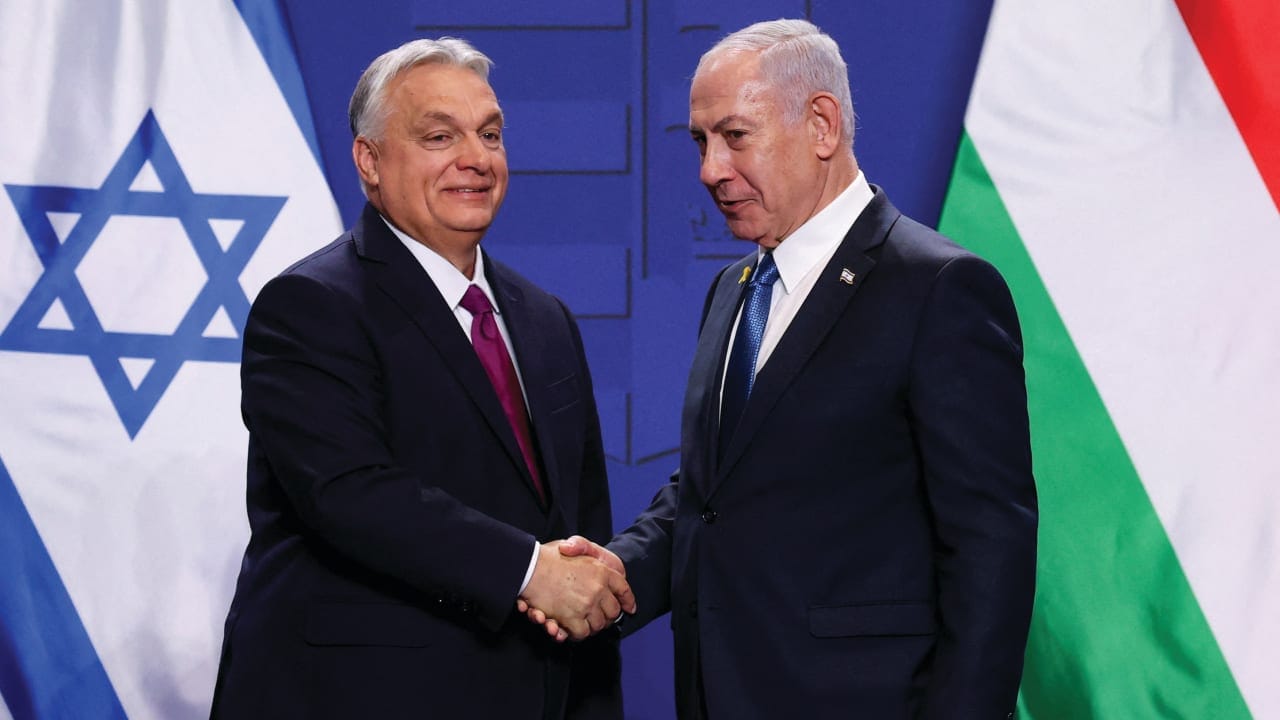
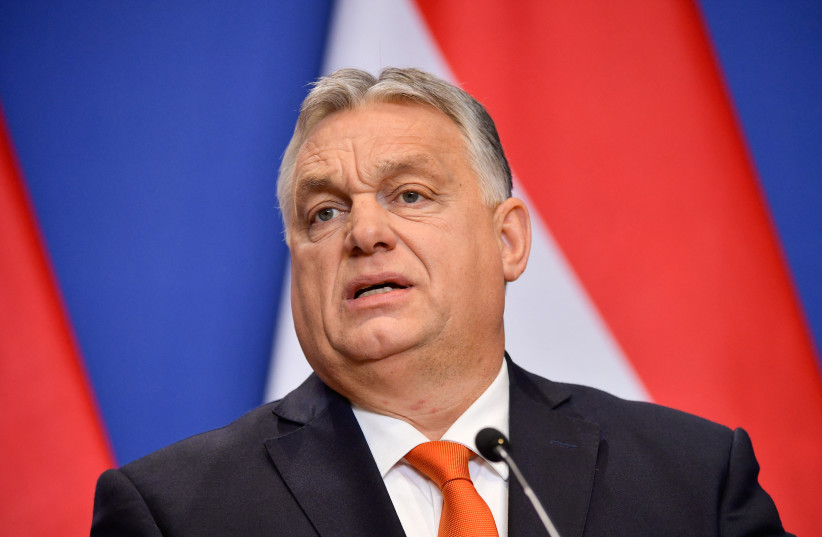
Loathe him or love him, one thing is undeniable about ousted Hungarian prime minister Viktor Orban – he proved to be a good friend of Israel’s.
For some, that is all that really matters.
For others, it is not enough. For them, his strong pro-Israel bona fides were drowned out by the antisemitic dog whistles he blew in his various campaigns against George Soros.
For still others, those dog whistles were not so shrill, since Soros himself is stridently critical of Israel. Over the years, Soros’ philanthropies have generously funded numerous NGOs whose work delegitimizes Israel, such as Human Rights Watch, IfNotNow, and Jewish Voices for Peace (JVP), to name just a few.
Orban, by contrast, had Israel’s back. He may have been an ultra-nationalist. He may have been anti-immigration. He may have been illiberal. But he had Israel’s back. Repeatedly.
Here are just a few recent examples:
In July 2025, Hungary led opposition – along with Germany and the Czech Republic – to punitive EU measures over Gaza, including potential suspension of the EU-Israel Association Agreement.
In April 2025, Orban received Prime Minister Benjamin Netanyahu in Budapest, the first European leader to invite Netanyahu to visit in defiance of an International Criminal Court arrest warrant against him. He also announced that Hungary would withdraw from the ICC.
In February 2024, Hungary prevented the EU from issuing two consensus statements by then-foreign policy chief Josep Borrell calling for an “immediate humanitarian pause” to Israel’s planned IDF operation against Hamas in Rafah.
In May 2021, Hungary vetoed an EU statement urging an immediate ceasefire during the Israel-Hamas clashes that year, calling the drafts “one-sided” for equating Israel with Hamas and not sufficiently condemning the terrorist organization’s rocket attacks on Jerusalem.
Israel's most reliable ally inside the EU
Taken together, these were not isolated decisions but part of a consistent pattern.
Hungary, under Orban, emerged as arguably Israel’s most reliable ally inside the European Union – alongside countries like the Czech Republic and, at times, Germany. If, on one side of the EU, stood countries such as Ireland, Spain, and Belgium leading the criticism of Israel, Hungary was firmly on the other side of the ledger.
That support extended beyond high-profile moments. In the day-to-day workings of EU diplomacy, where consensus is required for joint statements, Orban’s Hungary repeatedly used its position to block or dilute language seen as unfairly targeting Israel. The result was subtle but significant: Reflexive condemnations of Israel following meetings of EU foreign ministers or prime ministers were no longer automatic.
And the pattern carried over onto the international stage. At the United Nations, Hungary frequently aligned itself with the United States, Micronesia, and Fiji, willing either to vote with Israel or, at the very least, to abstain on resolutions singling it out.
Orban understood the relationship with Israel not in sentimental terms, but as part of a broader strategic calculation. Close ties with Israel strengthened Hungary’s hand in Washington, particularly during periods when Budapest’s standing in Western capitals was strained.
The relationship with Netanyahu was long-standing and mutually beneficial. Netanyahu was one of the few Israeli politicians to pay attention to Orban when he visited as head of the Hungarian opposition in the mid-2000s: Israel gained a reliable advocate within European institutions, while Hungary gained access, influence, and a channel into American political circles where Israel’s voice carried weight. This was especially true during Trump’s first term, when Orban’s relationship with Netanyahu opened doors in the US capital.
And yet, running alongside this strategic alignment was an uncomfortable parallel track. Orban’s political campaigns repeatedly trafficked in imagery and narratives that many saw as drawing on classic antisemitic tropes – most notably in his portrayal of Soros as a shadowy, transnational manipulator, and more recently in depictions of Ukrainian President Volodymyr Zelensky.
There were also problematic aspects to Orban’s broader effort to reshape Hungary’s national narrative by promoting a revisionist reading of history that cast the country primarily as a victim of foreign occupation and external forces, while downplaying its role as a perpetrator during World War II.
Figures like Miklós Horthy, the Hungarian leader during World War II, when 600,000 of the country’s 800,000 Jews were murdered in the Holocaust, were recast in a more favorable light, and challenges to this narrative were often framed not as legitimate debate but as opposition to Hungary’s national interest itself.
All of this led to charges that Orban winked at antisemitism. But here is the paradox: Even as there was unease about the political climate in the country, Hungary’s estimated 100,000 Jews could feel physically safe. Hungary is a place where Jewish life is secure, where the government invested in synagogues and Jewish institutions, and where officials spoke of zero tolerance for antisemitism.
Not only is it undeniable that Orban was a friend of Israel, but it is also clear that Hungary today is one of the safer places in Europe to live openly as a Jew. While synagogue bombings, shootings, and arsons have scarred communities in Paris, Manchester, Antwerp, and Amsterdam, by comparison, Budapest has largely been spared such attacks.
Orban embodies a dilemma facing many Jews: The leaders who like Israel the most are not necessarily the ones they would invite home for dinner, not the kind who reflect the liberal values Jews have long championed – Orban, Brazil’s Jair Bolsonaro, even America’s Donald Trump – while those they would love to be friends with, those who seem “enlightened,” often don’t have a soft spot in their hearts for the Jewish state: France’s Emmanuel Macron, former Canadian prime minister Justin Trudeau, and even former US president Barack Obama.
If this were a junior high school playground, the scene might look something like this: The outcasts like us; the cool kids don’t.
Orban was undeniably a European outcast, which explains the cheers that came out of Brussels when his defeat was announced on Sunday night. And he also, undeniably, liked us, which explains the obvious – if largely unstated – disappointment in Jerusalem.