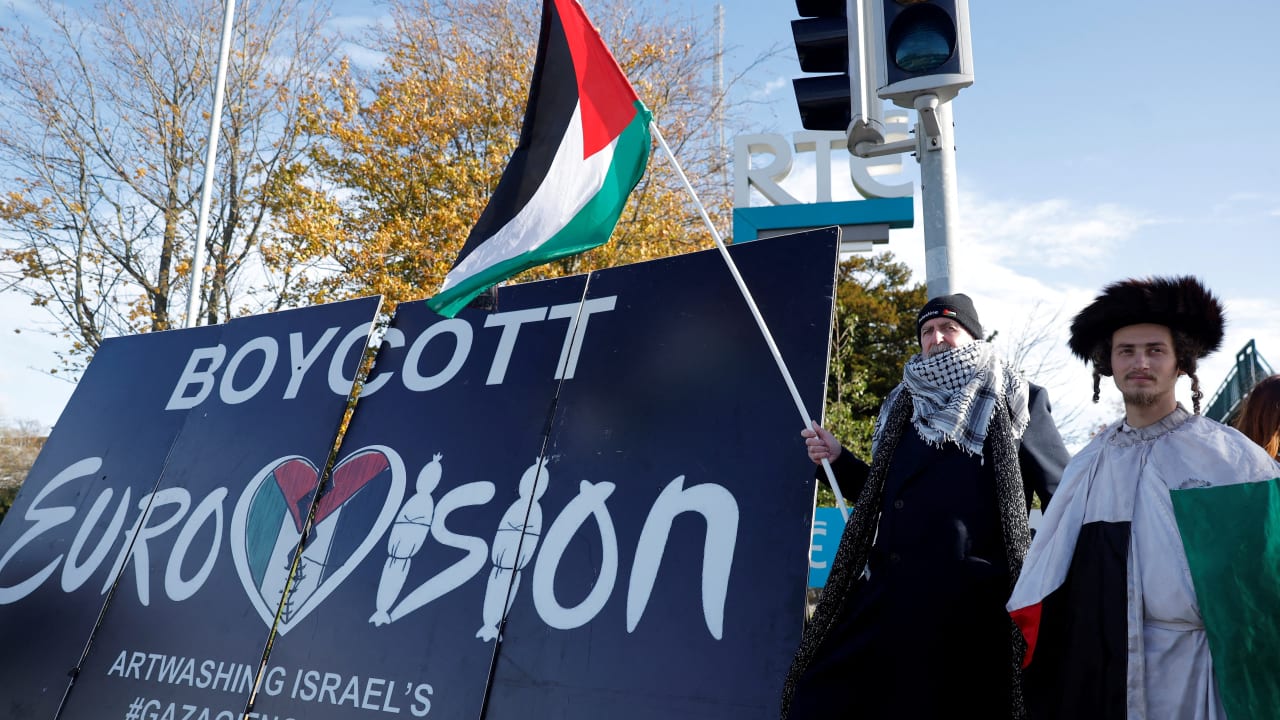
It’s early days in the runup to the Eurovision Song Contest this year, but the oddsmakers have already released an early lineup and – drumroll, please – Israel is currently ranked in first place.
According to a table published on Eurovisionworld.com’s website, Israel is in first place with a 10 percent chance of winning, Sweden is in second place with 9 percent, Ukraine is in third with 7 percent, followed by Finland with 6 percent, and Italy with 5 percent.
Few of the 35 countries that will be competing in this year’s Eurovision have announced which song and which contestant they have chosen yet, so it would be a mistake to read too much into this finding.
But this is a surprising result given the fact that five countries – Spain (one of Eurovision’s “big five” sponsors), Slovenia, Ireland, Holland, and Iceland – have announced they will be boycotting the song contest, which was established in 1956 to provide a peaceful forum for competition among nations, due to Israel’s participation. Israel has been competing in Eurovision since 1973.
These countries announced they would boycott due to a decision from Eurovision’s general assembly in early December that Israel would be allowed to take part despite calls for its exclusion.

Eurovision also announced a rule change, following allegations – which Eurovision asserted last year were baseless – that Israel cheated in the televoting and in its promotion of Yuval Raphael, the 2025 contestant.
The song Raphael performed, “New Day Will Rise,” came in first in the televoting, and she finished second overall. The new rule is that audiences can only vote 10 times, not 20, in the televoting, and specifies how contestants can be promoted online.
Some have said that this could harm Israel’s chances in 2026, because Israel tends to do far better in the audience vote than with the national juries. In 2024, Edan Golan came in second in the televoting with her song, “Hurricane,” and finished fifth overall.
Noa Kirel and her song, “Unicorn,” also finished second in the televoting in 2023, coming in third overall. Israel has won the song contest four times, most recently in 2018.
Social media declares Eurovision “dead” as Israel tops odds
Now that Israel is leading in the preliminary betting odds tables, some are taking to social media to pronounce the song contest “dead.” That assessment would come as a surprise to the 166 million viewers who watched the song contest last year, as well as the approximately 17 million who voted in the televoting (which costs around one Euro per vote).
In other Eurovision news, Swedish singer Gina Dirawi has been picked to co-host Melodifestivalen 2026, Sweden’s Eurovision talent contest, which drew criticism from anti-Israel commentators, who said that because she is of Palestinian descent, she should not have anything to do with any contest related to Eurovision.
In an Instagram post, she defended her decision, writing: “If you have followed me over the years… you know that my Palestinian identity permeates everything I do. I have always stood up for human rights, even at the cost, and I will always continue to do so. Let me be clear: I have not said yes to Eurovision. I have agreed to lead the Swedish Melodifestivalen.”
Back in 2011, the Jewish Chronicle reported on a blog post by Dirawi titled, "Israel imitates Hitler,” which the singer later retracted, saying, “ I distance myself from all comparisons between Israel's actions and the Holocaust. It was a clumsy and ill-thought-through formulation which I regret today… My purpose was never to denigrate Jews or to belittle the Holocaust."
Israel’s Eurovision talent contest, the Next Star for Eurovision, is running several nights a week on Channel 12.