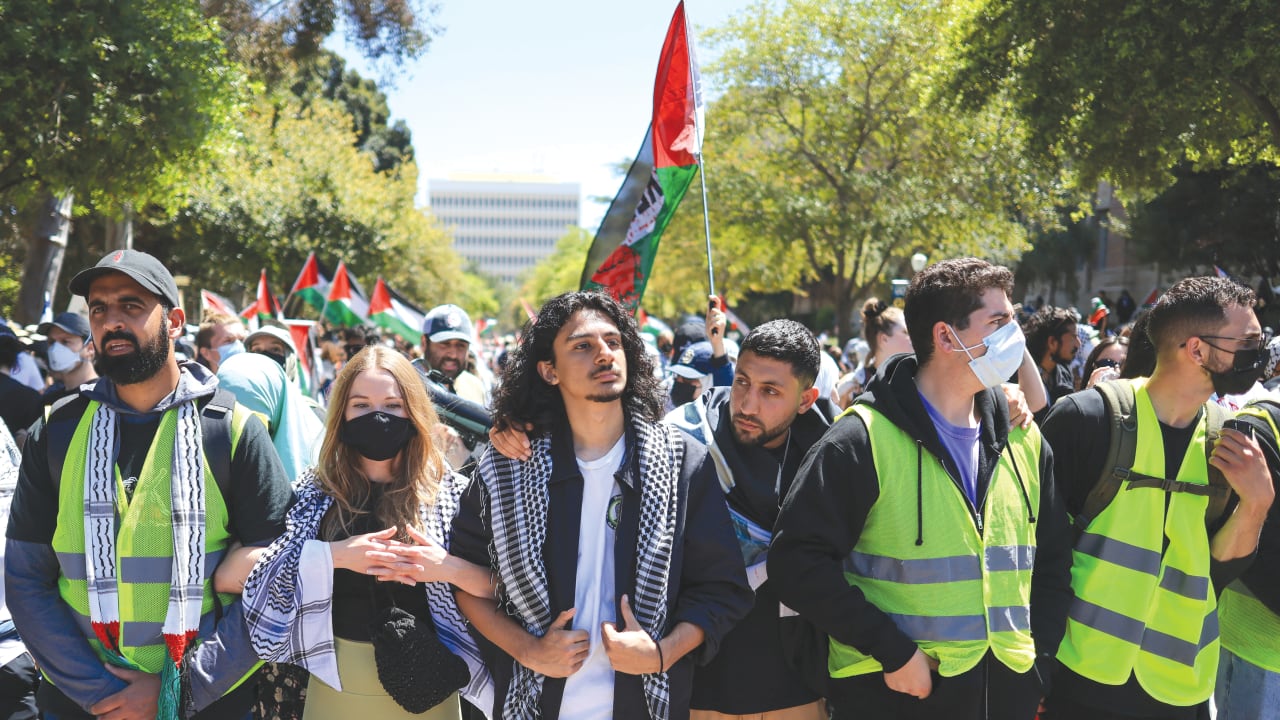
Following the Israel-Hamas War, universities across the US and UK faced multimillion-dollar expenses to repair the damage left by pro-Palestinian encampments.
According to The LA Times, the University of California system alone spent over $29 million during the spring of 2024 to address the explosive riots over the Israel-Hamas War. Ninety percent of this money was allocated to funding additional safety measures, including increased police presence and security.
According to the Jewish Telegraphic Agency, demonstrations set up tent encampments that swiftly descended into violence and property damage, with instances of vandalism, trespassing, theft, and constructing barricades being common.
Encampments across the University of California system descended not just into property damage and vandalism but also attracted rodents and pests, which required the universities to also spend money on waste removal and pest control, according to The LA Times.
Who had the highest clean-up bill?
UCLA, one of the hotspots for some of the most volatile protests of 2024, incurred the highest cleanup bill among all 10 UC campuses. According to The LA Times, UCLA spent $10m. on safety and security and $400,000 on building repairs.
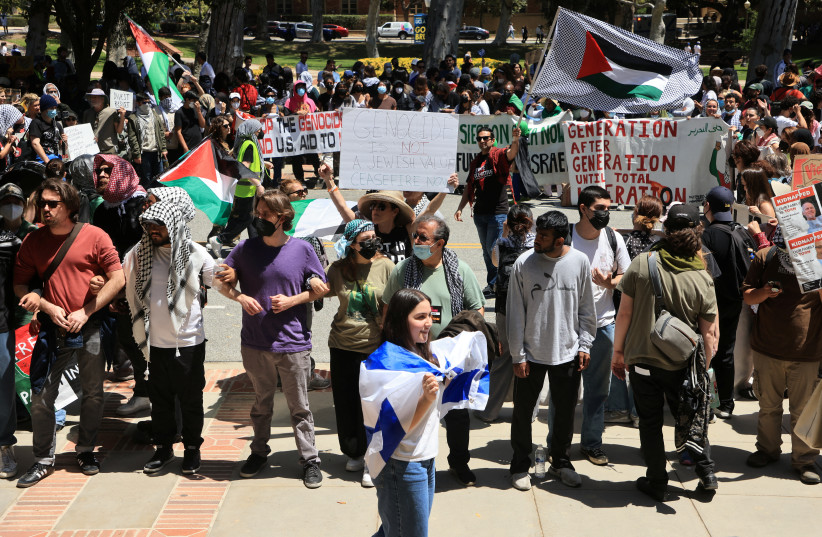
The LA Times reported that UC Berkeley spent $8m. on cleanup costs, UC Irvine paid $2.9m., UC Santa Cruz $2.7m., UC San Diego $2m., and UC Santa Barbara $1.3m.
Students voluntarily dismantled encampments without police intervention at the four lowest-spending campuses: UC San Francisco, at $325,000; UC Merced, at $255,000; UC Davis, at $150,000; and UC Riverside, at $25,000, according to The LA Times.
What students had to say
At UC Davis, Gabriel Gaysinsky, a member of the executive board of UC Davis’s pro-Israel group, Aggies for Israel, confirmed to The Jerusalem Post that members of the encampment ended up taking down their installation themselves.
However, he added that after their clean-up, “they left chalk graffiti in the middle of the quad saying that they’d be back and a number of pro-Palestine messages.”
Even though the encampment was taken down at the end of the school year, Gaysinky added that “the tents left dead grass for months,” which served as a reminder of what once lay there. Gaysinsky told the Post that the UC Davis encampment had posters of the PFLP, Hamas symbols, and even banners saying, “The intifada is here.”
Pro-Palestinian protest clean-up in the UK
American college administrations were not the only ones facing the grave task of cleaning up their campuses. According to The Jewish Chronicle, the University of Cambridge and the University of Oxford have incurred over £615,000 in combined costs because of pro-Palestine encampments and protests.
The Jewish Chronicle reported that the style of the protests bore a resemblance to pro-Palestinian protests in the US. Palestine Action, the direct group that the Home Secretary plans to put under anti-terror laws, occupied Greenwich House, an important administrative center for the university, from November 22 to December 6.
The center houses sensitive and confidential information. A statement from the University of Cambridge posted on its website on December 3, 2024, echoed concerns about the sensitive material in the center:
“The occupation of Greenwich House continues… as an employer and as a trusted partner to many other external organizations, we must take our responsibilities for the information held there, much of which is confidential and/or sensitive, extremely seriously.”