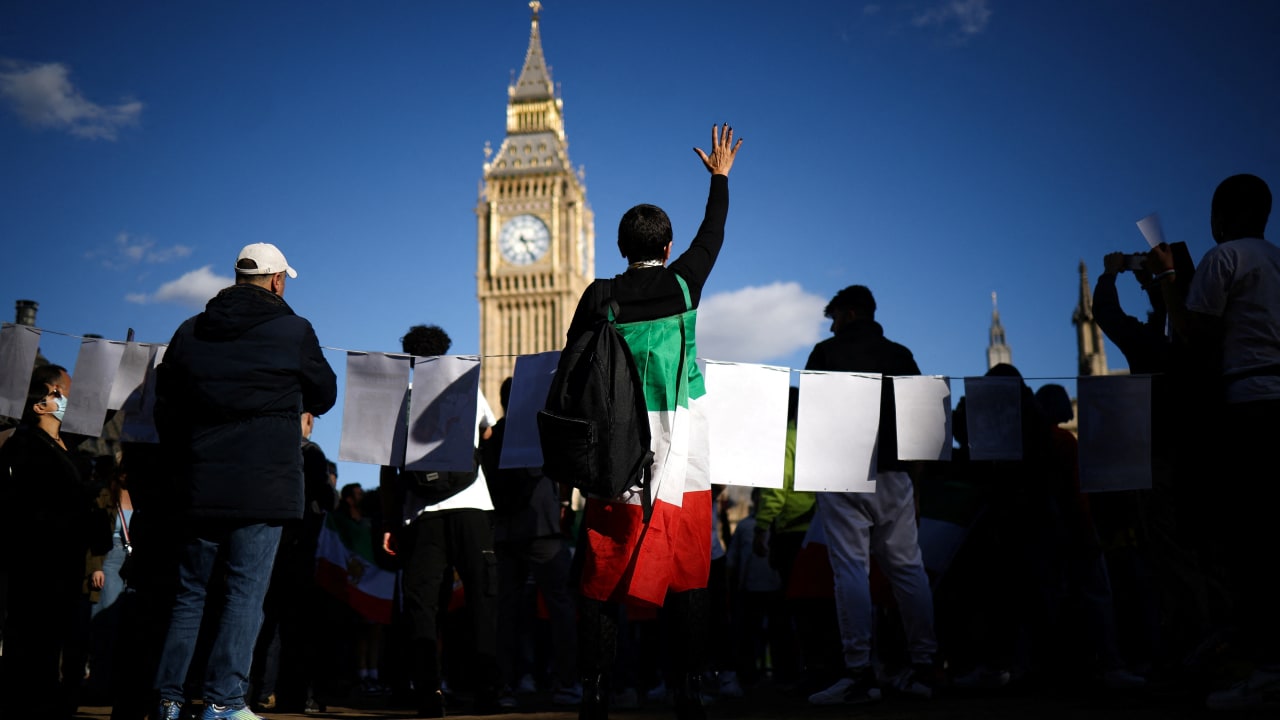
The Islamic Republic of Iran has developed a network of centers across the UK that actively promote Islamic Revolutionary Guard Corps propaganda, host Iranian officials and IRGC commanders for lectures on fundamentalist ideology, and attempt to influence the British populace to adopt an appeasement policy towards Iran, a special report by the National Union for Democracy in Iran (NUFDI) revealed on Sunday.
"The IRGC views the UK as the #1 destination to export their extremist ideology and influence to," NUFDI told the Jerusalem Post.
The new report looks at Iran’s “extensive and sophisticated” network in the UK, detailing the specific institutions and individuals responsible for “advancing its agenda.” It specifically draws attention to the Home Office’s inability to designate the IRGC as a terrorist organization, and Iran’s “vast network of propaganda centers masquerading as cultural centers.”
NUFDI claims that the most integral part of Iran’s UK operations is the Islamic Center of England, which it says “serves as the primary hub for... disseminating pro-Iranian propaganda” under the guise of “community, religious or educational organizations.”
The union categorizes Tehran’s work in the UK into three types: cultural, including radicalizing pre-existing diaspora and UK nationals, and the whitewashing of Iran’s actions; political, including lobbying British lawmakers to change policy positions and attempting to foster an appeasement policy agenda with Iran; and educational, involving the manipulation of younger generations to believe the republic’s “falsehoods” and “justify their terrorist-like actions across the region.”
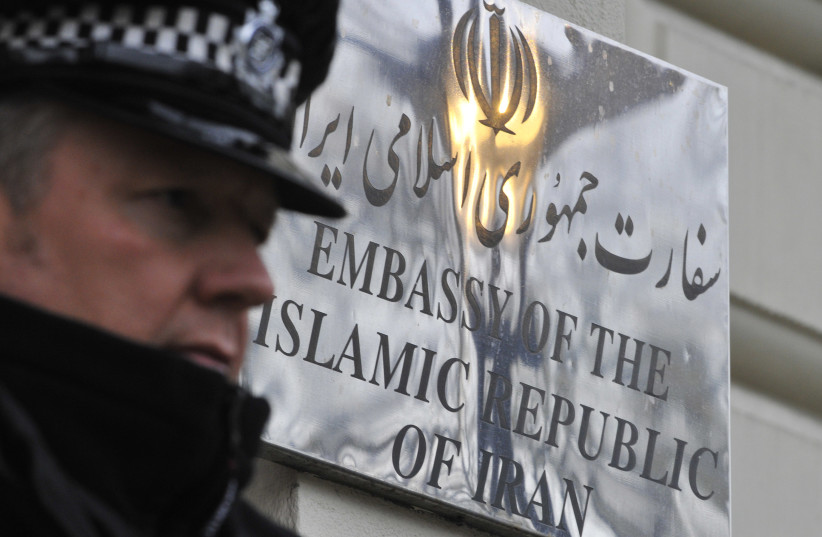
“From kindergarten to doctorate-level courses in a university setting, the IRI [Islamic Republic of Iran] has installed a robust and deep-rooted educational network in the UK, which traces its curriculum, virtues, and most importantly policy, from educational institutions based in Qom, Iran.”
The Islamic Center of England
ICE is what NUFDI calls “the head of the figurative octopus for the IRI in the UK.”
The center’s head imam is a man named Seyed Hashem Moosavi, who was personally selected by Supreme Leader Ali Khamenei and acts as his British representative.
Established in 1994, ICE is the “main artery of information between Tehran and London,” something which has been picked up on by various UK officials.
The center works by operating annexes in different cities and regions across the country, named after the area (for example: Manchester Islamic Center). Notably, many of these organizations have trustees listed publicly by the UK’s Charity Commission.
“These cultural centers enjoy the benefits of being protected by their religious/quasi-religious status and have become deeply rooted in several of the diaspora communities within the UK,” the NUFDI report said.
Cultural influence
Among the specific branches with known radicalization issues are the Manchester center (mentioned above), the Tawheed Newcastle Islamic Center, the Imam Reza Cultural Center in Birmingham, and the Al-Mahdi Islamic Centre of Glasgow.
MIC spokesperson Farrokh Sekaleshfar was the keynote speaker at the 2020 mourning ceremony of IRGC leader Maj.-Gen. Qasem Soleimani in Iran. The Newcastle branch also took part in the day of mourning for Soleimani, which actually resulted in the closure of ICE for a brief time.
The Birmingham center has been heavily criticized for receiving UK Charity Commission funding, “which was subsequently reported to have been used to fund several commemorative rallies for IRGC commanders Qassem Solemani and Abu Mahdi Al-Mohandis, two internationally recognized terrorists,” NUFDI said.
The Glasgow center was one of 11 voting locations for the regime’s elections in 2024 following the death of Iranian president Ebrahim Raisi in a helicopter crash, and also received over £372,000 for a climate change initiative they participated in despite its connections to Tehran.
Political influence
As mentioned, the political efforts of the Iranian regime in the UK focus on lobbying different groups to soften the stance of British lawmakers.
This has been somewhat facilitated, NUFDI continued, by the shift to liberalism in the West, meaning the regime is able to “position itself as a victim of Western aggression.”
“This influence extends beyond formal government channels, infiltrating think tanks, academic institutions, and media outlets to disseminate pro-regime narratives.”
One example given is the Islamic Human Rights Commission in London, which positions itself as a human rights non-profit. IHRC has a budget of over £400,000. Its current director, Massoud Shadjareh, also spoke at Soleimani’s memorial and organizes the IHRC’s Al-Quds Day.
Educational influence
The regime’s influence in Britain’s educational sphere is what NUFDI describes as the “most disturbing of the three.”
“From kindergarten to the PhD/Doctorate level, the IRI has effectively created a life-long, Islamic Republic-centric curriculum for children of all backgrounds in the United Kingdom.”
This is instrumental in “ushering in a generation of radicalized ideological based zealots” – people acting against their country and seeking to export the Islamic Revolution to the UK.
One concerning example is the normalization of critical drone technology information sharing between the regime and the UK, with IRGC officials receiving government funding to research drone tech at UK universities.
“In essence, dual-use technology that the IRI could not develop domestically is instead researched and developed within the UK via the educational network established by ICE6768,” the report said. “Reportedly, this research could be correlated to the increases in guidance range, accuracy, and ease of manufacturing as Iran began scaling up its kamikaze drone production for Russia’s war in Ukraine.”
Educational institutions known to be tied to the regime are the Islamic Republic of Iran School in London, the Tebyan Islamic School, the Navid Ayandeh International School and the Islamic College.
'Near impunity in the UK'
NUFDI explained to Post that Iran uses the UK for these purposes because "The United Kingdom has become an epicenter of Iranian terrorism and anti-Western ideology, largely due to a permissive political environment."
"Successive governments have allowed regime-linked institutions to operate with minimal scrutiny, effectively welcoming Iran’s terrorist preachers and sympathizers with open arms."
"This has enabled the MOIS and IRGC to expand their footprint in the UK with near impunity. Combined with the UK’s financial openness, immigration policy, and media reach, the result is a deeply entrenched network of malign influence. For too long, the Islamic Republic has been allowed to act unchecked."
While the report focused on the UK only, NUFDI said that initial research indicates that institutions bearing the same nomenclature and symbology exist within the US and other nations in Europe.
NUFDI told the Post that it was particularly surprising to see that the IRGC "has been able to create institutions that appear peaceful or cultural from the outside, but in reality act as thinly veiled frontline influence centers to whitewash and appease the crimes of the regime."
Most shocking for NUFDI was perhaps the "vastness of the operation," particularly in the educational domain, with over 20 institutions found to be linked to the republic.
"The UK needs to make it harder for the Islamic Republic to push their agenda on British soil," NUFDI added. "An easy first step that has been long demanded is to proscribe the IRGC as a terrorist organization. Additionally, we’d like to see the UK government take steps to block the funding, political protection, and the growth of the organizations that are linked to the Ayatollah."