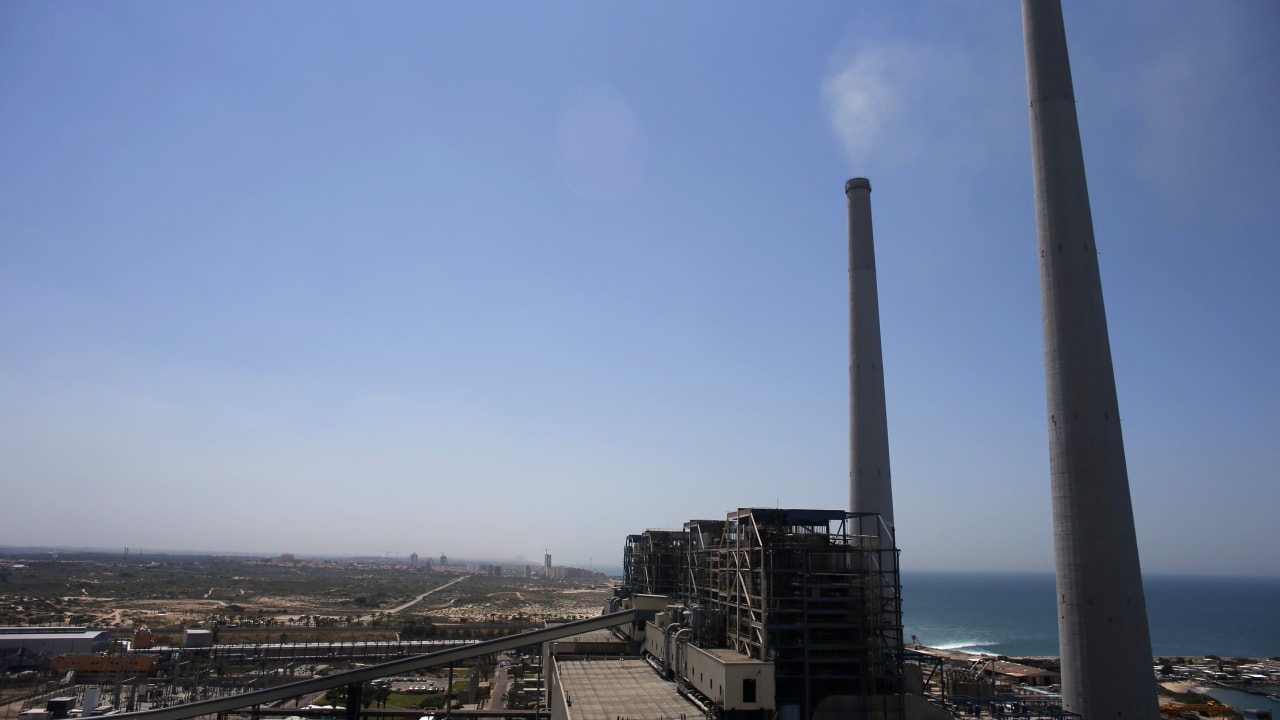
After many years of residents of the city of Hadera and the surrounding area suffering from unusually high air pollution, they received news on Tuesday that a significant reduction in the coal stockpile at the Orot Rabin power station will soon be implemented, along with continuous monitoring of coal dust emissions.
The Hadera Municipality announced that it has approved a move that will allow the Israel Electric Company to operate the planned units 70-80 on natural gas. As a condition for operation, it was determined that the existing coal pile and the on-site coal stockpile will be significantly reduced, and that, for the first time, orderly and advanced monitoring of coal dust will be conducted along the perimeter fence of the Orot Rabin complex at four monitoring stations.
The reduction in coal dust pollution is expected to be significant, about 80% of current levels, and the monitoring will enable close oversight of emissions and pollutants, providing a response to the demand of the municipality and the Sharon-Carmel Association of Cities for Environmental Protection for real and transparent environmental supervision.
In addition, units five and six, the main existing electricity generation units that currently operate on coal and are equipped with advanced pollution reduction systems, are also expected to enter a conversion process to natural gas. This project is expected to last about two years and is considered important environmental news, as operating the units on gas will sharply reduce pollution levels compared to coal.
This is significant news for city and surrounding-area residents, who have long suffered from high air pollution. The situation not only harmed residents’ quality of life but also prevented the development of new neighborhoods near the power station.

The Hadera Municipality emphasized that it will insist on completing the process to shut down coal-fired units one through four, the oldest and most polluting electricity generation units at the station, which operate on coal and continue to be active even today, despite having been scheduled to close in 2022 under a government decision. The target date has been repeatedly postponed and now stands at the end of 2026, when a coal stockpile for backup is also expected to remain at the site.
Hadera Mayor: Hadera achieving tremendous accomplishment for health, quality of life
Hadera Mayor Nir Ben Haim said, “Thanks to a persistent struggle for the basic right of Hadera residents to clean air to breathe in the city, we succeeded, in cooperation with the Energy Ministry, the Environmental Protection Ministry, and the Israel Electric Company, in achieving a tremendous accomplishment for health and quality of life in the city of Hadera.”
Environmental Committee chair Ron Shagan added, “Together with our partners in the Association of Cities for Environmental Protection and in cooperation with Israel Electric Company professionals, we will carry out an ongoing process of monitoring, learning, and improving pollution reduction measures, which will allow us for the first time a real ability to ensure that the air Hadera residents breathe will be cleaner and healthier.”
On Wednesday, as part of the government's decision to reduce coal use, the Electricity Authority approved the operating license for Unit 80, which will use combined-cycle technology and run on gas with diesel backup, with a capacity of about 650 megawatts.
Unit 80 is the second new station at the Orot Rabin site in Hadera, operating on combined-cycle technology, joining Unit 70, which is already operating there using this technology.
Its establishment and operation are intended to stop the use of the most polluting units in the economy located at the site, units 1 through 4, which will now move to a preservation mode and be used for emergency backup only.
The unit’s advanced H-Class technology is widely regarded as the most efficient in the world, delivering exceptionally high energy efficiency. This means generating more electricity with less fuel, while dramatically reducing air pollution and greenhouse gas emissions compared to the old coal-fired units it replaces.
The license will take effect upon deposit of the required bond, subject to approval by the Energy and Infrastructure Minister, and will remain valid until 2049.
The Environment and Climate Change portal is produced in cooperation with the Goldman Sonnenfeldt School of Sustainability and Climate Change at Ben-Gurion University of the Negev. The Jerusalem Post maintains all editorial decisions related to the content.