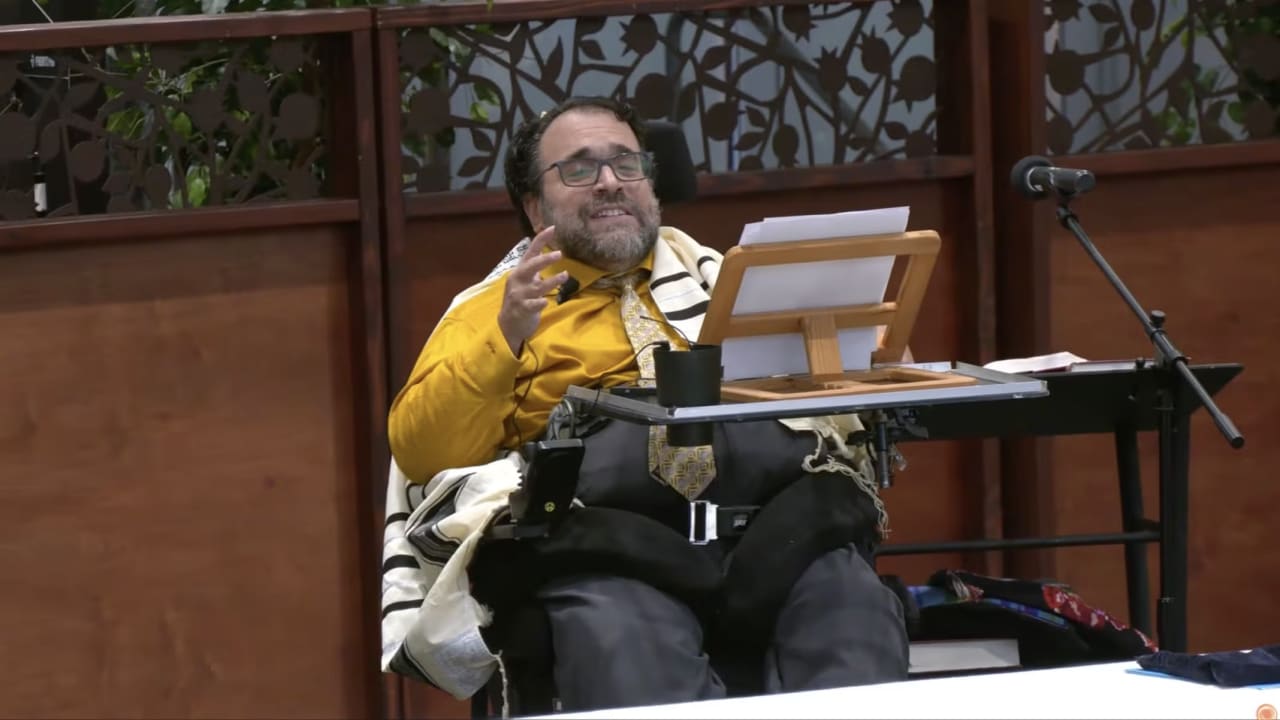
Matan Koch needed little introduction as he rolled up to the podium to speak at his synagogue’s Disability Shabbat service in October. His wide smile and power wheelchair made him well known to many in his Los Angeles congregation, Ikar.
Still, Rabbi Sharon Brous, beaming at him, described her congregant warmly before ceding the microphone.
“The most important thing for you to know about Matan is that he is a deeply soulful, profoundly decent, and incredibly kind human being. And every single day that you have been in our community, you have made our community better,” she said. “It’s an absolute joy and honor to dive in with you, to call you a friend, and to have you as a beloved member of our community.”
In the sermon that followed, Koch described times that he had felt excluded from Jewish communities or struggled to be included because of his own disabilities. He urged his fellow congregants to change the way they think about inclusion.
“Every time you’re looking for one more participant, one more volunteer, one more Torah reader, think about who is excluded from our community by disability or any other reason - and think about how we would be enriched if only they were here,” he said. “Then let that motivate us to create an inclusive community that truly lets everyone in.”

It was a synopsis of the mission that Koch carried with him in his personal and professional life. Koch, who used a wheelchair throughout his lifetime and was respected as an accomplished lawyer, a passionate advocate for people with disabilities, and a committed member of Jewish communities, died Friday in Los Angeles after a brief but fierce battle against stomach cancer. He was 44.
“His condition declined far more quickly than he, and we, had hoped,” his family wrote as they shared the news of his death on his Facebook page, filled with remembrances from hundreds of friends and followers from across the country.
“Ever optimistic, he pushed to squeeze every drop of love and connection and intellectual engagement out of life,” they added. “Even as options narrowed, Matan remained focused on staying present and connected to the people he loved.”
ADA compliance officer for Los Angeles
At the time of his death, Koch was the Los Angeles ADA compliance officer and director of its disability access and services division, ensuring that the city complied with the requirements of the 1990 Americans with Disabilities Act.
In the last post he authored earlier this month, Koch expressed both anger about his illness and appreciation for the many people who were contributing to a crowdfunding campaign to allow him to die with dignity at home.
He said he was feeling “fury that my life has been cut so tragically short, euphoric, overwhelming at the outpouring of love and support, and awe and gratitude for my family as they work with all of you in a full court press to see my needs met.”
Born in 1981 in New Milford, Connecticut, Koch was both brilliant and precocious, and, from an early age, moved through a world not built for his body with clarity and determination, according to Rabbi Shira Koch Epstein, one of his four siblings.
Born prematurely, he had cerebral palsy, a neurological condition that severely limited his mobility and required him to use a wheelchair.
It was just a few years after the passage of the Individuals with Disabilities Education Act, which reshaped schools' requirements for serving students with special needs. Yet his parents, the late Rabbi Norman Koch and Rosalyn Koch, a Jewish educator, had to fight for services from their local public schools.
Koch advanced to Yale University at age 16 and then to Harvard Law School at 20, graduating in 2005. He held numerous appointments on disability rights committees, first at Yale and then as vice president of the New Haven Disability Commission. In 2011, President Barack Obama tapped him to serve on the National Council on Disability.
“His whole life was breaking glass ceilings,” Epstein told the Jewish Telegraphic Agency in a phone conversation just hours before Matan’s death.
“He had a body that was built for a world that doesn’t yet exist, and he spent his whole life working to build systems that recognize ability, expand access, and include people across the full spectrum of disability,” Epstein said, adding, “He sees the goodness in every person he meets, and he sees the possibility.”
The family of five kids grew up in a deeply Jewish home. Epstein recalled her younger brother having deep conversations with her and their father about Jewish values and ideas.
“That was something very important to Matan. He really loved to learn and loved to sing. He sang with gusto. And he loved camp,” added Epstein, who serves as executive director of Atra, the Center for Jewish Innovation.
Their parents were leaders at Camp Eisner, the Jewish summer camp in the Berkshires, and the family spent their summers there. “The Jewish community is his home,” she said.
Rabbi Jonah Pesner, director of the Religious Action Center of Reform Judaism and senior vice president of the Union for Reform Judaism, served as director of education at Camp Eisner when Koch was a camper. He recalled a time when Koch asked Pesner to help him go to the bathroom.
Koch led Pesner back to the bunk and explained step by step how to assist, with laughter and without making Pesner feel self-conscious. “From the earliest age, Matan was engaging, mature beyond his years, and non-judgmental,” Pesner said.
After graduating from law school, Koch first worked as an associate at major law firms before striking out on his own as a consultant helping businesses and nonprofits become more inclusive. From there, he joined a disability rights organization called Respectability, moving to Los Angeles to become its local director.
Many people assumed that because he was quadriplegic, Koch must be helpless, according to Jennifer Laszlo Mizrahi, the Jewish activist who co-founded the group, now known as Disability Belongs. In fact, she said, his abilities were remarkable.
She recalled the role Koch played during the COVID-19 pandemic, a perilous time for people with disabilities, who faced high mortality rates if they became ill from the virus.
Many of his staff were disabled. They - and countless other disabled people - couldn’t risk going to a grocery store before vaccinations were available.
Koch’s team partnered with Los Angeles and the federal government to change the regulations to allow SNAP beneficiaries to have their groceries delivered in California and in several other states. “That was huge,” Laszlo Mizrahi said.
In Los Angeles, Koch was an active and beloved member of Ikar. In his Disability Shabbat sermon, he recalled an experience in college that led him to take a deep dive into a Talmudic debate on excluding people who might be distracting from leading the priestly blessing, he told them. Ultimately, the rabbis reasoned their way into acceptance.
“In using that text, Matan acknowledged the reality of how a community might interact with someone with a disability,” recalled Morris Panitz, the congregation’s associate rabbi. “People might be uncomfortable at first. But the work of the community is to get to know the person.”
Koch delivered his sermon with conviction, but gently, with his warm smile, Panitz said. This was true of him generally. “He invited people along for the journey,” he said.
“Matan Koch left an indelible mark on our community,” the synagogue told its members in an email on Sunday that added, “Matan’s persistent belief and tireless work to ensure that everyone feels welcomed and known will endure as a moral vision in our community. We will miss Matan’s enthusiastic davening, wide smile, and generous love.”
Koch could hold court in meaningful conversations as easily with heads of businesses as with Jewish texts, said Jack Rubin, one of his closest friends since they met their first week at Yale. Until Koch could not anymore, they talked for hours at a time.
“Nothing was outside the bounds of his intellectual curiosity or his capacity to wonder,” said Rubin, whose family spent the first of Passover with Koch at Koch’s home earlier this month.
“We had seder with him, for as long as he had the energy. He asked my kids questions. It was amazing,” Rubin said, holding back tears just a few hours before Koch died.
Although Koch possessed a unique ability to persuade people to embrace inclusion and create meaningful opportunities for disabled people, according to those who knew him well, he faced limits in his own life.
At one time, Koch hoped to attend Hebrew Union College and become a rabbi, Pesner recalled. He and others tried for a long time to make it happen. But Koch’s complex medical needs couldn’t be overcome within the school’s physical and programmatic constraints at the time.
“It’s the biggest regret of my career that we could not figure out how to get him rabbinic ordination,” Pesner said. “I think it was a loss for the Jewish people.”
Yet Koch never stopped pressing Jewish communities to rethink how they treat members with disabilities, challenging up-and-coming leaders at the Reform movement’s youth conference and being honored in 2016 by the Jewish disability inclusion organization Matan.
“Sometimes you can be a change-maker and be a person who’s putting out really big ideas, but sometimes it can come with a sharp edge,” Rabbi Rick Jacobs said in a movie compiled to honor Koch at the time, which also included a tribute from the actress Mayim Bialik. “With Matan, it comes with love, and he raises people up.”
Meredith Polsky, the director of the organization Matan, said in an email that her group would continue the mission of the friend and advocate who shared its name - a name meaning “gift” in Hebrew.
“Though his final breath came far too soon, we carry that charge forward, committed to building a Jewish community that reflects his vision of true inclusion and belonging,” Polsky wrote.
Koch’s father, Norman, died in 2015. Koch is survived by his mother, Rosalyn Koch, siblings Rabbi Shira Koch Epstein and Jason, Yonatan Koch, Adina Koch, and Aytan Koch; nieces and nephews Amichai, Kobi, Avigayil, Duncan, and Jason, and his honorary family: Martin Smith, Jack, and Stephanie Rubin and their children Olivia and Edward.