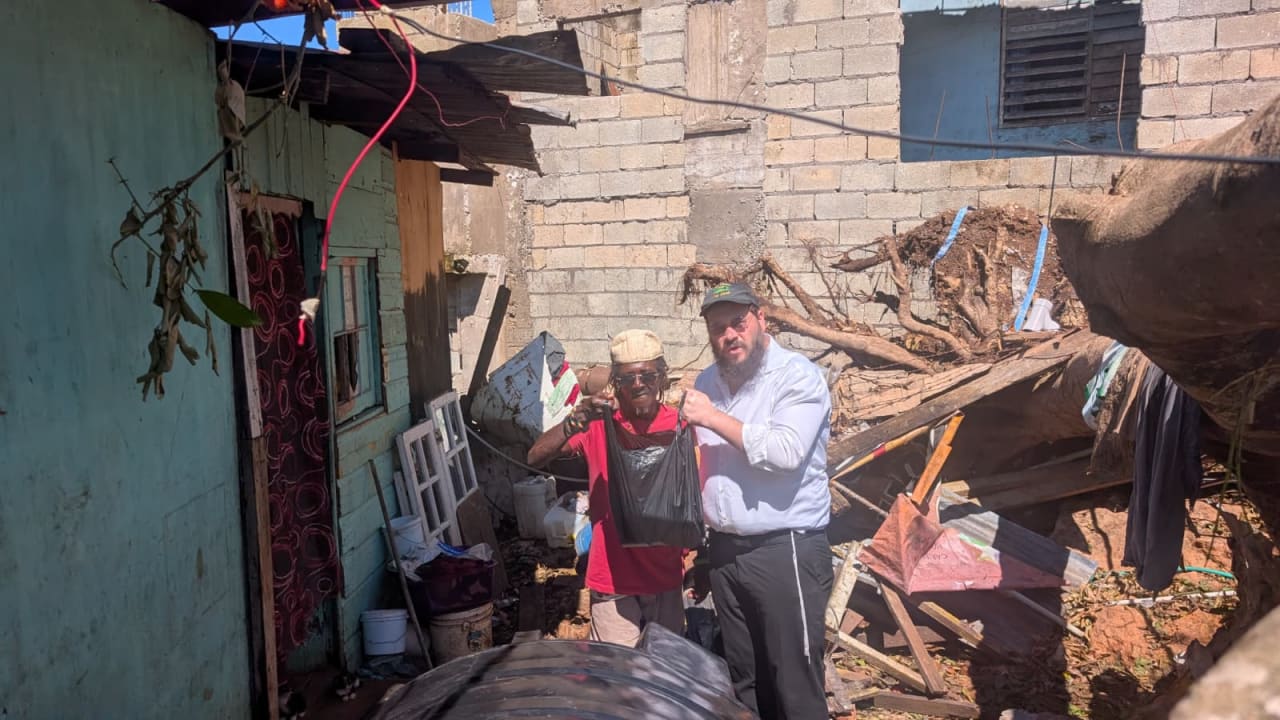
Rabbi Yaakov Raskin, locals, and Jewish tourists are sheltering in the ravaged Montego Bay Chabad center, but with high hopes for recovery following hurricane Melissa's landfall on Jamaica on Tuesday.
While the synagogue and center were damaged by the category five hurricane, Raskin said on Sunday that he was thankful to have gas in his generator and a roof over his head -- there were too many Jamaicans who had neither. When the rabbi spoke to The Jerusalem Post, he was just about to set out to deliver aid packages to the "hardest hit" regions.
"We'll overcome it and we'll rebuild, but the most important thing now is to help others," said Raskin. "Buildings can be repaired as long as we are all alive; Unfortunately, the death toll is over 30."
Over 70% of the island was without water or electricity, but because Kingston was relatively intact, Raskin anticipated that the capital's electrical grid and airport could be used as a springboard to help the rest of the island recover. With a functioning airport, aid could be flown in, and the rabbi was able to send his wife and children to stay with family in the United States.
Ahead of the storm, Raskin had boarded up every pane of glass and entry point for water. Despite his efforts, the center suffered some flooding, and windows were torn away by the storm to soak and batter the rooms inside. The nursery for Raskin's five-month-old baby was "smashed." The entirety of the center's exterior has been damaged, but the concrete roof held fast against the unyielding winds.

During the storm, one door flung open where the Raskin family sheltered, in the safest part of the center. Raskin used a bedframe to force it shut. For hours, he pressed against the door, praying to God for the storm to pass, "playing tug-of-war with Melissa."
Torah scrolls were safe
The Synagogue prayer hall was mostly in "good condition," though damp, and the ceiling was leaking. Many window hinges were damaged, and one of the larger windows had shattered. The Torah scrolls were safe, moved into the Mikvah waiting room before landfall, where there were no windows.
A donor had given the center a 5,000-gallon water tank ahead of the storm, but the pipes were compromised by the hurricane, and those sheltering at the center couldn't access the water. They use a bucket of water to do their washing.
One woman staying at the center had her roof destroyed. She took refuge in her car during the storm, but considering what happened to other vehicles during the tempest, Raskin said that she was lucky nothing happened to her person. Another survivor lost her whole house, and when she came to stay at the center, she related that she hadn't eaten for two days.
Chabad Jamaica opened a fund to help gather aid and eventually rebuild. He expected the recovery of the center would take until at least February. Food, bottled water, and other items were being collected in New Jersey and Miami.
https://www.jewishjamaica.com/templates/fundraising/default_cdo/aid/7091302/jewish/Campaign.htm
"We want to thank all those who reached out and prayed for us," said Raskin. "Jamaica -- the people are resilient, they're positive. We will rebuild again. Jews and non-Jews alike, we need to appreciate what we have. Material things can be replaced. We need to be thankful for our lives, our health, our mental health."
On Thursday, IsraAid embarked on an emergency response mission to help the Jamaican government and people, focusing on providing support for water, sanitation, hygiene, mental health, and psychosocial needs.
“The damage we’re seeing from hurricane Melissa is devastating, and IsraAID is committed to standing with affected communities at this critical moment. Communities in southwest Jamaica were severely impacted by hurricane Beryl just last year and are now experiencing destruction on a whole new scale. The full extent of the damage and the urgent needs will become clear in the coming days, but we can already see the historic scale of this storm," IsraAID Senior Director of Emergency Operations Michal Bar said in a statement. "As with our previous responses in the region, we’ll stand with communities for as long as they need us.”
An IsraAid representative told The Post on Sunday that the team had arrived in the country, but the roads were still impassable. NGOs and the government were still assessing the scale of the damage, but IsraAid expected that they were dealing with a disaster of enormous magnitude.