I muffed it from the start.
When I got into the back seat of the taxi outside Arrivals at Budapest’s Ferihegy Airport, I debated whether to step beyond my usual comfort zone and start chatting with the driver in Hungarian. I knew that would be the proper thing to do, but I vacillated for too long and said nothing apart from “Hello.”
Finally, I ventured to ask if he spoke English, and with the reply in the negative, silence returned. The longer it lasted, the more awkward and embarrassed I felt about not disclosing that I speak Hungarian and thus revealing antisocial tendencies I’d rather disown.
It was a discomfiting start to my four-day weekend in Budapest, where I joined my son Josh, his wife, Elisheva, and their children, who were in Hungary for a summer vacation before their eldest started National Service (Sherut Leumi).
Josh had Googled destinations considered safe for Israeli travelers – how utterly sad that today such a question should be relevant – and the search reply bounced back: the Czech Republic and Hungary. They chose Hungary, where I was born.

Thinking it might become a bit of a “roots trip,” they asked me to accompany them. When I declined, not wanting to intrude on their week of family togetherness, we compromised, and I joined them for a few days. I felt honored to be invited.
I arrived in Budapest a few hours before check-in time at the vacation apartment rental, and the taxi driver dropped me off in the city’s seventh district, the Jewish Quarter. There, I was happy to soak up the environs of my early childhood and reconnect with vivid, if selective, memories. This included the 1956 Hungarian Revolution, when, as a child, my parents and I fled the country (see “Memories of the Hungarian Revolution,” The Jerusalem Post, November 11, 2021).
The familiar street names warmed me like a favorite old woolly sweater. On that hot August day, I sat in a shady spot on the grass of Klauzal Square, in the heart of the Jewish Quarter, and lunched on the grapes and rye toast I had with me. Despite other groups and individuals relaxing in abundant tree-shade, the pretty picture seemed flat, as if the volume was muted and the lens at slow motion.
The quietness of the little park and its surroundings was unexpected and disconcerting – like a toy town, functional and robotic, missing life’s pulse, vibrancy, and joy – in stark contrast to my embracing Jerusalem neighborhood.
I lugged my 17-kilo suitcase (weighed down mostly by food for Shabbat, just in case...) to the short-term rental apartment in an old, once handsome, low-rise building. It had a typical layout with an inner courtyard, toward which all apartment doors faced – identical to my childhood home just a few streets away. My heart sank as I hauled the suitcase up dirt-brown, broken-edged stone stairs to the second floor, rousing childhood connections to fear-filled days sheltering in the cellar of our building when Russian tanks rolled through Budapest in October 1956.
It sank even lower when I entered the apartment: linoleum-floored, windowless living area, sofa with a cigarette burn, electrical wiring curling around door frames, chipped paint, dirty windows, all under shadowy ceilings more than three meters high, which only added to the gloom.
Photos on online booking sites can be misleading, and I thought briefly about upgrading to a hotel. But the air-conditioning was excellent, and I realized that this experience could be turned into a memorable adventure that would give my family a realistic window into Budapest of the 1950s. Not entirely realistic, though, since my childhood apartment had been in very good condition.
Later, when I led the family to 55 Wesselenyi Utca, where I had lived for most of my first decade, a resident just then happened to unlock the building’s entrance door. As we walked into the courtyard, someone came out of the apartment I had lived in, and they let us have a brief look inside.
It’s now a gorgeous Airbnb – upmarket, minimalist, and white-on-white. This isn’t surprising, since Hungary is a major tourist destination; 2024 was a record year, with millions of visitors bringing substantial revenue to Budapest and the countryside.
Sightseeing in Budapest
We fitted in a fair share of sightseeing despite the heat, which included a city tour on an amphibious bus that took us to the immense Heroes’ Square topping the wide tree-lined avenue nicknamed the “Champs-Élysées of Budapest.” The guide reeled off facts about the city and nation in that distinctive Hungarian-accented English (not quite as exaggerated as Zsa Zsa Gabor’s).
We shrieked with delight as the bus drove down a specially built ramp and splashed into the Danube River. It headed downstream to the main facade of that Gothic wedding cake-looking building the Hungarian Parliament, which stretches 268 meters in length. Its multi-spired height of 96 m. is the maximum height of any Budapest building; 96 symbolizes the year 896 CE, when the Hungarian Magyars first came to the area and the Hungarian Kingdom was established.
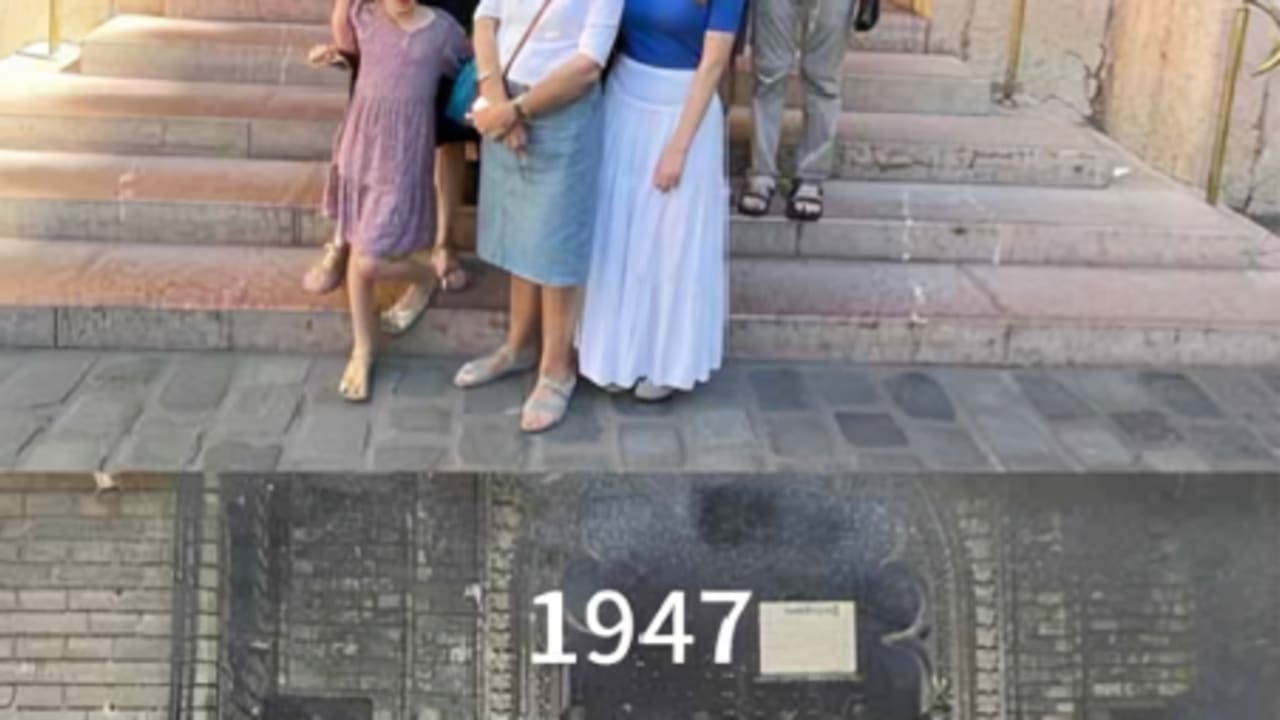
Later, we were immediately charmed by our guide Orsolya, who led us on a walking tour of the city’s Jewish sites. She focused on the grand Dohany Street Synagogue, a Moorish-style building completed in 1859, with its magnificent chandeliers and interior, a seat of Neolog Judaism, with a seating capacity for 3,000 people. My family and I posed for a photo outside the imposing entrance, a 2025 twin to my parents’ 1947 wedding photo at the very same spot.
Highly unusual in terms of location, in the courtyard next to the synagogue are graves and memorials of some 2,000 people who perished in the Budapest ghetto during the winter of 1944-45.
Frequently, in the streets of the Jewish Quarter, we stepped over metal strips embedded across the footpath that read: “Border of the Pest Ghetto,” and the dates December 10, 1944 to January 18, 1945. By then, more than 400,000 Jews had been deported to Poland from Hungary. They were exterminated in Auschwitz in just eight weeks, beginning in May 1944, including my paternal grandparents and other family members.
Hungarian Jewry was decimated relatively late in the war by the Nazis and their collaborators – the Hungarian Arrow Cross. In late 1944, thousands of Jews in Budapest were lined up along the banks of the Danube River and shot, disappearing into the water, which ran red with their blood. We saw the abandoned shoes of 60 of the murdered, which have been eternalized in a bronze memorial – a silent, forlorn, aching testimony.
Our guide led us through the small Hungarian Jewish Museum next to the Dohany Street Synagogue, where had stood the house in which Theodor Herzl was born in 1860. As we walked past glass cases displaying the physical essence and symbols of Jewish life – old and loved Torah scrolls, phylacteries, prayer books, Seder plates, hannukiot, havdala sets – it felt as if the preservation of the past substituted for the living and growing future.
Before the Holocaust, 24% of Budapest’s population had been Jewish. Some 565,000 Hungarian Jews were murdered between 1944 and 1945; many of the survivors fled the country after World War II and in the ensuing Communist era, when they could.
Today, there are some 100,000 Hungarian Jews of varying degrees of religious (non)identification. Whether it was my Hungarian roots, the dulling discomfort of a hot summer, or a reasonable assessment of what we saw, I was simply sad for the Jews living there, as if they were treading water, trying to hold on in the face of the pulling tide.
That’s what I felt even when enjoying meals at the kosher restaurant and café, where there were few smiling faces. Josh recounted that the prayer services were “a little depressing” at the small shul next to the impressive (and currently closed) Orthodox Kazinczy Street Synagogue.
Sad, too, like in many European countries, is the low birthrate; 1.5 births per woman does not augur well for the future of the nation. Our guide on the Jewish tour has two children and is thus eligible for reduced tax – a government measure to encourage families to have more children.
I didn’t see evidence of this, though, as we walked in the city on Shabbat afternoon. The majority of families I saw consisted of parents with one child, who was dressed and acted like a mini-adult. Exactly like my family in the 1950s, but that was post-war Europe rather than almost 80 years thence.
Trip highlights
Our trip also had many highlights. For instance, my eight-year-old granddaughter Netta’s take on overseas travel: “We’re so lucky they don’t have kosher, so we always have to buy Coca-Cola!” And seeing my grandsons wear their kippot, tzitzit showing, and Hebrew writing on T-shirts – not a problem in the city or countryside.
Prices are reasonable, and cleanliness is prized. My family wanted me to speak Hungarian with the locals so they could get a glimpse of the person I was before they came along.
Wherever you vacation with loved ones, it’s an enriching special treat. Coming back home to Jerusalem was the final highlight. I just wish that I had brought back some of those small, juicy, golden-fleshed purple plums, and the long, crisp, light-green peppers with the perfect amount of spicy heat in every crunchy bite.
Certain childhood memories remain forever.
The writer was a lawyer in Melbourne, Australia, before she and her husband, Joe, made aliyah in 2015 to join their children. She lives in Jerusalem, where she writes and reads for pleasure and emotional sustenance.