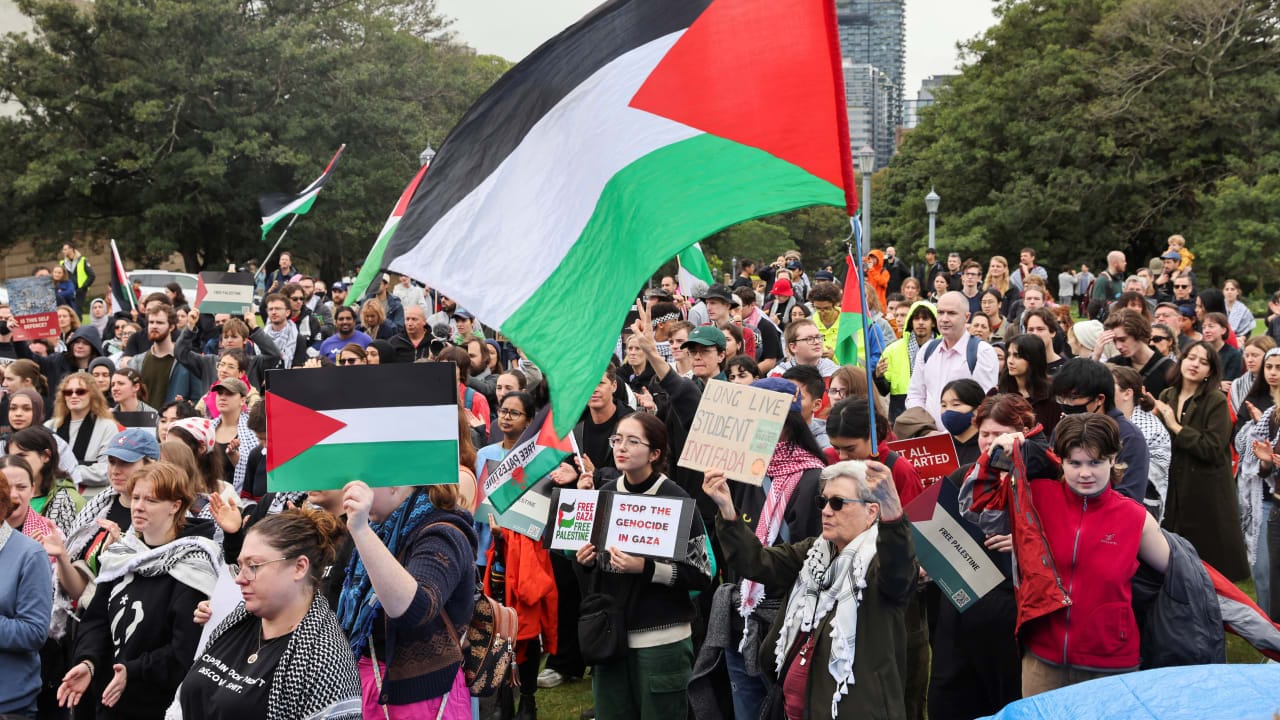
Two protests scheduled as part of Australia’s Nationwide March for Palestine carry a “high risk level,” according to Israel’s National Center for Combating Antisemitism. Pro-Palestinian groups, including the Australia Palestine Advocacy Network, local Justice for Palestine branches, and an affiliate of the UK’s Palestine Action, have jointly planned a day of coordinated action on August 24 across 27 cities.
Multiple trade unions and union federations have also backed the protests, including the National Tertiary Education Union, Unions NSW, Hunter Workers, Unions WA, and the South Coast Labour Council. This is the first time union federations have backed Palestine Action in any coordinated way, Australian media reported.
The key demands of the groups are sanctions on Israel, an end to the two-way arms trade, and an end to “genocide.”
Tens of thousands marched across the Sydney Harbour Bridge earlier in August
The National Center for Combating Antisemitism noted that many of the protests are not located in areas with significant Jewish or Israeli communities, with the exception of two: one in Sydney and one in Melbourne.
Given that these protests are set to take place in highly central areas of major Australian cities, the NCCA said there is a likelihood of spontaneous clashes with security forces and passersby. Additionally, the turnout is expected to be in the thousands, leading to the NCCA’s designation of a “high risk level.”

The Queensland Police Service (QPS) announced on Monday that it intends to take one of the pro-Palestinian protest organizing groups to court in an effort to stop a march over Brisbane’s Story Bridge during the national march.
Justice for Palestine Magan-djin officially notified the municipality of its plans to march on the bridge on August 7, which police said raised “public safety concerns” and could pose “significant disruptions to the rights and freedoms” of others.
“The QPS respects the right to peacefully assemble; however, this must be balanced with the need to ensure public safety and minimize disruption to the broader community,” they said in a statement.
According to the Australian Broadcasting Corporation, no resolution through mediation between the police and the protesters was reached as of Monday.
A QPS spokesperson told ABC that the service would now lodge documents in the Brisbane Magistrates Court in an attempt to stop the march from proceeding over the Story Bridge. Remah Naji, a spokesperson for Justice for Palestine Magan-djin, said, “This ongoing livestreamed genocide demands visibility. It is not enough for us to do the usual routes.”
Tens of thousands marched across the Sydney Harbour Bridge earlier in August after it was authorized by the High Court.
Diplomatic disputes between Israel and Australia are heating up
Relations between Israel and Australia have soured since the country’s leader, Anthony Albanese, announced his plans to recognize a Palestinian state in September. An additional contretemps broke out between Albanese and Prime Minister Benjamin Netanyahu on Tuesday after Australia banned MK Simcha Rothman from the country less than 24 hours ahead of a planned solidarity trip with the country’s Jewish community.

“History will remember Albanese for what he is: a weak politician who betrayed Israel and abandoned Australia’s Jews,” Netanyahu wrote on X/Twitter.
In response, Foreign Minister Gideon Sa’ar announced that he would be revoking the residence permits of Australia’s representatives to the Palestinian Authority and that any future official Australian visa requests for entry to Israel will be put under careful review.
Australian Foreign Minister Penny Wong called Sa’ar’s decision an “unjustified reaction” in a statement, continuing that the “Netanyahu government is isolating Israel and undermining international efforts toward peace.”
Keshet Neev and Reuters contributed to this report.