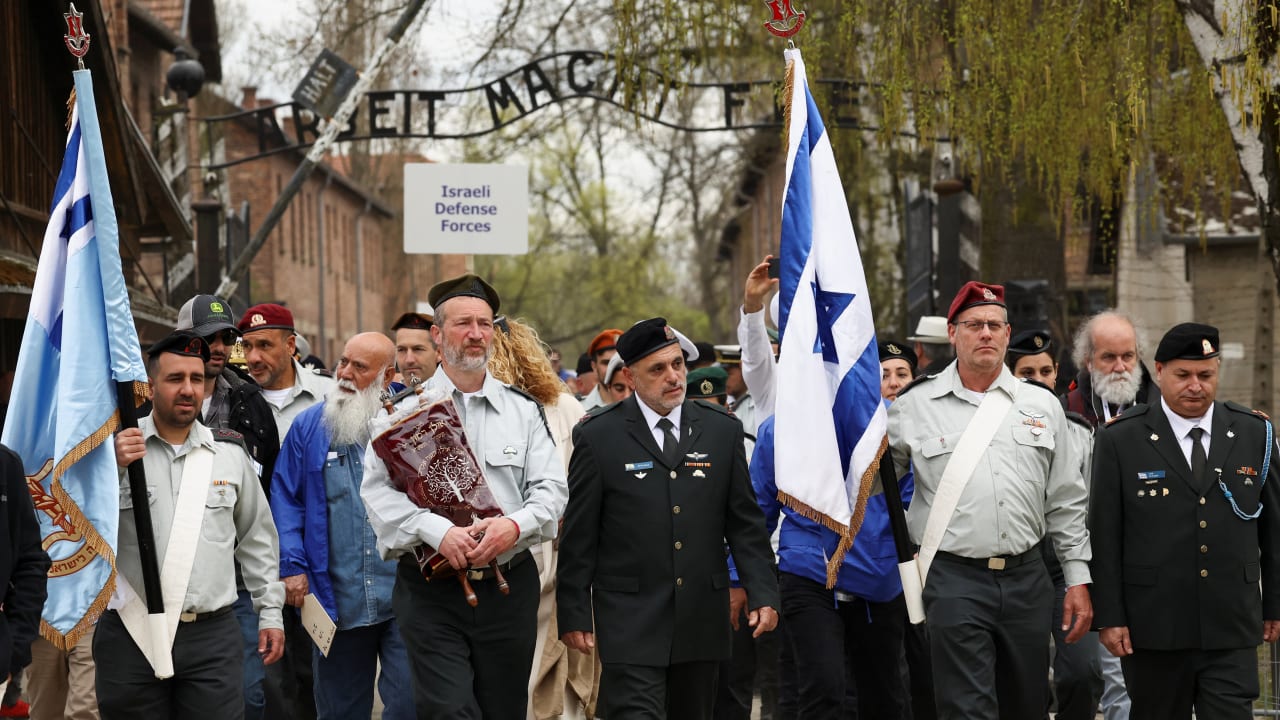
KRAKOW - Nearly two thousand visitors flocked to the Penderecki Hall on Monday evening to honor Holocaust survivors who came to lead the March of the Living. The annual march where Jewish youth, dignitaries, and educators walk from Auschwitz to Birkenau to remind humanity of Nazi crimes against the Jews and cry out against antisemitism.
Hundreds of burning memorial candles lit the orchestra pit while Agam Berger played a violin donated by an Israeli family of a Holocaust survivor to Yad Vashem.
Berger, a survivor of the Hamas October 7 terror attack held captive in Gaza, expressed Jewish resilience against murderous hatred.
"Even after experiencing the worst, Holocaust survivors rebuilt the world one mitzvah at a time," a Canadian-Jewish youth told the audience, sharing her experience that, today, "being openly Jewish is not always accepted."
"Crowds marched from the Sydney Opera House chanting 'Gas the Jews'," an Australian-Jewish speaker shared. He added that he and his wife are currently discussing exit plans, what to do if Jewish lives in Australia would no longer be safe.

"How many of the people murdered during the Holocaust had such plans too?" He asked.
Holocaust survivors lead March of the Living
The elderly survivors lit symbolic torches and handed them to the Jewish youth present. Each accepted their respective missions: to stand up to hatred, to teach others the lessons of the Holocaust, and not to stand idly by when evil things happen.
Jordan Nachmias from Toronto arrived wearing a photograph of his grandfather, Haim Cohen, who was murdered in Auschwitz, around his neck.
Born in Morocco, Cohen was living in Belgium when WW2 broke out, and the Nazi Reich started the so-called 'Final Solution', to send all Jews to their deaths in camps built in occupied Poland.
"This is my second time here," Nachmias told the Jerusalem Post. "I first took part in March of the Living when I was 16-years-old."
Now a father himself, he was deeply shaken by the Hamas terror attack on October 7 and believes that Jewish self-agency and advocacy must grow.
"It's up to us to know, even without the stones," the barracks of the camp, "and tell people it was real," he told the Post.
"In 100 years, who knows if Auschwitz will even be here anymore?"