Pro-Palestinian activists were expelled from an interfaith event in Dakar, Senegal, when they interrupted a speech by the Israeli ambassador.
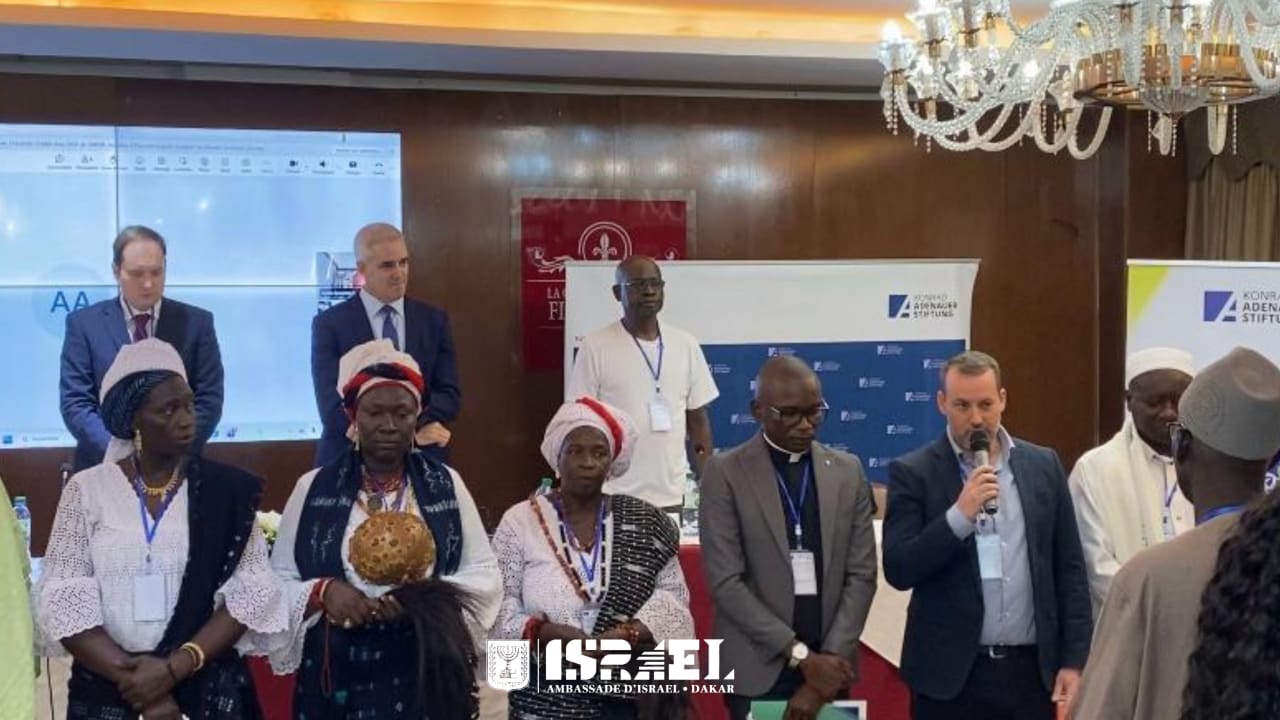
The incident occurred last week during the 25th Konrad Adenauer Foundation interfaith event, which had the theme “Religions in Senegal: Between Heritage, Modernity, and Spiritual Recompositions.” Of the 25 years the conference has been held, 17 have been in partnership with Israel.
The symposium brought together the ambassadors of Germany and Israel, as well as the director of the Islamic Institute of Dakar.
KAF member Waly Aliou Youm said, “What we have in common is our traditional religions. Neither my father nor my mother was born Muslim or Christian. I am Roman Catholic. But I believe that what unites us most deeply is our religions of origin... This has not removed what is the foundation of our country here, the question of traditional religions, which certainly underpins the fact that we continue to live together.”
In his speech, Jonathan Nowak, representative of the KAF in Senegal, remarked, “This is the 25th time we have organized this meeting between different religions and communities in a spirit of tolerance, peace, and living together.”
“All Senegalese should be proud of this spirit of tolerance, openness, and exchange,” he added.
'Israel is a genocidal state': Pro-Palestinian protestors
However, during the speech of Ambassador Yuval Waks, anti-Israel protesters caused a commotion by shouting, “Free Palestine,” and “Israel is a genocidal state,” and declaring that he had “no place in the meeting” and that Waks’s presence went against the intention of interreligious dialogue. The activists were ultimately expelled.
Waks continued with his speech about forging peace, noting that Israel began having peace agreements with Jordan and Egypt and “will continue to seek peace in the Middle East.”
Also representing the Jewish community at the KAF conference was Rabbi Elhanan Miller, who read the prayer, “He who establishes peace on the heights, he will also establish peace for us, for all Israel, and for all the inhabitants of the earth.” He then proceeded, at the request of a local sheikh, to recite the closing verses of the Quran.
Miller has previously praised Senegal for its efforts at dialogue, remarking, “One thing we can highlight and learn from Senegal is religious and community coexistence.”
The Israeli embassy in Senegal called the conference “a moment of great depth, carried by a common aspiration: that of a world where faith becomes a bridge, where believers meet in respect, and where each tradition illuminates, in its own way, the great human family.
“In celebrating this quarter century of dialogue, understanding, and listening, we honor the commitment of all religious communities that work every day for peace, solidarity, and social cohesion. Their action reminds us that living together is not only a heritage but a renewed choice, a shared commitment.”
This is not the first time Waks has been protested; in April this year, he was chased out of a conference at Cheikh Anta Diop University in Dakar by protesters who opposed his participation.
Senegal-Israel relations
Senegal is a 97% Muslim country, with the majority coming from a Sunni background. There is said to be a very small Jewish community in the country, mostly French Jews who are working at international organizations. However, Jews have lived in the country since around the 14th century, when they were expelled from Spain and other countries.
Israel was one of the first countries in the world to recognize Senegal’s independence from French colonial rule in 1960. The two now enjoy full diplomatic relations.
In an article on Ynet following the event, Miller recalled that Golda Meir visited in 1964 as foreign minister, followed by prime minister Levi Eshkol two years later, and that Israel has long assisted Senegal in agriculture.
Nevertheless, he added that in a traditional society like Senegal, “where deep anti-Israel sentiments persist, classical diplomacy has limits.”