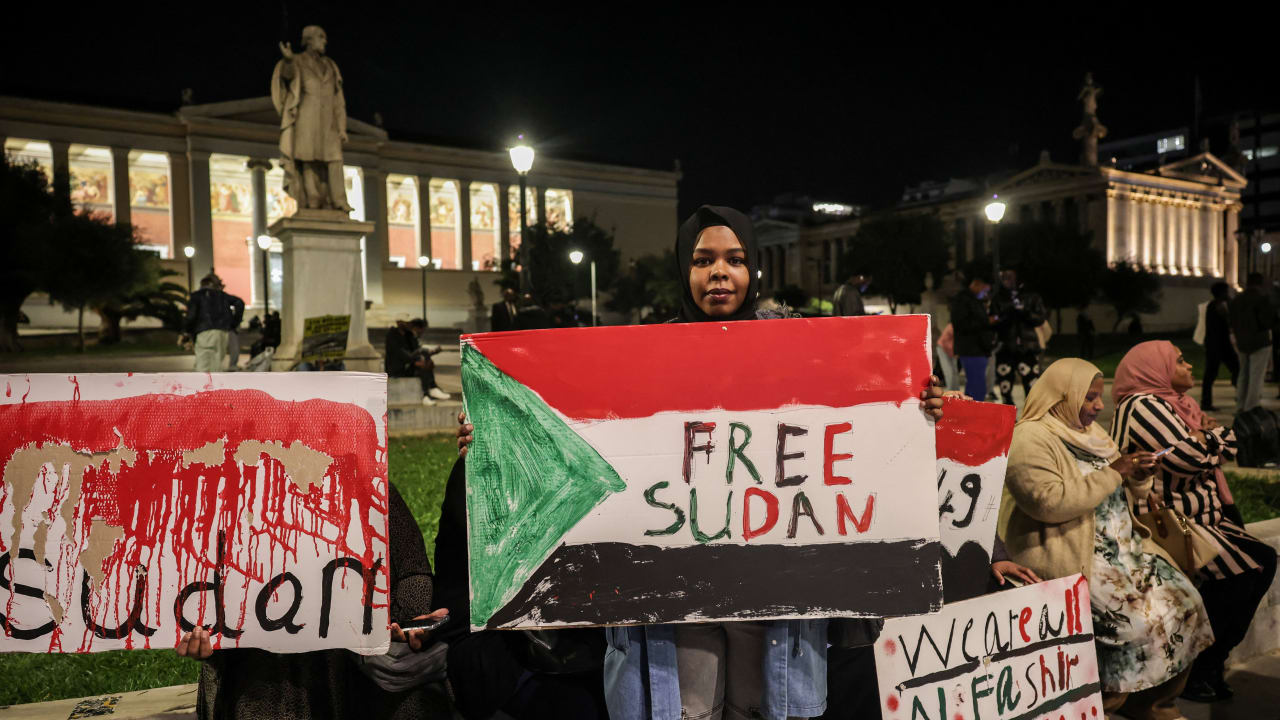
The latest phases of the Israeli-Arab conflict and the Sudanese civil war both began in 2023. Yet, even when the brutality regarding the latter rose to a crescendo in late October with the El Fasher massacre, the African conflict did not muster the same level of attention as its Levantine counterpart.
What stands behind this disproportionate attention is simply a matter of utility: Activism for the Israel-Hamas War advances political objectives; activism for the Sudan conflict does not.
The narrative parallels are there for any Western activist who would care. Anti-Israel activists have accused Israel of the deliberate slaughter of civilians, cutting off humanitarian aid in a siege, and displacing hundreds of thousands of people.
While there have been estimates ranging from 20,000 to 150,000 deaths since the fighting in Sudan renewed, there have been no mass protests in the streets, activists lying outside on the ground to represent the war’s victims, or red paint splashed on businesses and monuments to demand an immediate ceasefire.
Meanwhile, the UN World Food Programme has confirmed famine conditions in some areas of Sudan, with over 21 million people facing acute food insecurity. Nevertheless, streets have not been occupied every week with protesters calling on governments to provide humanitarian aid.

Furthermore, although El Fasher suffered a devastating 18-month siege, there were no celebrity-filled flotillas seeking to break the blockade, nor were “all eyes” on El Fasher when the invasion finally commenced.
Even when an alleged massacre unfolded at the Saudi Hospital, there were no mass calls to boycott anything associated with the Sudanese Rapid Support Forces (RSF) or its backers by “professional members for Darfur.”
Many have pointed out the hypocrisy of career activists focusing on one conflict and not the other, when the war in Sudan has reached the stage at which even The Guardian claimed that the blood stains could be identified by satellite imagery alone.
Yet few have sought to explain the difference in focus.
The choice of focus can be understood through the motivation of the post-October 7 massacre protest coalition.
There are several far Left political movements in this coalition. They have prioritized the Gaza war as an issue to bind various Islamic and Marxist groups to disrupt systems across the West. Many see Israel as an outpost of an American empire, standing on the frontline. They believe that if the Jewish domino were to fall, it would cause the US to falter.
“We mobilize in the belly of the beast because we understand that we have a unique role to play in combating material support for Zionism, and weakening the handmaiden of US global imperialism,” the People’s Forum, the Party for Socialism and Liberation, and the ANSWER Coalition said in an October 8, 2023, joint statement with Palestinian nationalist groups.
Anarchist groups have also suggested that harming Israel would bring about the collapse of the US, as indicated in flyers circulated at the University of Michigan in 2024.
“Ultimately, our main task as revolutionaries in the United States remains to be the unmaking of the American empire,” the flyer read. “Freedom for Palestine means death to America.”
In January, in response to a Gaza ceasefire, progressive Jewish groups said that its perceived victory over Israel had “fractured the Zionist entity” and that this would serve as “the first step to the inevitable fall of empire.”
Sudan's lack of support happens because there is no American Imperialism
The enemy of revolutionary groups is imperialism, and the ghost’s traces are elusive in the Sudan conflict. Yet if there is any imperialism in Sudan, it is not of the American brand. Each faction has alleged regional backers, such as the UAE or Saudi Arabia, but the US is a distant influence.
When Code Pink issued a rare statement about Sudan on Saturday, it was about blaming the US for arming the UAE, which in turn allegedly armed the RSF. The story is not as simple, doesn’t narratively flow as well, and falls flat when Russia’s PMC Wagner, at times, supported the RSF.
The inability to harm US interests reduces the incentive to interfere in the conflict.
Western Palestinian nationalist and Islamist groups are in a similar situation, though often, they seek to coerce or harm America domestically in order to strategically damage Israel.
“US imperialism and Zionism are inseparable,” Within Our Lifetime founder Nerdeen Kiswani said on X/Twitter on Sunday.
“Zionism depends on US power to sustain its occupation, while US imperialism relies on Israel to enforce its dominance in the region and beyond,” Kiswani continued. “They uphold each other, two sides of the same coin.”
Since the September ceasefire, the pro-Palestinian groups have pivoted from calls for a truce to demands for arms embargoes.
The Palestinian Youth Movement stated in an October Instagram post that Western supporters “must organize for the implementation of an arms embargo. Our cities, legislatures, and workplaces can no longer be pipelines for genocide.”
In a statement it posted on its website, Jewish Voice for Peace said that “even with this ceasefire in place, our movements will continue to call for an immediate and full arms embargo and an end to the complicity of US corporations that profit from ethnic cleansing.”
Palestinian nationalists are obviously focused on the interests of their compatriots, and Sudan seems to serve only one purpose for them insofar as they can use it to draw attention to Gaza or attack Israel and the US.
Some groups in this regard have joined forces, such as the PYM Ottawa’s collaboration with protests for Sudan in the Canadian capital, but signs and social media conflated the Sudanese and Gaza conflict.
PYM Ottawa blamed Israel and the US for the crisis in Sudan, declaring that “just as our enemies are united, we must be as well. From Gaza to Darfur, we must stand side by side in our fight against imperialism!”
On November 1, Palestinian writer Susan Abulhawa called on X for a boycott of the UAE for its alleged involvement in the Sudan war, but related the issue just as much to the Gulf state’s relations with Israel.
Islamists have little to gain from a power struggle that falls less neatly along religious lines than ethnic and tribal conflicts. For those who support Hamas’s jihadist inclinations, Israel is of far more importance, given its religious sites and theological challenges to doctrines of Islamic supremacy.
American far-right doesn't care about Sudan
For segments of the American Right that have obsessed over Israel in recent months, there is a similar lack of utility. The isolationist factions, or elements that have found purchase on the issue of Israel by tapping into this concern, do not care for matters that are beyond the US.
The conflict is a local or regional issue with little American input, rendering it beyond their purview.
White supremacists and neo-Nazis have used the cover of Israel and anti-Zionism to advance their own ideologies, promoting theories of Jewish control and conspiracies under more digestible anti-Israel terminology and framing. Scapegoating Jews for the ills of society, such as blaming them for every war, has little grounding in an African civil war.
The mass protests against Israel that have wracked the West have always been a combination of aligned political interests. They have never been about a principled position on mass murder or human rights, but about utility and power. No matter how large the tragedy of the Sudan conflict grows, it will never serve as a suitable vehicle for these interests.