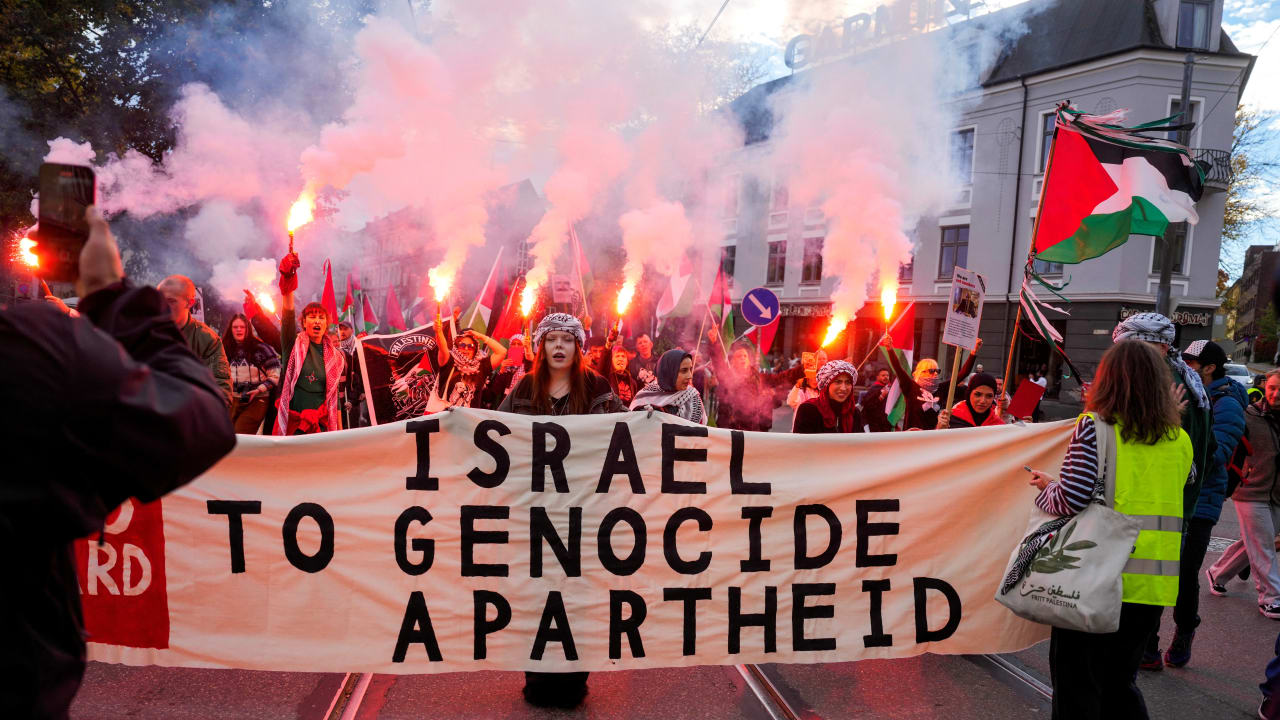
The growing criminalization of expressions of solidarity with Palestinians constitutes a violation of fundamental freedoms, the International Federation for Human Rights (FIDH) said in its report, published on Wednesday.
Titled “Solidarity as a Crime: Voices for Palestine Under Fire,” the study presented FIDH’s research into what it calls “the repression of the solidarity movement with Palestine.”
It was conducted between October 2023 and September 2025, covering four countries: France, Germany, the UK, and the US.
These states were selected because they all took “public positions supportive of Israel’s actions in Palestine” and allegedly “responded to pro-Palestine solidarity protests with disproportionate restrictions,” the federation said.
According to FIDH, the report aimed to outline the manner in which those protesting against the “genocide in Gaza” suffered “stigmatizing narratives, policing, surveillance, administrative sanctions, criminal sanctions, kidnapping and detention.”

It ultimately concluded that the “growing conflation of antisemitism with legitimate criticism of Israeli state policies is one of the key drivers of this repression.”
Resultingly, the federation said, it is imperative that the fight against antisemitism and terrorism “not be manipulated to suppress human rights.”
FIDH also said that the adoption of the International Holocaust Remembrance Alliance’s (IHRA) definition of antisemitism contributed to the repression of pro-Palestinian solidarity. Further, it condemned state actors for using protection of public order, antisemitism prevention, and national security “to justify draconian measures.”
Notably, FIDH’s report was predicated on the notion that Israel was, in fact, committing genocide in Gaza, something which remains contested in the field of international law.
This organization was, significantly, one of the first international bodies to accuse Israel of genocide, releasing a statement on December 12, 2023, that “FIDH recognizes that Israel’s actions against the Palestinian people constitute an unfolding genocide.”
The statistics on which FIDH based its discussion of suffering in Gaza were taken from the Hamas-run Gaza Health Ministry, Al Jazeera, and UN-based bodies such as UNRWA.
The three standout criticisms were as follows:
• The IHRA definition of antisemitism “contravenes international human rights standards on freedom of expression and on discriminatory speech,” thus repressing Palestinian solidarity and legitimate criticism of Israel
• The designation of Hamas as a terrorist organization has “created room for broad attacks on pro-Palestinian activists and other supporters by conflating support for Palestinian liberation with support for terrorism”
• Charges of antisemitism have been weaponized against marginalized communities, particularly Palestinian and Muslim ones.
Criticism of United Kingdom's response to pro-Palestine protests
FIDH was highly critical of the UK’s response to pro-Palestinian protests, beginning with then-British home secretary Suella Braverman’s comments on October 30, 2023, that such protests were “hate marches.”
According to the report, Braverman’s statements that it would be a criminal offense to “recklessly” express support for Hamas, wear clothing or symbols that could reasonably arouse suspicion that the individual supported Hamas, and that the slogan, “From the river to the sea, Palestine will be free” should be understood as an expression of “a violent desire to see Israel erased from the world” stigmatized “support for Palestine and Palestinian resistance movements.”
Also, it added, the home secretary’s rhetoric “worked to discriminate against Muslims and other [marginalized] groups in the UK.”
Additionally, FIDH said the July 2024 switch from the conservative to the Labour leadership did little to change the narrative on Israel. The government led by UK Prime Minister Keir Starmer has also “pushed to legitimize Israel’s genocidal violence.”
The study also criticized the UK’s designation of Hamas as a proscribed organization in 2021, saying it “created a broad scope for censoring support for Palestinian resistance under British terrorism legislation.”
FIDH also condemned the British government for firing or suspending political office holders who voiced their solidarity with Palestinians in Gaza or for calling for an end to Israeli attacks.
Outside politics, the federation accused the BBC of censoring public statements in support of the Palestinian people, particularly in its coverage of the British Academy of Film and Television Arts (BAFTA) in Scotland in November 2023, and by removing BBC News Arabic journalists from the air.
The report also highlighted examples of British crackdowns on NGOs (such as Palestine Action) and student protests as examples of “repression and censorship.”
United States pro-Palestine solidarity activism met with repression
According to FIDH, pro-Palestinian solidarity activism in the US has been met with “repression, sanctions, and censorship... abuses against the right to freedom of expression, including false and inflammatory accusations of antisemitism and support for terrorism, official denunciation, and criminal investigations and prosecutions.”
FIDH deemed both the IHRA’s definition and the Antisemitism Awareness Act bill as “anti-Palestinian legislation.”
It went on to allege state-sponsored repression of Palestinian activism, censorship of journalism, and curbs to academic freedoms.
The report also slammed how “nonprofits and NGOs opposing the genocide” had to contend with “private lawsuits by individuals alleging” that “their advocacy” was “somehow connected to the attacks of October 7.”
“Individual Israeli plaintiffs have sued groups such as the National Students for Justice in Palestine (NSJP), American Muslims for Palestine (AMP), and UNRWA USA, among others, alleging they somehow share responsibility for the attacks,” FIDH said.
In 2024, nine American and Israeli survivors and victims of Hamas’s October 7 massacre filed a lawsuit in the US District Court for the Eastern Division of Virginia, Alexandria, against the AMP and the NSJP, maintaining that these groups collaborated with Hamas to legitimize its attacks and provide public relations services for the terrorist organization.
France accused of using terrorism laws to restrict free speech
FIDH called France a “long-standing ally to Israel,” seemingly using as evidence the fact that President Emmanuel Macron described the Hamas attack as the “largest antisemitic massacre of the 21st century”.
The report accused France of long using terrorism laws to restrict freedom of expression, citing, for example, the use of the concept of “apology for terrorism” to clamp down on any positive reference to a terrorist act or group following the Charlie Hebdo attacks in 2015.
In a particularly shocking statement, FIDH condemned France for cracking down on Hamas support following October 7, saying that “[Hamas’s] actions on October 7 took place in the context of resistance to settler colonialism.”
The federation also said that immigrants and foreigners have “borne the brunt of repressive measures,” as the immigration system has been “weaponized against those without French citizenship.”
To back this argument, FIDH cited France’s call for the “immediate expulsion” of foreign perpetrators of antisemitic acts in October 2023.
“The Palestinian solidarity movement and particularly activism from Palestinians has been met with intense stigmatization [in France],” it said.
Germany accused of anti-Muslim racism
Regarding Germany, FIDH focused particularly on the country’s concern about “imported antisemitism” in Muslim communities after Hamas’s October 7 massacre and how this has led to “anti-Muslim racism.”
It detailed what it said was Germany’s support for Israel’s security, saying this still has “far-reaching effects that push back against any expression of solidarity with Palestine.”
One example given was how, in June 2024, Germany amended its citizenship laws by expanding the questions on its naturalization test to require an explicit declaration concerning Israel’s right to exist.
FIDH also condemned Germany’s ban of the group Samidoun, which it called “a Palestinian solidarity network that advocates for prisoners held in Israeli jails,” but which is understood to be a front for the terrorist organization the Popular Front for the Liberation of Palestine.