SARAJEVO – The last-minute cancellation of the Conference of European Rabbis’ (CER) biannual executive meeting, which was supposed to be held in Bosnia and Herzegovina (BiH), highlighted the problem of antisemitism in this multi-ethnic country as it wishes to join the European Union.
The meeting was moved to Munich, Germany, after being cancelled by the hotel and disinvited by Government ministers. The CER described one BiH minister’s “vicious public attack” and an antisemitic social media campaign calling, among other things, for the assassination of visiting rabbis.
Conference president Rabbi Pinchas Goldschmidt stated: “Our Jewish organization was abruptly disinvited from the city and publicly lynched by activists and politicians in the media, purely because we were Jews.”
He continued, “If Jews are unwelcome in BiH, [the country] should not be welcomed in the EU, failing to share the values and shared concept of tolerance and cooperation that member states strive for.”
The office of the US Special Envoy to Monitor and Combat Antisemitism reacted by saying: “We are deeply alarmed by the cancellation of a European Rabbis [Conference] convening in Sarajevo. Antisemitism cannot be tolerated and the US will continue to call for the safeguarding of Jewish life globally.”

At first, the only reaction of the federal BiH government to the international uproar was a polite meeting between Foreign Minister Elmedin Konakovic, a Muslim, and local Jewish community leader Jacob Finci.
This was followed by another meeting between the minister and the head of the local Palestinian community. Koankovic did not respond to an interview request sent by The Jerusalem Post.
Then, two weeks after the cancellation, Council of Ministers Chairperson Boriana Krišto, a Croat, sent the CER a letter in which she expressed her sincere regret over what happened and invited Conference president Goldschmidt to visit Sarajevo.
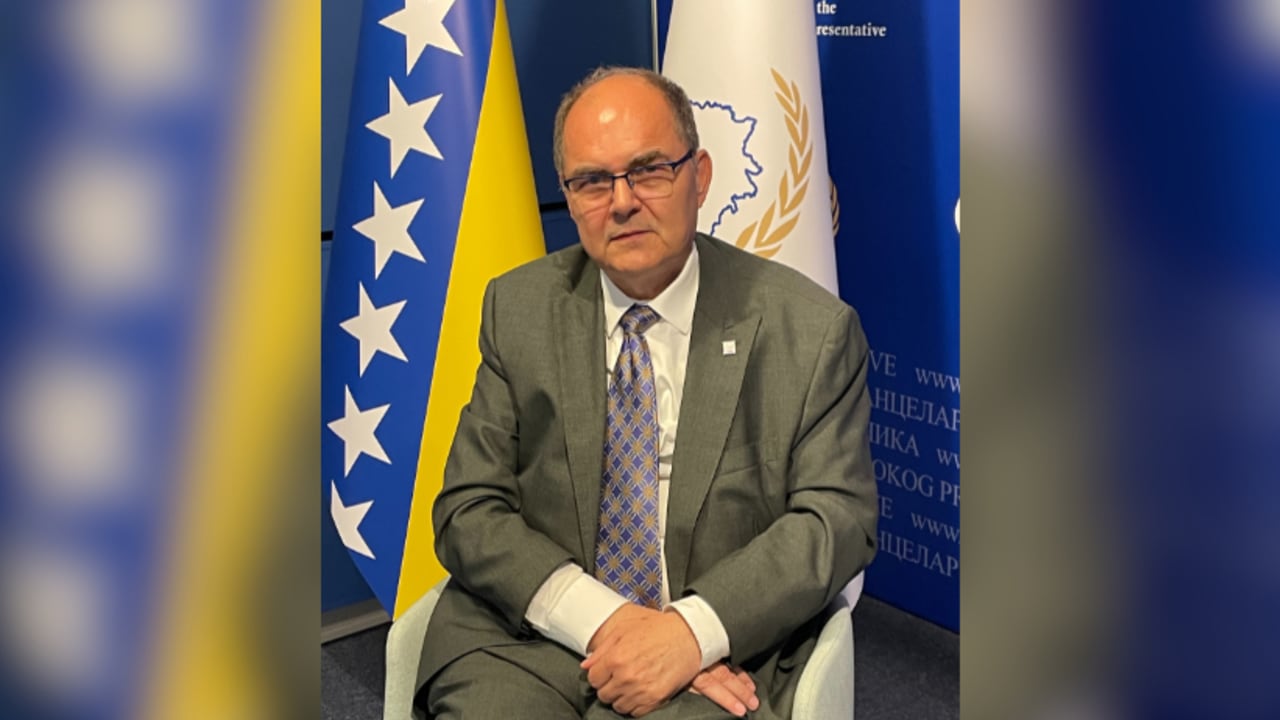
One of those who was behind the invitation was BiH High Representative Christian Schmidt, who has been in this post since August 2021 and agreed to speak with the Post.
Who is Schmidt?
A veteran of German and European politics, he twice served as minister – for agriculture and later for transport and digital infrastructure – and twice as state secretary in the Defense Ministry and Economic Cooperation and Development Ministry under former chancellor Angela Merkel.
As a member of the Bundestag, he headed the German-Israeli Parliamentary Friendship Group between 1994 and 1998.
The CER event in Sarajevo was canceled by the hotel and was publicly disinvited by BiH Government ministers. Were you surprised by the reactions and disappointed by the cancellation of the meeting?
I suggested the CER should consider coming to Sarajevo because of the city’s history for religious coexistence, which I see as favorable for interreligious dialog.
We were expecting some criticism because of the views of the locals. I don’t have all the facts about the security situation. I haven’t heard from the relevant institutions that there was a serious threat to the presence of the rabbis in Sarajevo.
However, I have an understanding that amid such uncertainty, the CER decided to avoid the meeting in Sarajevo.
I regret this. I think that out of respect for the Jewish community in Bosnia and Sarajevo, this issue should not be politicized.
I wouldn’t say that there was a public discussion about inviting the CER. But some reports, especially here, do not always have good intentions. There was an unacceptable statement made by the federal labor minister. But that didn’t make the headlines in newspapers.
I was very confident that the CER meeting would not cause problems, because I could not see any antisemitism in this city and due to the pro-interreligious position of the Reis-al-ulema [Grand Mufti].
I was even proud to say that, compared to what we saw in the last two years in Berlin and in other capitals or university cities in the EU, we didn’t have any major incidents against Jews and Israel here.
So the main problem was political opportunism and not radicalized imported antisemitism among local Muslims?
I am not praising the communist Tito era when I say that everyone here, at least up to the 90s, managed to live together. It wasn’t an idyllic paradise, but according to many testimonies, there was functioning coexistence.
Without politicizing it today, I would say that interreligious coexistence is possible. The population here is a bit more secular. Muslims in Bosnia feel European.
Having said this, we see that the war of 1991-95 led to a kind of segregation, mainly between Muslims and Serbs. Before the war, Sarajevo was a real mixed city.
Now we have 85% Muslims and less than 15% Croats, Serbs, and others. In the past, there was a big advantage of everyone living together. Now there is a risk of this all being lost.
Three decades after the civil war, would you say the international community failed in trying to create the peaceful coexistence you mention?
Yes and no. Yes, because I think that all the ideas that one can easily achieve in terms of nation building never work. No, because this was an attempt to get the locals to look after themselves.
There are many NGOs that are doing good things. However, the public never came to an agreement on their end goal. Take the school curricula for example: there are different curriculums for Croats, Bosniaks, and Serbs.
I think that this is a failure not only of the international community but of the very local segregative practices.
Is BiH a center of Muslim Brotherhood activities?
My impression is that this is not the case. Although Muslims are the majority here, religion does not have a major impact on society.
Maybe some hotels do not serve alcohol, and religion is more visible in the summer, when tourists come here from Saudi Arabia, Qatar, and other countries. But I would not say that it has the tendency to change society.
Iran's role in Bosnia
Is Iran a factor of what is happening in Bosnia?
I would not say that there is no connection, and Iranian officials have visited high-ranking ministers in BiH. But local politicians are working to integrate BiH into the EU. They want to achieve it.
They are masters in creating obstacles for themselves, but being close to Iran is not one of them. They know that they should not do it.
Some say that the EU might be the solution to the complicated problems of BiH. Others say that integrating BiH into the EU would create a problem for the union. What is your position?
I would say that in terms of economy, the integration of BiH would not affect the EU. The GDP of BiH is less than a quarter of the GDP of Munich.
The currency of BiH is still the convertible mark, whose value is exactly the exchange rate of the Deutsche mark to the Euro.
Politically, the key challenge is corruption and the rule of law. These are indeed issues we must look at. But if there is a need to integrate Ukraine into the EU, integrating BiH should be easier.
We must work for the EU integration of all the six Western Balkan countries that are candidates, including Serbia.
It might be complicated, but we must readjust our EU enlargement strategy to regional economic interests, as well as the competing interests of Russia and China.
It is indispensable to keep this part of Europe for Europe. The peoples of BiH want peace and not conflict.