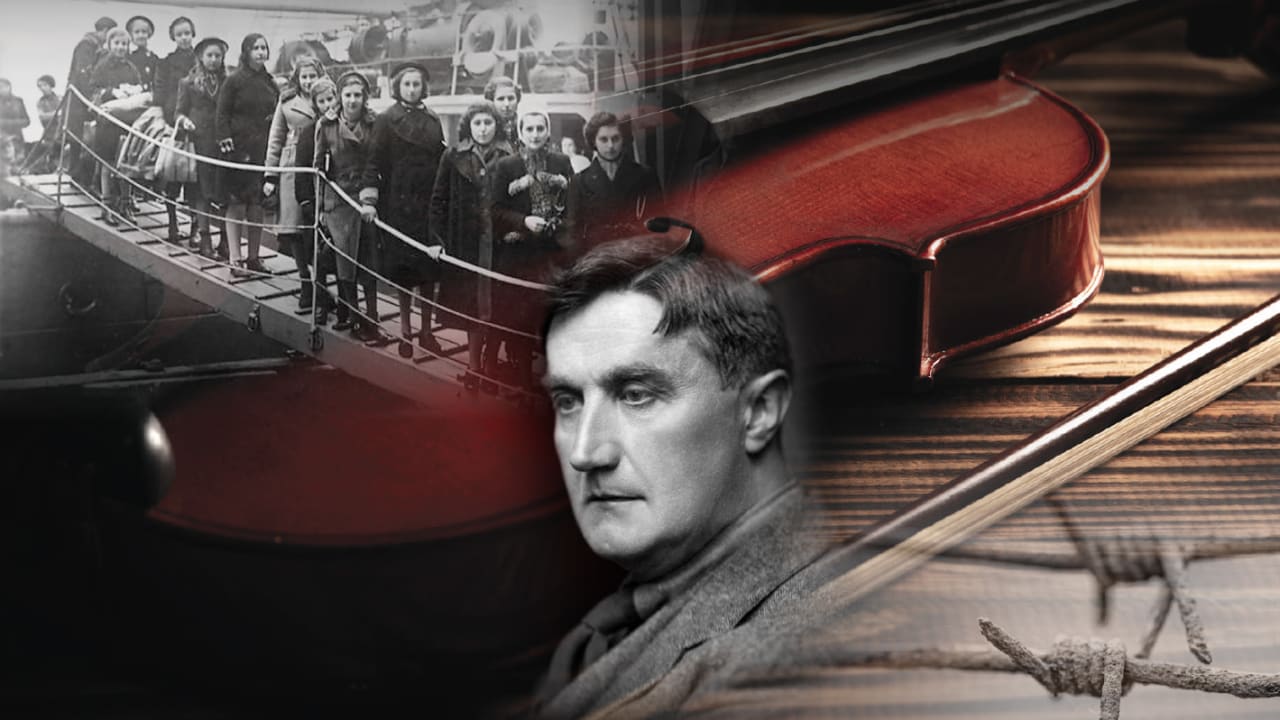
‘We wish to record our solemn protest, before the conscience of civilization, against the persecution of the Jews in Germany’ – Letter from Vaughan Williams (and 87 others) to The Times, November 22, 1938
Ralph Vaughan Williams (affectionately known as “RVW” or “Uncle Ralph,” but any pronunciation of his first name other than “Rafe” greatly infuriated him) was one of the giants of the 20th-century British classical music scene. Today, he is mostly remembered for the stratospheric violin stylings of The Lark Ascending, which has topped the UK Classic FM charts a record 12 times. What’s not well known about him is that he was instrumental in bringing Jewish musicians out of Nazi Germany and also for finding homes for Kindertransport children in England. This is the story of a gentle bear of a man and his colleagues who persistently argued the case for those unable to do so for themselves. It’s also the story of some of those who were helped by these actions.
Vaughan Williams was born in 1872 in Gloucestershire, England, to a well-to-do family. His mother, Margaret, came from a confluence of famous people: She was the great-granddaughter of Josiah Wedgwood, who made world-famous pottery, and niece of Charles Darwin, famed for his theories of evolution contained in his book On the Origin of Species.
Vaughan Williams attended Charterhouse public school and in September 1890 enrolled at the Royal College of Music in London. Two years later, he temporarily left the RCM to study music and history at Trinity College, Cambridge, where he obtained his doctorate. While there, he fell in love with Adeline Fisher, daughter of friends of the Vaughan Williams family. They married in 1897.
At the outbreak of WW I in 1914, despite approaching age 42, Vaughan Williams volunteered for military service. He was assigned as a private to the Royal Army Medical Corps, working as an ambulance stretcher bearer in France and then Greece. This involved back-breaking work ferrying wounded soldiers between the lines, often in appalling conditions. In 1917, he was commissioned as a lieutenant in the Royal Artillery and subsequently returned to France. He was greatly affected by the loss of many friends and musical colleagues during the war; however, his concern for humanity and his desire to do what was right overrode any concern for his own comfort and welfare, a thread which ran throughout his life.

Following the war, Vaughan Williams returned to civilian life. He taught composition at the Royal College of Music, and in 1921 he took over as conductor of the Bach Choir, from which he derived much pleasure. During the 1920s, Adeline became increasingly immobilized by arthritis, so the couple moved from their London house to the more manageable White Gates in Dorking, Surrey. In 1938, Vaughan Williams was approached by Ursula Wood, a poet and wife of an army officer, with a proposed ballet scenario. Although there was a four-decade age gap between them, they immediately fell in love.
Gerhard Pinthus was a noted Jewish musicologist and Communist sympathizer who had endured years of persecution under the Nazis. In 1933, he was sentenced to two years imprisonment, then handed over to the Gestapo and sent to the Lichtenburg concentration camp. In 1937, Vaughan Williams sent the following sponsorship letter to Pinthus’s mother, Stephanie: “I herewith declare that I am prepared to make myself responsible for the whole financial support necessary to enable your son, Doktor Gerhard Pinthus, to take a two-year course at a music teacher’s training college in London. This responsibility will cover the costs of the actual training, as well as living expenses for two years.” RVW’s letter elicited a response from the Gestapo, who were “willing to release [Pinthus] from the concentration camp at Dachau” on the condition that he leave Germany permanently.
Playing his part at the outbreak of World War II
Pushing age 67 at the outbreak of WW II in 1939 and no longer the slim commissioned officer of the Great War, Vaughan Williams was desperate to play his part. He grew vegetables, reared chickens, took part in fire-watching duties, and collected salvage – aluminum for aircraft, together with all sorts of detritus for potential war material. But it was his success with the Pinthus case that really fired his humanitarian war effort, the conduit through which he could channel his huge energy. In 1938, he set up the Dorking and District Refugee Committee, specifically tasked to help those fleeing from Nazi persecution. Bloomsbury House was the London hub of this refugee effort. His contact there was Maud Karpeles, the Jewish daughter of a German immigrant father and a London-born mother. She had been honorary secretary of the English Folk Dance Society from 1922 to 1930, and Vaughan Williams was an inveterate collector of English folk songs, so their paths would have crossed earlier. In 1939, RVW wrote her the following apologetic request: “I hate writing begging letters – I know…you have already done more than your share for refugees.” The request was to raise money for a Dr. Fuchs, a Jewish architect who had been released from a concentration camp and was short of funds to complete his arranged immigration to New Zealand. Karpeles, another unsung hero, obliged with a loan.
The Dorking Committee had secured from the Duke of Newcastle rent-free premises at Burchett House, just outside town. Over the years, it housed some 130 refugees. Vaughan Williams supervised all aspects of its running, from the heating and water systems (this by a man who had difficulty attaching his collar and putting his tie on straight!), to paying for a radio set and ordering manure for the garden. The Dorking Committee was a joint venture with celebrated novelist E M Forster (known for A Passage to India and A Room with a View). Forster was a member of the British Humanist Association, whose credo “belief in the human race” would have chimed with the sentiments of Vaughan Williams.
Another of those to offer themselves in the war effort was Jewish pianist Dame Myra Hess. Vaughan Williams was one of a small committee who promoted her idea of lunchtime concerts throughout the war at the National Gallery in London. These took place for over six years without fail, even during the Blitz and when relocation became necessary. Hess hosted 1,698 such concerts, attended by 824,152 people, and she performed in 150 of them. For her contribution to maintaining the morale of the people of London, she was dubbed a Dame Commander of the Order of the British Empire in 1941.
ERIC REICH was born in Vienna in 1935. His father was a cantor. He arrived in Dorking in August 1939 at the age of four on one of the last Kindertransports to arrive in the UK before the outbreak of war. He never saw his parents again, as they were murdered in Auschwitz. His older brothers were evacuated with London’s Jews’ Free School to Cambridgeshire, but Reich was too young to attend school. Bloomsbury House was undecided as to his destination when Vaughan Williams, as chairman of the Dorking Refugee Committee, took control of matters. He placed Reich in a refugee home, where he was fostered by a Protestant family, themselves refugees from Sudetenland, Czechoslovakia. Reich attended church and Sunday school, at that early stage unaware that he was Jewish. The Dorking Committee contributed to the boy’s clothing, watched his school progress, and presented him with a fountain pen on the occasion of his bar mitzvah. In fact, Reich recalls having tea with Vaughan Williams on several occasions at the composer’s home in Dorking, although, with no interest in music, he was “bored stiff.” After an unhappy six months in an Orthodox school in London, in 1949 he embarked on Youth Aliyah to Israel following the establishment of the Jewish state. At 18, Reich joined the IDF, taking part in the 1956 Sinai campaign and reporting directly to Ariel Sharon. He returned to London in 1967, becoming a director at Thompson Holidays, and then Thomas Cook. He subsequently set up his own company, Classic Tours, specializing in global activity-based travel. In 1992, he proposed a fund-raising bicycle ride along the newly opened Israel National Trail from Dan in the North to Beersheba in the Negev. Given his Christian and Jewish background, the proceeds were to go to the Edinburgh Medical Missionary Society and to Ravenswood for the Jewish handicapped. In the cycling event, 230 riders took part, and £600,000 was raised. Thereafter, in almost two decades of operations, Classic Tours inspired more than 50,000 people to raise £90 million for more than 300 charities. Reich also became chairman of the Association of Jewish Refugees Kindertransport Group, mirroring RVW’s various positions some 70 years earlier. There is a sculpture in London’s Liverpool Street Station, erected in 2006, called Kindertransport – The Arrival. The smallest boy in the sculpture was modeled on Reich. In 2010, he was knighted for his charitable work. From small acorns, as they say, and all because of the personal intervention of RVW.
As a composer Vaughan Williams was desperate to assist fellow composers escape the terror of the Nazi regime. Robert Muller-Hartmann, who was Jewish, had written songs, chamber music, and orchestral pieces, and taught music theory at the University of Hamburg from 1923 to 1933. He managed to escape from Germany in 1938; but upon his arrival in England, he was interned as an enemy alien. On a national level and close to his heart as a composer, Vaughan Williams had been appointed chairman of the Home Office Committee for the Release of Interned Alien Musicians. In this respect, he urged British musicians to unite in persuading the authorities that “artistic and intelligent people who will spread the gospel of anti-Nazism are an asset to the country.” In this capacity, he could use his knowledge and compassion to help those, such as Muller-Hartmann, who were suffering as a result of the government’s strict internment policy. Vaughan Williams fought hard for the German’s release, writing to him: “May you again soon be free to work…for the cause we all have at heart.” He was finally released in 1941 and went to live with a refugee couple from Germany, Yanya and Genia Hornstein, who were friends of Vaughan Williams, Genia being a member of the Dorking Refugee Committee. Muller-Hartmann became a close friend and confidant of RVW, who highly valued his friend’s musical opinions. Two exchanges between them reflect the depth of their feelings for each other: On his friend’s naturalization in 1948 Vaughan Williams wrote: “I feel it a great honour to be able to claim you as a fellow citizen.” In heartfelt terms, Muller-Hartmann commented: “May I tell you…how fortunate…I am for all the kindness you have shown to me…since I came to England.”
As the war continued, and even following its conclusion and the release of the interned refugees, the Dorking Committee continued to operate, re-focusing its aims toward naturalization of the refugees, assisting the Kindertransport children who had arrived from the concentration camps, and financing emigration as some of the refugees began to return to Europe, where a number became interpreters with the US Army of Occupation. In 1949 the committee was disbanded, following 11 years of altruistic labor. Vaughan Williams was still chairman at the age of 77, having remarkably, given the commitments of his “other life” (composing, conducting, teaching, organizing music festivals), attended almost every meeting.
In 1951, having suffered progressive disability for many years, RVW’s wife, Adeline, died. Despite his association with Ursula Wood, he had deeply loved and devotedly cared for Adeline throughout their marriage of over 50 years. Friends rallied round to comfort him, particularly Wood (who, incidentally, as a young woman, had worked at Bloomsbury House assisting the refugees), to whom Vaughan Williams had provided similar sympathy when her husband died suddenly of heart failure in 1942. Vaughan Williams and Wood married in 1953, at which point he left the Dorking house and took a lease in London at 10 Hanover Terrace, overlooking the beautiful gardens and lake of Regents Park.
In truth, it’s difficult to separate RVW the composer from RVW the humanitarian (a word much bandied around these days, but the essence of which coursed through RVW’s lifeblood). Moreover, the spirit of his music was often responsive to his harrowing personal war experiences and the terror of the Nazi threat. The ubiquitous Lark Ascending, completed in 1914, appears on the face of it to be a contemplative romance, floating with rapturous birdsong. However, given its composition on the eve of WW I and its first performance after its conclusion in 1918, it can be interpreted as a nostalgic paean to the lost peace of the world as it was before the horrendous carnage. In his Third Symphony, which premiered in 1922, the ghostly trumpet solo was inspired when, on duty in the Great War, Vaughan Williams heard a lone evening bugler. At the end of the symphony, the composer stunningly introduces an ethereal wordless soprano, fading into silence. Known as the Pastoral Symphony, this wasn’t the English countryside being portrayed but the killing fields of France, the fragrance of summer captured with a passing girl’s song amid total destruction.
WW II presented a fresh opportunity. In 1940, he was commissioned by filmmakers Michael Powell and Emeric Pressburger to write the incidental music for their film 49th Parallel. Pressburger was a Jewish refugee from Eastern Europe, and both producers had for years been critical of the Nazi regime. The narrative presented extreme Nazi evil and how the force of good ultimately wins the day, a scenario that would have appealed powerfully to RVW’s humanistic principles. Following this, his Fifth Symphony was premiered in 1943 at a Promenade concert, conducted by the composer himself. Despite the horror of the continuing war, Vaughan Williams wrote his symphony containing, in the words of writer Neville Cardus, “the most benedictory and consoling music of our time.” This spiritual radiance, in the face of such adversity, represents bravery of the highest order. Backtracking to the late 1930s and encapsulating RVW’s true essence, his cantata Dona Nobis Pacem (“Grant us peace”) represents his most heartfelt plea, this while Winston Churchill was declaring that “the whole state of the world is moving steadily to a crisis that cannot long be delayed.” At its conclusion, a noble soprano voice compellingly intones the mantra “War and all its deeds of carnage must in time be utterly lost.”
On August 25, 1958, the brother-in-law of his old friend Robert Muller-Hartmann had asked if he could bring round an Israeli composer, Alexander Haim (whose career was halted by the Nazis in 1936 and who immigrated to Palestine the same year). Vaughan Williams devoted the afternoon to Haim, discussing his music and only stopping for tea. That evening, he didn’t want any dinner but, according to Wood in her biography RVW, “by bedtime he was hungry and sat on his bed eating bananas and biscuits…we did not guess that before dawn death, not sleep, would claim him.” In her later autobiography, Paradise Remembered, Wood describes how, after RVW passed, she opened the windows of their home overlooking Regent’s Park and let his spirit fly out into the morning air, to the dulcet strains of his Pastoral Symphony.
The above refugee stories have rarely been told and need to be known. They represent just a small selection of those who helped and those who were helped, those who saved and those who were saved. There were many more in both categories, too numerous to mention. Like Oskar Schindler and his 1,200, the descendants of those whom Vaughan Williams and others supported now number in the thousands. Indeed, this is recognized on the Royal College of Music’s website, which comments that the wave of skilled musicians who emigrated in the 1930s and 1940s following the murder of their families by the Nazis has had a lasting impact on musical culture in Britain and the United States, so that “today’s international professional classical music scene owes much to their contribution.”
So, next time you hear the rapt, silken poetry of The Lark Ascending, give a thought not only to Vaughan Williams the composer but also to RVW the humanist, the man who made himself persona non grata in Germany as a result of his opposition to the Nazi regime and who fought hard to help those of all denominations, including many Jews, to escape the depths of despair. His ability to show us how to face the world’s challenges while retaining a sense of humanity makes him and his music as relevant today as it was all those decades ago. In our present troubled times, with wars and refugees never out of the news, we need people like Uncle Ralph more than ever.■
With grateful thanks and acknowledgments to: The Ralph Vaughan Williams Society (article by Neil Wenborn titled “A Desirable End” and book titled Paradise Remembered by Ursula Vaughan Williams: rvwsociety.com); Stainer & Bell Ltd (article by Angus Smith titled “Eminent Distinction,” stainer.co.uk); Oxford University Press (publishers of book titled RVW by Ursula Vaughan Williams: corp.oup.com); The Vaughan Williams Foundation (rights to book titled RVW by Ursula Vaughan Williams and Vaughan Williams letter database: vaughanwilliamsfoundation.org); The Dorking Museum (general information on Dorking refugees: dorkingmuseum.org.uk).