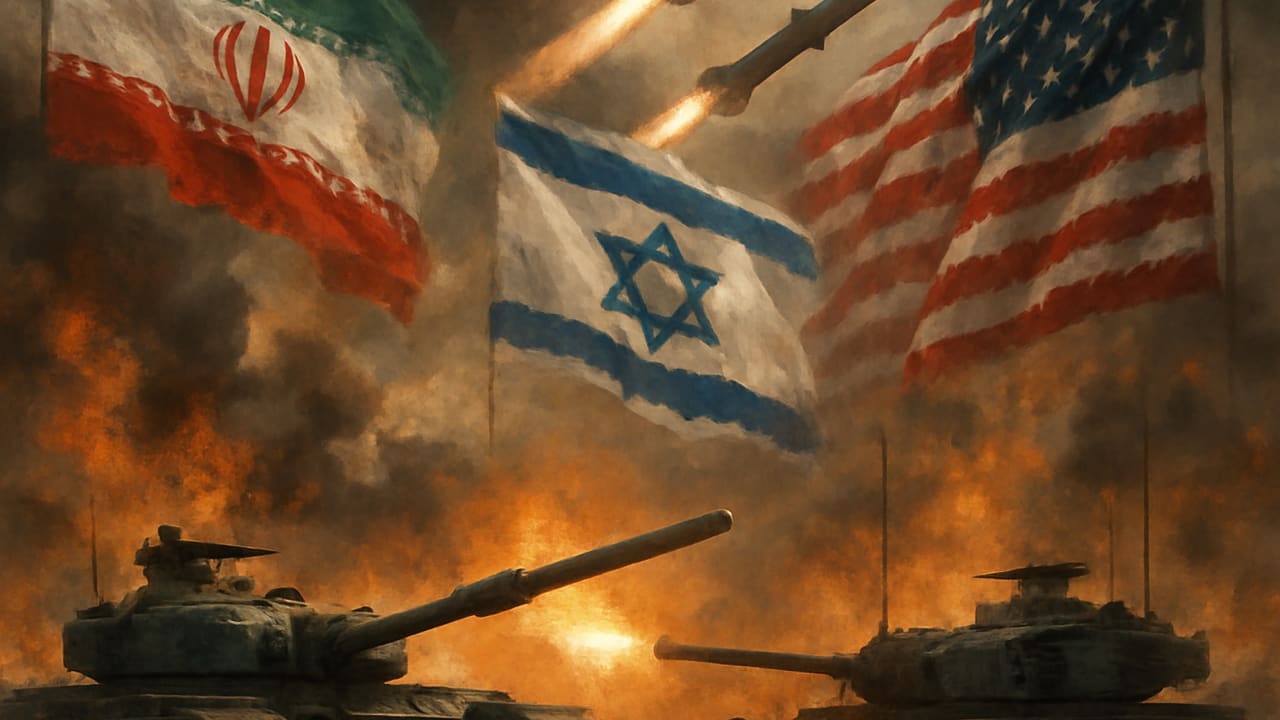
The Pentagon reportedly asked outside analysts this month for creative ideas on Iran. That request itself is worth paying attention to. Over 180 days into a war that produced the most intensive American air campaign since Iraq in 2003, the CIA has now confirmed what the strike data was already reflecting.
First, Iran's military capacity did not collapse. Second, air power resolved neither the institutional problem nor the negotiating problem. Third, the Pentagon still lacks the tools needed to end the war with the Islamic Republic.
Three moves remain available and must be calculated within the Pentagon and the American administration.
Congressional recognition of Iranian minority independence
Iran is not a nation-state in the conventional sense of the word. At its core, it is a Persian majority governing four other large national minorities with distinct languages and cultural identities. Some of these communities have longstanding autonomy or independent movements, which the Iranian government has worked to suppress by monitoring them or, in some cases, confronting them militarily.

The four minority groups in Iran consist of the Kurds in the western Kurdistan province of Iran and surrounding regions; Ahwazi Arabs in Khuzestan, sitting on top of Iran's oil; the Baluchis in the southeast; and the Azeris in the northwest. Together, these populations account for approximately 50% of Iran's over 90 million citizens.
Hypothetically, a unanimous resolution passed by the US Congress recognizing the sovereign independence of the Iranian Kurdistan, Ahwaz, and Baluchistan people would do something no airstrike can do. It would change the internal calculation of every ministry official, every IRGC provincial commander, every Basij unit, and every Iranian citizen calculating whether the regime survives the year. It would do this at zero kinetic cost and maximum pressure - something no economic warfare can achieve.
Such a move is not without precedent.
The Kurds living in Iran declared independence in the 1940s. They had an independent state that existed for one year before the Soviets withdrew their support and the Kurdish Republic collapsed in Mahabad. In 2017, the Kurdistan Region in Iraq launched an independence referendum. Meanwhile, the Ahwazi liberation movement has been active for decades, and the sustained Baluchi insurgency in Sistan and Baluchistan all provide organizational infrastructure that congressional recognition would legitimize and further empower.
Sure, Turkey will object, and Iraq likely will as well. But that is the point.
Recognizing these states would force a choice on Tehran that airstrikes have not. It would change course on its nuclear program, its network of regional proxies and other forward defenses, and its posture in the Strait of Hormuz. Otherwise, Iran would risk seeing the country break into smaller states that look increasingly toward the Gulf and the West rather than toward Tehran.
Partition would signal that the war has moved past regime change as a coherent objective. Regime change assumes the same territorial container with different management. This unbundles the container.
America must follow through and not abandon these minorities again.
Economic enlistment for indebted military-age Americans
The narrative war on the domestic American front has already failed. The Pentagon has not been able to sell this war to the American public because the war has been rhetorically fused with Israel's operations in Gaza, and the American public rejects the fusion.
Recruitment numbers are running below what a ground invasion of Iran would require. Estimates for a successful ground campaign against Iran's 31 provincial commands and its Mosaic Defense Doctrine run between 750 thousand and 1.5 million American troops. The current active US Army stands at roughly 452 thousand. The math does not work, obviously.
Based on American history, however, there is a path forward. Not conscription or a draft in a world war-era sense, but enlistment through a “debt forgiveness program.”
The average American aged 18 to 34 carries more than $40 thousand in non-mortgage debt across student loans, credit card balances, auto loans, and personal loans, with some estimates go as high as $100 thousand.
This is the cohort the Pentagon needs. A federally administered debt-forgiveness enlistment program that fully discharges student loan, credit card, and loan balances after 24 or 36 months of service, and extends the GI Bill, would produce voluntary enlistment at scale.
This is not theoretical.
It is the American state doing what the American state has always done when it needed staff it could not otherwise generate. World War II offered the GI Bill. Vietnam offered college deferments. The post 9/11 wars offered signing bonuses and citizenship pathways. The Iran war will need to offer debt relief. The economics of the indebted American 20-and 30-something make this the most efficient conversion mechanism available to the Pentagon and the Trump administration.
The moral reading on this is uncomfortable. But states generate the soldiers they need through the incentives that work on the population they have.
A Washington-to-Beijing agreement on Iranian oil
China’s President Xi Jinping's visit to the United States this year creates a window that has not existed at any prior point in this conflict. The bilateral agenda will include trade, semiconductors, Taiwan, and the South China Sea. It should and most likely will include the Iran file.
The frame is transactional. China's current exposure to Iranian oil, the Belt and Road Initiative, and Gwadar Port infrastructure is protected under only one scenario:. A Washington-to-Beijing understanding that guarantees Chinese access to Iranian oil under a post-conflict governance arrangement, in exchange for China withdrawing diplomatic and material support to Tehran. Beijing gets its supply insulated. Washington gets Tehran's most consequential strategic partner off the board.

The counter-trade is Taiwan. Beijing has wanted a public American recalibration on Taiwan for two decades. Whether Washington and Trump are willing to offer that, and at what depth, is the negotiation. But the negotiation is available for the first time in a way it has not been before, because Iran has finally created a scenario in which both capitals have overlapping interests strong enough to overcome their structural competition.
This signals that the Iran war is now large enough to reorder the primary rivalry of the 21st century. China calculated correctly during the kinetic phase. It provided sanctions-blocking cover and diplomatic protection because the cost of doing so was low. The cost is now rising. Beijing will listen to a deal it would have refused six months ago.
Where this lands
None of these three moves solve the Iran problem alone. Together, they might resolve it. Partition breaks the state morally, politically, psychologically, and undermines Iran’s authority on its own soil. Debt-driven enlistment provides the force to enforce the partition if Iran does not capitulate during that phase. A Beijing deal removes the external protection that has kept the Iranian government standing.
While the kinetic phase of this war is over, the strategic phase is just starting.
The tools that win the strategic phase have almost nothing to do with what the F-35s and B-2s have been doing for the last six months. They have to do with legislative action, domestic economic policy, and great power negotiation.
The Pentagon asked for creative ideas. Here are three. The real question is whether Washington has the political stomach to execute any of them. My read is that the administration will attempt all three in some sequence, and that the sequence will start with the China deal because it is the lowest-cost and highest-leverage of the three.
The Iran war does not end at the point that a ceasefire is signed. It ends when Iranian institutional coherence is broken. Six months of airstrikes did not do that. Three quiet moves in Washington might.
AJ Jaff is a senior strategic security strategist and analyst with 20 years of experience across corporate security, military, and geopolitical intelligence. He covers defense, intelligence, and conflict analysis. He is the author of Signal, Not Noise!
Follow him @aj_geo_analysis on X.