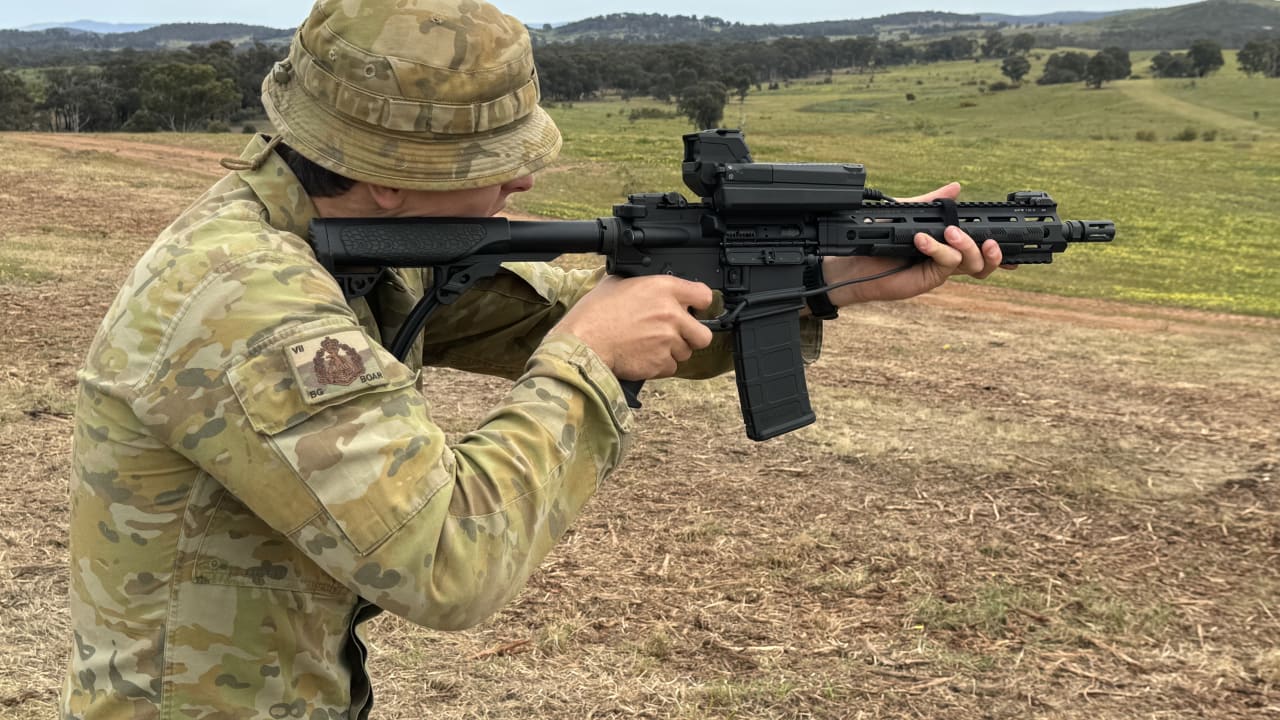
SMARTSHOOTER, the Israeli developer of advanced fire control systems, has announced that it has secured a contract with the Australian Defence Force to supply its cutting-edge SMASH 3000 Fire Control System as part of the technology evaluation for project LAND 156 LOE 2.
The evaluation will assess the system’s suitability for integration into the ADF’s Dismounted Interim Counter-Unmanned Aerial Systems (C-UAS) Ensemble.
The contract represents SMARTSHOOTER's first strategic breakthrough into the Australian defense sector, following extensive appraisal of its SMASH technology by the ADF.
“The recently fulfilled order marks a strategic breakthrough into the Australian market after significant appraisal of SMASH Fire Control by the ADF, with potential for follow-on purchases in other programs,” the director of SMARTSHOOTER’s Australia and New Zealand Territory, Lachlan Mercer, said.
“This further extends SMARTSHOOTER’s established presence in the Asia-Pacific region,” he said.

Combining (AI), computer vision, and advanced tracking algorithms
The SMASH 3000 is the company’s lightest handheld-operated fire control system, designed to give tactical forces a decisive edge against aerial and ground threats.
By combining artificial intelligence (AI), computer vision, and advanced tracking algorithms, the system enables soldiers to detect, track, and neutralize drones and small unmanned aerial systems (UAS) with unmatched precision.
Beyond its hard-kill capabilities, the SMASH 3000 enhances battlefield coordination through advanced situational awareness features. Soldiers can share real-time target data across units via SMARTSHOOTER’s proprietary platform, significantly improving operational efficiency and coordination in combat scenarios.
SMARTSHOOTER’s SMASH family of systems is already operational with forces in the United States, Israel, Europe, the United Kingdom, and other NATO nations.
The portfolio includes handheld-operated remote- controlled unmanned ground-vehicle-mounted solutions, designed to maximize hit probability against aerial and land targets.
At the core of the technology is an onboard computer that locks onto targets, tracks their movements, and synchronizes shot release for precise engagement.
This integration of AI-driven ballistic algorithms transforms standard weapons into smart-shooting platforms, ensuring accuracy, minimizing collateral damage, and enhancing situational awareness.
Michal Mor, SMARTSHOOTER CEO, said, “We are honored to support the Australian Defence Force and to work alongside yet another highly respected partner.”
He said that the partnership marked “an important milestone in our long-term commitment to the Australian market, and we look forward to expanding our activities across multiple segments.”
“SMASH fire control systems deliver precision capabilities at the moments they are needed most – whether the threat is airborne or ground-based, and we remain committed to providing superior operational advantage to our Australian partners,” Mor explained.
Heightened scrutiny
SMARTSHOOTER’s breakthrough in Australia demonstrates the growing global demand for advanced counter-drone technologies.
The deal also reflects the complex geopolitical realities of defense procurement in an era where military innovation intersects with humanitarian scrutiny. The Israel-Hamas War both fueled demand for Israeli weapons proven on the battlefield and triggered diplomatic fallout.
In September, Australia, alongside the UK and Canada, formally recognized an independent state of Palestine. SMARTSHOOTER’s entry into the Australian defense market, therefore, comes at a time of heightened scrutiny by Australia over Israeli defense technology.
Public sentiment against Israel has grown increasingly critical, with activists and civil society groups demanding an end to defense exports linked to the Jewish state.
Nevertheless, while the Australian government maintains that it does not directly supply arms to Israel, dozens of military export permits approved before the war remain active.