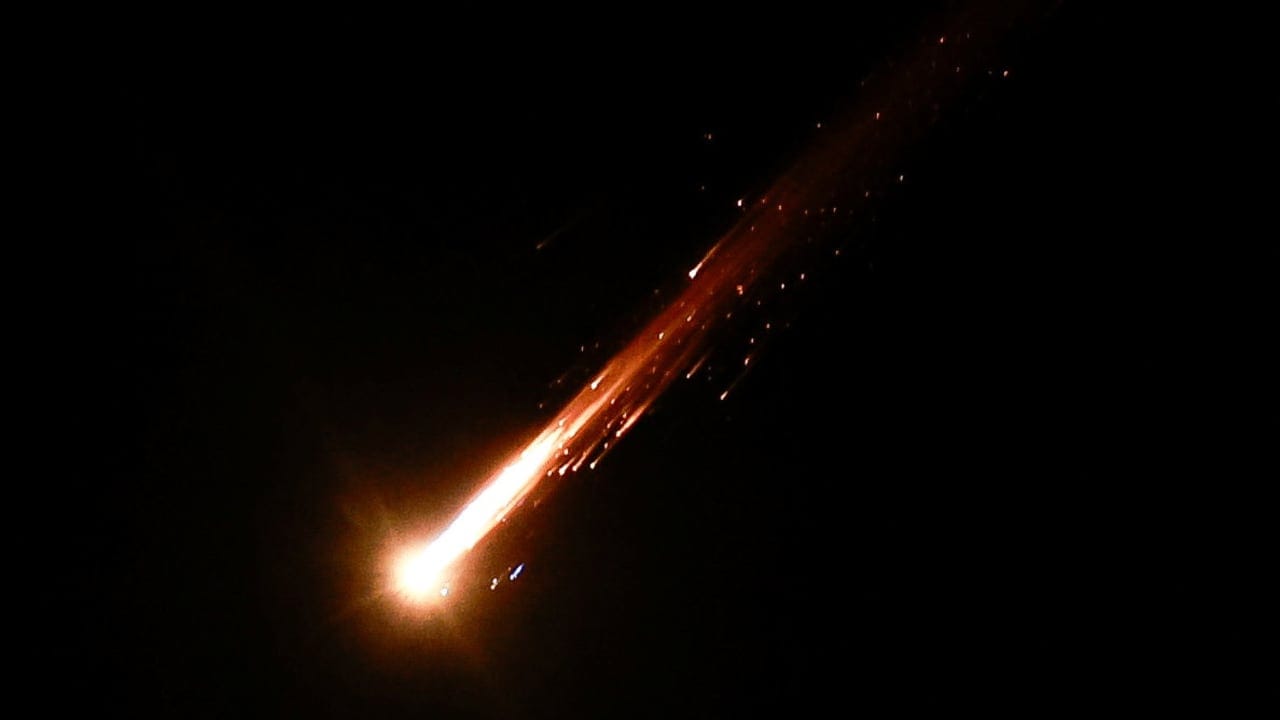
With robotics, artificial intelligence, and missiles intercepted in space, the war of the future is already here, Israel Aerospace Industries (IAI) CEO Boaz Levy said on the sidelines of the UVID conference in Tel Aviv.
Referring to the 12-day war between Iran and Israel in June, known in Israel as Operation Rising Lion, Levy highlighted the role of the company’s Heron and Heron TP unmanned aerial vehicles (UAVs), which closed operational loops in an unprecedented fashion.
“This was a digital war, and the combination of UAVs with satellites and mission aircraft, alongside the ability to receive coordinates, proved that the war of the future is already here,” Levy said on Wednesday. “These autonomous capabilities are based on advanced, groundbreaking AI technology that enables not only operational superiority but also better protection of human life.”
Speaking to reporters, Levy said that IAI has invested heavily in unmanned platforms, from drones to robotic defense systems, and that these technologies are no longer experimental but operationally decisive.
Stressing the centrality of autonomous systems in modern warfare, Levy said that the robotic battlefield was “clearly demonstrated” during the war with Iran.

Iranian audacity
During the June war with Iran, 70% of all flight hours by the Israel Air Force were carried out by UAVs as opposed to piloted fighter aircraft like F-35s. The UAVs struck critical targets, including ballistic missile launchers and air defense systems, before they could be fired against Israel.
Over 500 ballistic missiles were fired by the Islamic State, as well as over 1,000 drones. Moshe Patel, director and general manager of the Israeli Missile Defense Organization (IMDO) reported a high success rate in ballistic missile interception and an even higher percentage against the drones.
“Our systems, including Iron Dome, David’s Sling, and Arrow, have been continuously adapted to counter emerging threats-from maneuvering and precision missiles to unmanned aerial systems. During recent conflicts, these systems achieved remarkable operational success,” Patel said during the conference.
Nevertheless, the number of rockets fired during several salvos surprised Levy and the Israeli defense establishment.
“Our surprise regarding the Iranians does not stem from the technology they possess. The main surprise lies in their audacity,” he said. “I did not believe that a state would dare to launch such an enormous quantity of missiles at a civilian population. We now understand very clearly that the threat stems from swarms [of drones]. The response we will formulate will accordingly bring additional capabilities.”
His comments reflect a shift in defense thinking: The country must prepare for mass, coordinated attacks designed to overwhelm defenses, not just for advanced weapons anymore.
Levy praised the performance of the company’s Arrow missile defense systems during the war.
“We provided Israel with systems that successfully intercepted most of the ballistic missiles, with both Arrow 2 and Arrow 3 performing excellently,” Levy said. “Once Arrow 4 replaces Arrow 2, it will deliver additional capabilities, and that is precisely what our engineers are working on day and night.”
The Arrow program, long a cornerstone of Israel’s defense posture, continues to evolve to meet new threats, with engineers racing to stay ahead of adversaries’ capabilities. Israel is also set to deliver the first Arrow battery to Germany as it beefs up its aerial defense systems to face Russian threats.
Navigating global politics
Levy also addressed the political headwinds facing Israel’s defense industry, as some European countries call for boycotts following the Israel-Hamas War in the wake of the October 7 attacks.
“Our relations with countries around the world are excellent. Of course, there are countries that have never been interested in cooperation, and there are others with which we did not have fruitful business anyway,” he said.
“France and Spain have taken the most extreme approach. We are not troubled by this and view their conduct as a disgrace for them.”
Despite these challenges, he pointed to IAI’s robust order backlog of nearly $27 billion as evidence of success.
“We aren’t ashamed to say that our technology is phenomenal. Israel’s capabilities have not diminished for a moment,” Levy said.