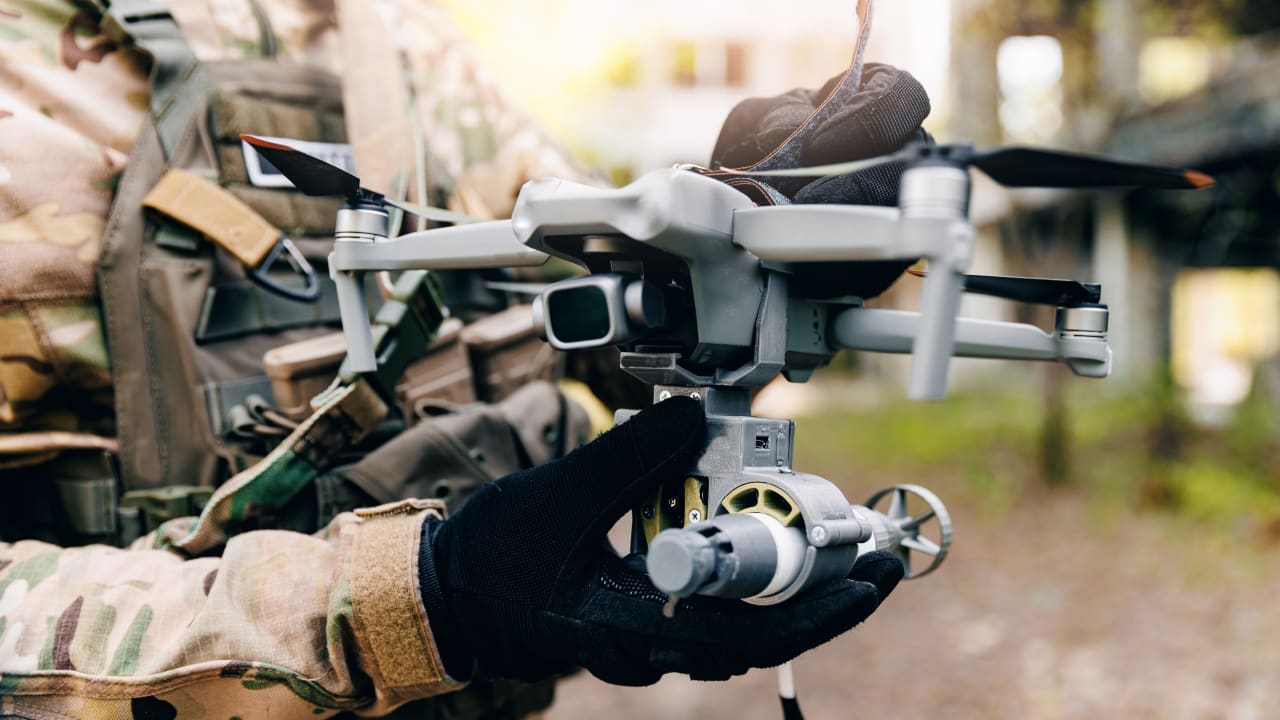
A century after bodies piled up in the trenches of World War I, 70-80% percent of casualties in the Ukraine-Russia war are now caused by drones.
While Ukraine produces 5.5 million drones annually and the United States invests tens of billions in domestic production, Israel, despite being a tech powerhouse, remains dangerously unprepared for this revolution. That could prove fatal.
Advancing at dramatic speed
The past five years have fundamentally transformed the modern battlefield, and the drone, once an auxiliary tool, has evolved into the primary weapon in wars, terrorist operations, and border smuggling. Production rates are growing worldwide, with a direct impact visible in every theater.
In Ukraine and Russia, thousands of drones are launched daily - reconnaissance drones, lethal drones, cellular-communication-based drones, and especially fiber-optic drones flying with cables stretching over 10 to 20 kilometers. Some have demonstrated at ranges of up to 60 km.

Throughout the Middle East, Africa, and Latin America, terror groups and cartels attack each other with drones.
At numerous borders worldwide – from Arizona to Eastern Europe – criminal gangs employ drones of various sizes, including in daily smuggling operations across the Israel-Egypt border involving drugs, weapons, and more.
The attack drone revolution
In Ukraine, what began at the war's outset as improvised production in garages and workshops became, within two years, an industrial-scale national system.
Today, the nation produces approximately 5.5 million drones every year and operates an Amazon-style military supply model. Every unit orders, receives, and operates strike, navigation, and observation tools at an almost industrial pace.
The Ukrainians have become world experts in drone operations, severely damaging Russia's energy infrastructure, dramatically impacting the Russian Air Force – both airborne and on the ground – including near-total destruction of Russian air power in Crimea, and the destruction of 41 Russian strategic bombers in Operation Spider Web in June 2025, at a depth of 4,000 km inside Russia.
The United States analyzed the strategic situation, adopted a model like Ukraine's, and established a logistics system enabling ordering of military drones with accelerated delivery.
Simultaneously, Washington advanced the comprehensive American Security Drone Act signed in 2024, also known as "The Big Beautiful Bill." The act aims to restore American supremacy in the field: developing complete domestic industry, removing regulatory barriers, and creating lists of authorized manufacturers and sellers, along with comprehensive bans on Chinese drones and components in military and federal institutions and investments of tens of billions of dollars to build production infrastructure in competing with the Far East.
On the Russia-Ukraine front, reality is even more extreme. Thousands of drones are launched daily. Defense nets cover dozens of kilometers of roads out of fear of attacking drones. FPV drones with fiber optics reach ranges of dozens of kilometers without any RF signature, making them undetectable by SIGINT means and impossible to jam or block.
The result is devastating: 70-80% of war casualties are attributed to drone strikes. This is the weapon that has changed the rules of the game.
Air defense, the new reality
Ukraine has built new defensive layers: cheap interception systems, laser systems, electronic warfare measures, and missiles adapted to new threats. A prime example is the Ukrainian Stinger version that has already downed over a thousand Shahed-136 drones.
Alongside this, disturbing phenomena have appeared across numerous countries in Europe – such as Germany, Norway, Denmark, Poland, Latvia, and Romania – and military bases as well as civilian airports have repeatedly closed due to penetration by unidentified aircraft. Some blame Russia for launching UAVs from the Black Sea from unmarked vessels, but so far there's no forensic evidence.
War in Europe spills westward
Russian activity doesn't stop at Ukraine's borders.
Shahed UAVs have already penetrated Poland, which was forced to scramble Dutch Air Force F-35s within NATO. The result was dismal: of 19 objects, only four were downed. NATO forces chose the wrong weapon system for downing UAVs, and the results are proving it.
These numbers are far from the 85% interception Ukrainians currently achieve; and they are especially far from the 99% demonstrated by the Israeli Air Force, the highest interception rate in the world, but not yet against 850 drones in one night.
Russia operates unmanned systems over Norway, Sweden, Denmark, and other Northern European nations. European airspaces have been facing unseen tension for many years.
What the world is doing
Ukraine understood early in the war that the old defense model wasn't relevant. The nation is responding at a national scale: mass drone production, training for high school students, developing defensive layers, sensors, electronic warfare, and diverse interception capabilities.
In the United States, massive investments continue, with a clear doctrine: transition to full American production, without dependence on Chinese components. This capability will shape future control of the world's skies.
Israel's gap
Israel is a start-up powerhouse and global leader in technological capabilities: detection, intelligence, navigation, attack, and autonomy. Yet alongside this exist significant gaps:
- Insufficient equipment in units
- Defense capabilities not adapted to the threat
- Limited domestic production
- Regulation not matching the pace of development
- Lack of an integrating body leading national strategy
Israel knows how to develop and is among the world's most sophisticated and technological nations, but it hasn't yet built the capability to implement at national scale.
What must be done now
The time has come to establish a National Drone Authority under the Defense Ministry. One body that will coordinate all development, procurement, operation, and defense systems.
A serious five-year plan is required, with emergency mechanisms:
- Border and strategic site defense: Immediate deployment of detection and interception layers across all borders and critical infrastructure.
- Acquisition of interception layers: Multiple defense systems, from electronic warfare to kinetic solutions, adapted to the full spectrum of threats.
- Mass production capability: Israel must build domestic industrial capacity to produce hundreds of thousands of drones annually, matching Ukraine's scale and America's ambition. This isn't about procurement alone; it's about establishing production lines that can sustain the IDF and all security agencies in extended conflict.
- Make drones expendable: As the Americans defined them, massive acquisition of hundreds of thousands of drones distributed throughout the IDF for various missions. Eyes for every soldier in the field and an effective and available weapon in the hands of every squad commander, border guard, and Border Police officer – essentially all military units. This is part of personal armament, exactly like a hand grenade.
- Public institution defense: Protecting government buildings, hospitals, power stations, and sensitive facilities from drone attacks.
- Removing regulatory barriers: Streamlining approval processes for development, testing, and operational deployment.
- Significant start-up support: Creating accelerated development tracks through MAFAT (Directorate of Defense R&D) leading to building an "Israeli Anduril" - a company whose purpose is to develop fast, produce fast, and provide immediate operational capability without getting stuck in slow processes.
Israel stands at a decisive moment. Threats are developing faster than ever, and the gap with the world is growing. Now is the time to act - before the next war finds us unprepared. We have technology, talent, and start-ups.
What we lack is the national will to mobilize them on a scale. The question isn't whether drone swarms will test our defenses, it's whether we'll be ready when they do. Every day of delay closes our window of opportunity.
The drone revolution isn't coming. It's here. And Israel cannot afford to be a spectator.