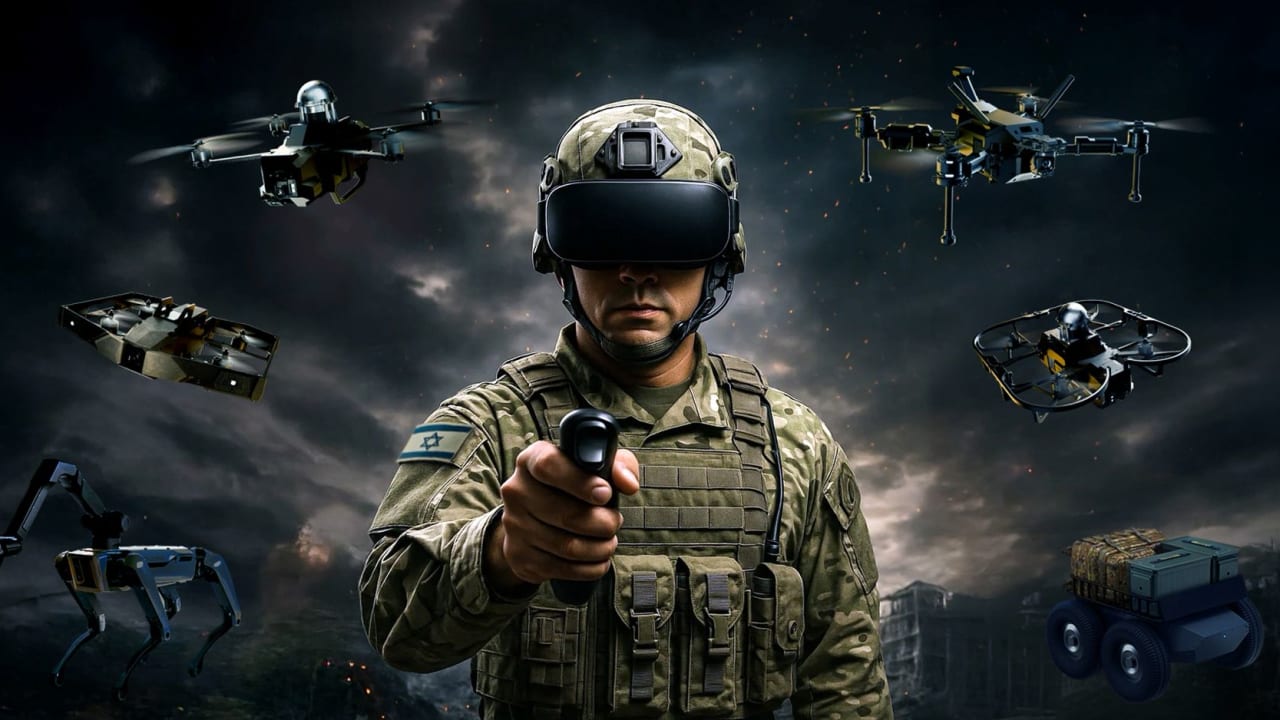
Israeli drone start-up XTEND has secured a multi-million-dollar contract from the US Department of Defense (DoD) to develop and deliver AI-enabled, modular, one-way attack drones designed for close-quarter combat.
The award was announced by the Office of the Assistant Secretary of War (OASW) for Special Operations/Low-Intensity Conflict (SO/LIC), and highlights Israel’s growing leadership in the drone market as the US military boosts its drone procurement.
The Affordable Close Quarter Modular Effects FPV Drone Kits (ACQME-DK) program will provide the US military with small, lethal automated aerial systems (UAS) optimized for irregular warfare in dense urban terrain and confined rural environments. They will feature XTEND’s ESAD high-voltage fuse, the only US-approved high-voltage fuse in the category.
The drones form a Modular VTOL + munitions kit. This reloadable, reusable distraction device allows for rapid reconfiguration in the field, day or night reconnaissance and surveillance operations, lethal inert training payloads, and lethal payloads.
XTEND will deliver training, spares, maintenance, and production from its Tampa headquarters, ensuring a domestic supply chain for the US Department of War.

The contract comes at a time when swarm-based autonomy is reshaping modern warfare doctrine.
Rather than relying on single-platform control, distributed robotic systems are increasingly deployed to perform complex missions at the tactical edge. By enabling operators to remotely command swarms of drones, XTEND’s technology promises precision strikes and enhanced survivability without exposing personnel to direct risk.
The company’s focus on low-cost loitering munitions aligns with directives from Secretary of War Pete Hegseth to expand affordable lethality options for US forces. Last week, Daniel P. Driscoll announced that the army plans to buy at least one million drones over the next two to three years and acquire millions of them annually in the years to come. Currently, the army acquires only about 50,000 drones annually.
“One million drones in the US might sound like a lot, but in Ukraine, they have 4.5 million,” said Aviv Shapira, XTEND’s co-founder and CEO, who described the program as a breakthrough in operational capability.
“We understand that drones are the new method of modern warfare; they are changing how things are done. Instead of traditional weapons, armies are using drones to deliver munitions,” he told The Jerusalem Post. “Drones are the new bullets of the future.”
'Drones are the new bullets of the future'
Shapira said that the company has been working with the DoD “very closely” for the past several years and that their platforms have been operationally proven on several fronts around the world.
According to Shapira, what’s unique about the contract is that it is the first global contract for a multi-dimensional swarm, allowing one operator to operate several drones or robots simultaneously from anywhere in the world.
“This is the first operational system in the world that allows one operator to command and deploy swarms of AI-enabled tactical drones remotely, with resilient Fiber Optic-plus-RF dual-comms precision and zero-latency control,” he said.
“After years of real combat deployments across five war zones, this is not a concept – it is a battle-proven system, lessons learned and applied, that gives war fighters reach and unparalleled tactical overmatch.”
Rubi Liani, co-founder and CTO of XTEND, discussed what he called the company’s AI backbone.
“Our XOS unifies sensors, radars, payloads, and third-party apps into a single mission framework. This program extends that advantage deeper into complex terrain, scaling both precision and survivability through fully coordinated swarm behavior.”